
Albert Einstein reportedly called compound interest “the eighth wonder of the world.” Whether or not he actually said it, the sentiment is spot-on: compound interest is one of the most powerful forces in personal finance. Our free Compound Interest Calculator shows you exactly how your savings or investments grow over time — factoring in your principal, interest rate, compounding frequency, and time horizon.
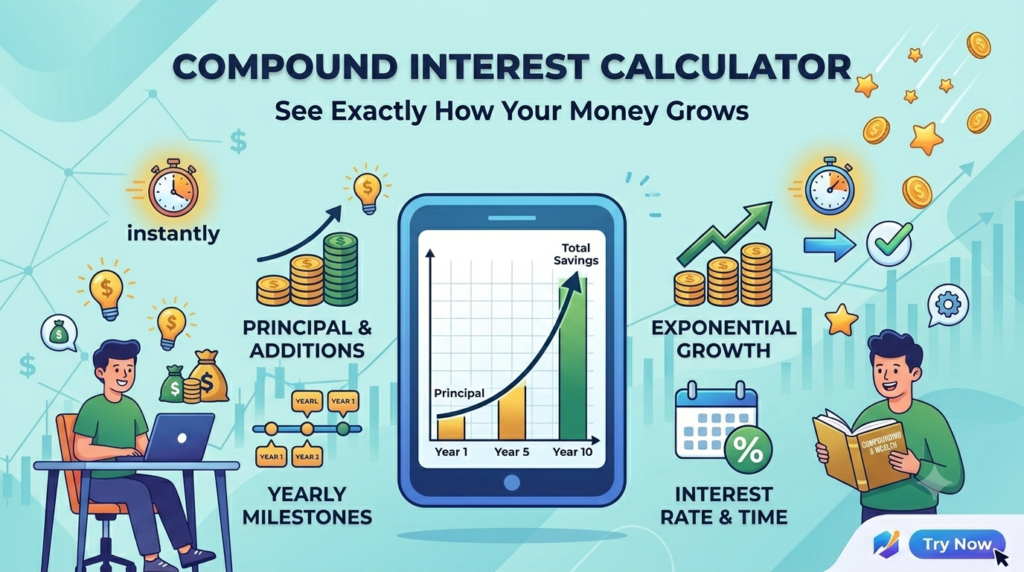
How to Use the Compound Interest Calculator
- Enter your starting amount (principal) — the money you’re investing or saving today.
- Enter the annual interest rate — check your bank’s APY for savings, or use a historical average for investments.
- Select compounding frequency — daily, monthly, quarterly, or annually.
- Enter the time period in years.
- Click Calculate — see your final balance, total interest earned, and a year-by-year growth breakdown.
What Is Compound Interest?
Compound interest is interest earned on both your original principal and the interest that has already accumulated. Unlike simple interest (which only earns on the original amount), compound interest grows on itself — creating an exponential snowball effect over time.
Simple Interest vs. Compound Interest
| Simple Interest | Compound Interest | |
|---|---|---|
| Earns interest on | Principal only | Principal + accumulated interest |
| Growth pattern | Linear | Exponential |
| Example ($1,000 at 10% for 3 years) | $300 total interest | $331 total interest |
| Better for | Borrowers | Investors/savers |
Simple Example:
You deposit $1,000 at 10% annual interest for 2 years.
Simple Interest: Year 1: $1,000 × 10% = $100 interest → Balance: $1,100 Year 2: $1,000 × 10% = $100 interest → Balance: $1,200
Compound Interest (annual): Year 1: $1,000 × 10% = $100 interest → Balance: $1,100 Year 2: $1,100 × 10% = $110 interest → Balance: $1,210
That $10 difference seems small, but over decades, compounding creates a massive gap.
The Compound Interest Formula
Basic Formula (Annual Compounding):
A = P(1 + r)^n
Where:
- A = Final amount
- P = Principal (starting amount)
- r = Annual interest rate (as a decimal)
- n = Number of years
Example: $5,000 invested at 7% annually for 20 years: A = 5,000 × (1 + 0.07)^20 = 5,000 × 3.8697 = $19,348
Formula for Multiple Compounding Periods Per Year:
A = P × (1 + r/n)^(n×t)
Where:
- P = Principal
- r = Annual interest rate
- n = Number of compounding periods per year
- t = Time in years
Example: $5,000 at 7% compounded monthly for 20 years: A = 5,000 × (1 + 0.07/12)^(12×20) = 5,000 × 4.0387 = $20,194
The more frequently interest compounds, the more you earn.
Continuous Compound Interest Formula:
A = P × e^(rt)
Where e ≈ 2.71828 (Euler’s number)
Example: $5,000 at 7% compounded continuously for 20 years: A = 5,000 × e^(0.07×20) = 5,000 × e^1.4 = 5,000 × 4.0552 = $20,276
Continuous compounding represents the theoretical maximum — it’s only marginally more than daily compounding in practice.
How Compounding Frequency Affects Your Returns
More frequent compounding = more interest earned. Here’s how the same $10,000 at 6% grows over 10 years depending on compounding frequency:
| Compounding Frequency | Final Balance | Total Interest Earned |
|---|---|---|
| Annually | $17,908 | $7,908 |
| Quarterly | $18,061 | $8,061 |
| Monthly | $18,194 | $8,194 |
| Daily | $18,220 | $8,220 |
| Continuously | $18,221 | $8,221 |
The difference between annual and daily compounding on $10,000 over 10 years is about $312 — not life-changing. But on $100,000 over 30 years, that gap becomes thousands of dollars.
The Rule of 72 — A Mental Math Shortcut for Compound Growth
The Rule of 72 is a quick formula to estimate how long it takes for an investment to double at a fixed annual interest rate.
Years to Double = 72 ÷ Annual Interest Rate
| Interest Rate | Years to Double (Rule of 72) | Actual Years |
|---|---|---|
| 2% | 36 years | 35.0 |
| 4% | 18 years | 17.7 |
| 6% | 12 years | 11.9 |
| 8% | 9 years | 9.0 |
| 10% | 7.2 years | 7.3 |
| 12% | 6 years | 6.1 |
Example: If your 401(k) earns an average of 8% annually, your money will double roughly every 9 years. Start at 25 with $20,000 and by age 67, it could grow to over $320,000 — without adding another cent.
APR vs. APY — What’s the Difference and Why It Matters
These two terms appear on every US bank account and loan statement, and they’re often confused:
| Term | Stands For | What It Reflects | Used For |
|---|---|---|---|
| APR | Annual Percentage Rate | Interest rate without compounding | Loans, credit cards |
| APY | Annual Percentage Yield | Interest rate with compounding included | Savings accounts, CDs |
Key insight: APY is always equal to or higher than APR for the same nominal rate. A savings account advertising 5% APR compounded monthly actually earns 5.12% APY.
When comparing savings accounts, always look at APY — it’s the true return. When comparing loans, focus on APR — it reflects the true cost.
Real-World Compound Interest Examples
🏦 High-Yield Savings Account
You deposit $15,000 into an online savings account offering 4.5% APY, compounded daily. After 5 years (no additional deposits): Final Balance: ~$18,718 | Interest Earned: ~$3,718
📈 Stock Market / 401(k) Investment
The S&P 500 has historically returned about 10% annually (before inflation). $10,000 invested at 25 with no additional contributions:
- Age 35: ~$25,937
- Age 45: ~$67,275
- Age 55: ~$174,494
- Age 65: ~$452,593
That’s 45x your original investment — with zero additional money added.
💳 Credit Card Debt (Compound Interest Working Against You)
A $5,000 credit card balance at 24% APR (compounded daily) with minimum payments only:
- It could take over 15 years to pay off
- You’d pay over $8,000 in interest alone
This is compound interest in reverse — working against you.
The Power of Starting Early: A Tale of Two Investors
This is perhaps the most eye-opening illustration of compound interest’s power:
Investor A — Early Start:
- Invests $5,000/year from ages 22–32 (10 years only), then stops
- Total invested: $50,000
- Assumed annual return: 8%
- At age 65: ~$787,000
Investor B — Late Start:
- Invests $5,000/year from ages 32–65 (33 years continuously)
- Total invested: $165,000
- Assumed annual return: 8%
- At age 65: ~$747,000
Investor A invested $115,000 less but ended up with $40,000 more — simply because they started 10 years earlier. Time is the most powerful ingredient in compound interest.
How Different US Investment Vehicles Use Compound Interest
| Account Type | Typical Rate | Compounding | Tax Treatment |
|---|---|---|---|
| High-Yield Savings (HYSA) | 3%–5% APY | Daily | Taxable |
| Money Market Account | 3%–5% APY | Daily/Monthly | Taxable |
| Certificate of Deposit (CD) | 4%–5.5% APY | Daily/Monthly | Taxable |
| 401(k) / IRA | Historical ~7–10% | Annually (returns) | Tax-deferred or tax-free |
| Treasury Bonds (I-Bonds) | Variable | Semiannual | Federal taxable |
| Index Fund (S&P 500) | ~10% historical avg | Annual (reinvested) | Capital gains rules |
Compound Interest vs. Simple Interest: When Does Each Apply?
Simple interest is used for:
- Short-term personal loans
- Some car loans
- US Treasury Bills
Compound interest is used for:
- Savings accounts and CDs
- Mortgages (calculated monthly)
- Credit cards (compounded daily)
- Student loans
- Investments and retirement accounts
In the real world, compound interest dominates — which is why understanding it is so critical to your financial health.
How to Maximize Compound Interest on Your Savings
- Start as early as possible — every year you wait costs you exponentially more than you think.
- Choose accounts with higher compounding frequency — daily beats monthly beats annually.
- Compare APY, not APR — APY tells you the actual annual return after compounding.
- Reinvest dividends — in investment accounts, always choose to reinvest dividends rather than take them as cash.
- Avoid withdrawals — every dollar you take out resets that portion of your compounding clock.
- Add regularly — consistent monthly contributions supercharge compound growth through dollar-cost averaging.
Frequently Asked Questions (FAQ)
What is the compound interest formula?
The standard formula for compound interest with multiple compounding periods is: A = P × (1 + r/n)^(n×t), where P is the principal, r is the annual interest rate, n is the number of compounding periods per year, and t is the time in years.
How does daily compounding differ from monthly compounding?
Daily compounding calculates and adds interest every single day, while monthly compounding does so once per month. Daily compounding earns slightly more because each day’s interest becomes part of the base for the next day’s calculation. The difference is small for typical savings balances but becomes meaningful on large amounts over long periods.
What is the Rule of 72?
The Rule of 72 is a quick way to estimate how long it takes money to double at a given interest rate. Simply divide 72 by the annual interest rate. At 8% interest, your money doubles in roughly 9 years (72 ÷ 8 = 9).
What is the difference between APR and APY?
APR (Annual Percentage Rate) is the base interest rate without factoring in compounding. APY (Annual Percentage Yield) reflects the actual annual return after compounding is applied. For savings accounts, APY is the more relevant number since it shows your real return.
How much will $10,000 grow in 20 years at 7% compound interest?
Using the formula A = 10,000 × (1.07)^20, the result is approximately $38,697 — nearly 4x your original investment. With monthly compounding, it grows to about $40,064.
Why is compound interest bad for debt?
When you carry debt — like a credit card balance — compound interest works against you. The interest you don’t pay gets added to your principal, so next month you’re charged interest on a higher balance. Over time, this can cause your debt to grow exponentially.
When does compound interest start to really kick in?
The most dramatic growth typically occurs in the later years of a long investment period, a phenomenon often called the “hockey stick” growth curve. This is why financial advisors emphasize starting early — the biggest gains come in the final years when the compounded base is largest.
Is compound interest the same as APY?
APY is the annualized version of compound interest. It represents what you’d earn over one year, incorporating the effect of compounding. So yes — when a bank advertises 4.5% APY, they’re telling you the compounded annual return you’ll receive on your deposit.
Related Calculators
- Mortgage Calculator — See how compound interest affects your home loan over 30 years
- Percentage Calculator — Quickly work out interest rate percentages
- Investment Return Calculator — Calculate returns on various investment types
- Date Calculator — Find out how many years until your retirement goal
This calculator is provided for educational and planning purposes. Past investment performance does not guarantee future results. Consult a licensed financial advisor for personalized investment advice.