
Need to know how many days until your vacation? Want to figure out what date falls 90 days from today? Trying to calculate business days between two deadlines? Our free Date Calculator handles all of it — instantly, accurately, and without any sign-up.
Whether you’re managing a project deadline, planning a countdown, handling legal timelines, or just satisfying your curiosity, this tool gives you exact answers in seconds.
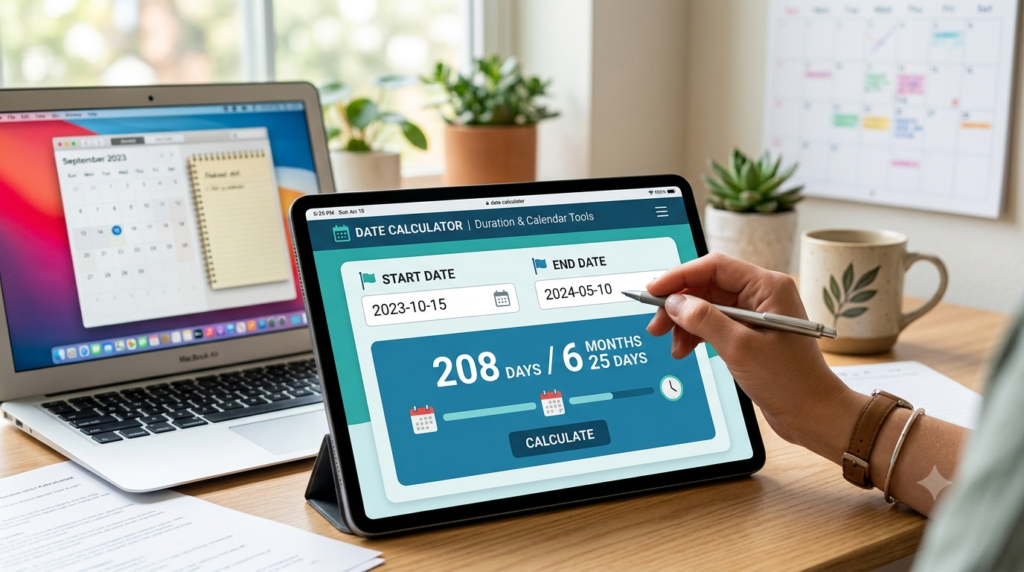
What This Date Calculator Can Do
This tool has two core functions — and both are available for free:
Function 1: Days Between Two Dates
Enter a start date and an end date. The calculator tells you the exact number of:
- Calendar days between those dates
- Business days (Monday–Friday, excluding weekends)
- Weeks and months in that span
- US federal holidays that fall in the range (optional)
Function 2: Add or Subtract Days from a Date
Enter a starting date, then add or subtract any number of days, weeks, months, or years. The calculator tells you the exact resulting date — automatically accounting for month lengths, leap years, and calendar quirks.
Both functions also support business day mode, which skips weekends and US holidays when counting.
How to Use the Date Calculator
To find days between two dates:
- Enter your Start Date
- Enter your End Date
- Choose whether to include or exclude weekends and holidays
- Hit Calculate — your result appears instantly
To add or subtract days from a date:
- Enter your Starting Date
- Choose Add or Subtract
- Enter the number of days, weeks, months, or years
- Hit Calculate — your target date appears
It’s that simple. No account. No cost. No waiting.
Why Date Calculations Are Trickier Than They Look
You might think counting days is straightforward — but the calendar is full of surprises that can throw off a manual count:
Months have different lengths. January has 31 days, April has 30, and February has 28 (or 29 in a leap year). Add 1 month to January 31 and you get February 28 — not March 2.
Leap years add an extra day. Every 4 years, February gets an extra day (February 29). This matters when calculating across years.
Business days skip weekends. A 10 business-day deadline starting on a Wednesday doesn’t end 10 days later — it ends 2 full weeks later because weekends don’t count.
Federal holidays affect business timelines. Many legal, financial, and government timelines exclude US federal holidays from business day counts. Our calculator includes all major US federal holidays and lets you toggle them on or off.
Month-end edge cases. Adding exactly 1 month to March 31 produces April 30 — not May 1 — because April only has 30 days. Our calculator handles all of these edge cases automatically.
Calendar Days vs. Business Days — What’s the Difference?
This is one of the most important distinctions when using a date calculator, especially for legal and financial purposes.
| Feature | Calendar Days | Business Days |
|---|---|---|
| Counts | Every day including weekends | Monday–Friday only |
| Excludes holidays? | No | Optional (yes, if selected) |
| Used for | Event countdowns, personal planning, travel | Contracts, legal deadlines, payroll, HR |
| 30-day example | Always 30 days | ~21–22 days (depending on holidays) |
| Common in | Informal settings | Legal, financial, government contexts |
Real-world example: You sign a contract on Monday, June 2 with a “30 business day” deadline.
- 30 calendar days later = July 2
- 30 business days later (excluding weekends + holidays) = approximately July 14
That’s a 12-day difference — which matters enormously in legal and business contexts.
US Federal Holidays (2026 & 2027)
When using business day mode, our calculator automatically accounts for all US federal holidays. Here are the official dates:
2026 US Federal Holidays
| Holiday | Date |
|---|---|
| New Year’s Day | January 1, 2026 |
| Martin Luther King Jr. Day | January 19, 2026 |
| Presidents’ Day | February 16, 2026 |
| Memorial Day | May 25, 2026 |
| Juneteenth National Independence Day | June 19, 2026 |
| Independence Day | July 4, 2026 |
| Labor Day | September 7, 2026 |
| Columbus Day | October 12, 2026 |
| Veterans Day | November 11, 2026 |
| Thanksgiving Day | November 26, 2026 |
| Christmas Day | December 25, 2026 |
2027 US Federal Holidays
| Holiday | Date |
|---|---|
| New Year’s Day | January 1, 2027 |
| Martin Luther King Jr. Day | January 18, 2027 |
| Presidents’ Day | February 15, 2027 |
| Memorial Day | May 31, 2027 |
| Juneteenth National Independence Day | June 19, 2027 |
| Independence Day | July 4, 2027 |
| Labor Day | September 6, 2027 |
| Columbus Day | October 11, 2027 |
| Veterans Day | November 11, 2027 |
| Thanksgiving Day | November 25, 2027 |
| Christmas Day | December 25, 2027 |
Note: When a federal holiday falls on a Saturday, it is typically observed on Friday. When it falls on a Sunday, it is observed on Monday.
Common Date Calculation Scenarios
Here are some of the most frequent real-world situations where people use a date calculator:
📋 Legal and Contractual Deadlines
Contracts often specify timelines in business days — “payment due within 30 business days,” “respond within 10 business days,” or “notice must be given 60 days in advance.” Our calculator handles all of these precisely.
🏠 Real Estate Transactions
Home purchase timelines are full of date math. Inspection contingency periods, closing dates, loan commitment deadlines, and move-out dates all need to be calculated accurately — often in business days.
⚖️ Legal Proceedings
Courts operate on strict timelines. Filing deadlines, response windows, statute of limitations, and appeal periods are often calculated in business days or calendar days from a specific event date.
💼 HR and Payroll
Employee onboarding periods, benefit eligibility dates (e.g., “benefits begin after 90 days of employment”), performance review cycles, and vacation accrual all rely on date arithmetic.
📦 Shipping and Delivery
“Your package will arrive in 5–7 business days.” Starting from today, what’s the expected delivery window? The answer changes significantly depending on whether you’re counting from a Thursday vs. a Monday.
🎓 Academic Deadlines
Semester start and end dates, registration deadlines, add/drop periods, financial aid disbursement windows — college students deal with date calculations constantly.
🎉 Event Planning and Countdowns
How many days until the wedding? How many weeks until the baby shower? How many days since we started dating? Date calculators are surprisingly popular for personal milestones too.
💰 Financial Planning
Certificate of Deposit (CD) maturity dates, loan payoff timelines, IRS tax deadlines (April 15), estimated quarterly tax due dates — personal finance is full of important date math.
How to Calculate Days Between Dates Manually
Don’t have a calculator handy? Here’s how to count days the old-fashioned way — and why it can get complicated fast.
Simple Example: From March 10 to March 25 of the same year → 25 − 10 = 15 days
Crossing a Month: From March 10 to April 15:
- March 10 to March 31 = 21 days
- April 1 to April 15 = 15 days
- Total = 36 days
Crossing a Year: From November 15, 2024 to February 20, 2025:
- Nov 15 to Nov 30 = 15 days
- December = 31 days
- January = 31 days
- Feb 1 to Feb 20 = 20 days
- Total = 97 days
Accounting for Leap Years: If your date range crosses February 29 in a leap year (2024, 2028, 2032…), you need to add that extra day. Our calculator does this automatically.
As you can see, manual date calculation is manageable for simple cases — but it gets error-prone quickly. That’s why the calculator exists.
Days in Each Month — Quick Reference
A common reason date math goes wrong: people forget how many days are in each month.
| Month | Days (Standard Year) | Days (Leap Year) |
|---|---|---|
| January | 31 | 31 |
| February | 28 | 29 |
| March | 31 | 31 |
| April | 30 | 30 |
| May | 31 | 31 |
| June | 30 | 30 |
| July | 31 | 31 |
| August | 31 | 31 |
| September | 30 | 30 |
| October | 31 | 31 |
| November | 30 | 30 |
| December | 31 | 31 |
| Total | 365 | 366 |
Memory trick used by Americans: Knuckle counting. Make a fist. Starting from your index knuckle (January), alternate between knuckles (31 days) and valleys (30 or fewer days). Every knuckle = 31 days; every valley = 30 days or less.
Leap Years: What They Are and Why They Matter
A leap year occurs every 4 years and adds one extra day — February 29 — to the calendar. This correction keeps our calendar aligned with Earth’s actual orbit around the sun, which takes approximately 365.242 days (not exactly 365).
The Leap Year Rules:
- A year divisible by 4 is a leap year — UNLESS:
- It’s also divisible by 100 — in which case it’s NOT a leap year — UNLESS:
- It’s also divisible by 400 — in which case it IS a leap year.
Examples:
- 2024 → divisible by 4 → Leap year ✅
- 2100 → divisible by 100 but not 400 → NOT a leap year ❌
- 2000 → divisible by 400 → Leap year ✅
Upcoming Leap Years: 2024, 2028, 2032, 2036, 2040
If your date range spans a February in a leap year, our calculator automatically includes the extra day in the count.
A Brief History of the Gregorian Calendar
The calendar Americans use today — and the one this date calculator is built on — is the Gregorian calendar, introduced by Pope Gregory XIII on October 15, 1582.
It replaced the Julian calendar (introduced by Julius Caesar in 45 BC), which had a small but accumulating error: it was about 11 minutes too long per year. By 1582, those extra minutes had added up to 10 full days of drift from the actual solar year.
Pope Gregory’s reform did two things:
- Skipped 10 days immediately (the day after October 4, 1582 became October 15)
- Changed the leap year rule to exclude century years not divisible by 400
The Gregorian calendar is now used by virtually every country in the world for civil purposes — making it the universal standard for date calculations.
Different countries adopted it at different times:
- Catholic countries: 1582
- Great Britain and American colonies: 1752
- Russia: 1918
- China: 1949
This matters historically when researching dates from old records — a date in an 18th-century English document might use the old Julian calendar, which would be 11 days off from the Gregorian equivalent.
What Are “Floating” Holidays and Why Do They Matter?
Some US holidays fall on the same date every year — these are called fixed holidays. Others fall on a specific weekday within a specific week — these are called floating holidays.
| Type | Examples |
|---|---|
| Fixed | New Year’s Day (Jan 1), Independence Day (Jul 4), Christmas (Dec 25), Veterans Day (Nov 11), Juneteenth (Jun 19) |
| Floating | MLK Day (3rd Monday in January), Presidents’ Day (3rd Monday in February), Memorial Day (last Monday in May), Labor Day (1st Monday in September), Columbus Day (2nd Monday in October), Thanksgiving (4th Thursday in November) |
Floating holidays shift by up to 6 days from year to year. Our calculator accounts for these shifts automatically for each year.
Date Calculator Use Cases by Profession
| Profession | Common Date Calculation Needs |
|---|---|
| Attorney / Paralegal | Statute of limitations, filing deadlines, response windows |
| Real Estate Agent | Closing dates, contingency periods, possession dates |
| HR Manager | Hire date → benefit eligibility, PTO accrual, review cycles |
| Project Manager | Sprint durations, milestone tracking, delivery deadlines |
| Accountant / CPA | Tax deadlines, fiscal quarter dates, payment due dates |
| Teacher / Professor | Semester timelines, assignment deadlines, grading periods |
| Healthcare Provider | Follow-up appointment scheduling, prescription refill windows |
| Event Planner | Vendor booking deadlines, RSVP cutoffs, day-of countdowns |
Frequently Asked Questions (FAQ)
How do I calculate the number of days between two dates?
Subtract the earlier date from the later date. For simple same-month calculations, just subtract the day numbers. For calculations spanning months and years, it’s much easier to use our Date Calculator, which handles all the edge cases automatically.
What is the difference between calendar days and business days?
Calendar days count every day of the week, including weekends and holidays. Business days count only Monday through Friday, and can optionally exclude US federal holidays. For legal contracts, financial agreements, and government deadlines, always clarify which type is specified.
What date is 30 days from today?
Since today is June 2, 2026, adding 30 calendar days lands on July 2, 2026. For 30 business days from today (excluding weekends and holidays), the date would be approximately July 14, 2026.
How do I add or subtract months from a date?
Adding months is straightforward — except at month ends. Adding 1 month to January 31 gives February 28 (or 29 in a leap year), not March 2 or 3. Our calculator handles these month-end edge cases correctly using standard calendar rules.
How many days are in a year?
A standard (non-leap) year has 365 days. A leap year has 366 days. On average, accounting for leap years, a year has approximately 365.2425 days.
How do leap years affect date calculations?
If your date range crosses February 29 of a leap year (2024, 2028, 2032, etc.), that extra day is counted. This means the same date range can have a different number of days depending on whether it includes a leap day. Our calculator accounts for this automatically.
What does “business days” mean in a contract?
In most US legal and business contexts, “business days” means Monday through Friday, excluding federal holidays. Always verify with the specific contract, as some agreements may use a custom holiday schedule or a different definition of business days.
How do I count 90 days from a date?
Enter your starting date in the calculator and add 90 days. For example, 90 days from June 2, 2026 = August 31, 2026. In business days, 90 business days from June 2, 2026 ≈ October 6, 2026 (excluding weekends and holidays).
How many days since January 1, 2024?
From January 1, 2024 to June 2, 2026 = 883 days (including the leap day in February 2024). Use our calculator for any specific date range.
What is the Gregorian calendar?
The Gregorian calendar is the internationally accepted civil calendar used today. Introduced in 1582 by Pope Gregory XIII, it corrected errors in the older Julian calendar. It features 12 months, 365 days per year, and a leap day added to February every 4 years (with specific century year exceptions).
Related Calculators You’ll Find Useful
- Age Calculator — Calculate exact age from date of birth to today or any date
- Time Calculator — Add or subtract hours, minutes, and seconds
- Due Date Calculator — Calculate your pregnancy due date from LMP or conception
- Time Duration Calculator — Find elapsed time between two specific times on different dates
- Countdown Timer — Count down to an upcoming event or deadline
This Date Calculator is provided for informational and planning purposes. For legal, contractual, or official deadline calculations, always verify results with a licensed professional and confirm the applicable definition of “business days” in your jurisdiction or agreement.