
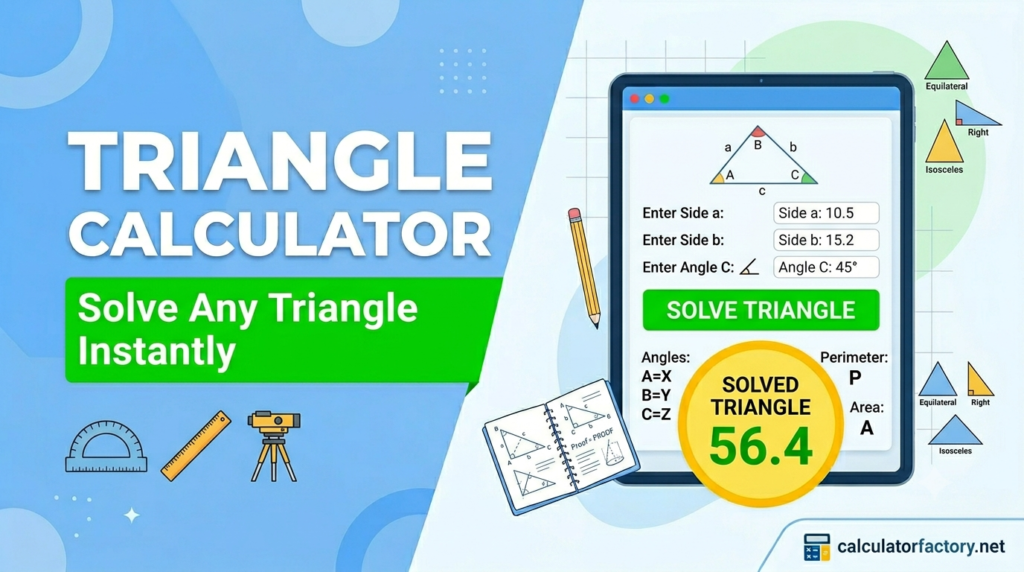
Whether you’re a student working through geometry homework, an engineer calculating structural angles, or a DIYer trying to figure out a roof pitch — our free Triangle Calculator solves any triangle in seconds.
Enter any combination of sides and angles (at least one side required), and the calculator gives you all remaining sides, all angles, the area, the perimeter, and more. No trigonometry textbook required.
What This Triangle Calculator Can Solve
Our calculator handles every standard triangle-solving scenario:
| Input Type | What You Provide | What You Get |
|---|---|---|
| SSS | All 3 sides | All 3 angles + area |
| SAS | 2 sides + included angle | 3rd side + remaining angles + area |
| ASA | 2 angles + included side | All sides + 3rd angle + area |
| AAS | 2 angles + non-included side | All sides + 3rd angle + area |
| SSA | 2 sides + non-included angle | May have 0, 1, or 2 solutions |
| Right Triangle | Any 2 known values | All remaining sides and angles |
It works with both degrees and radians for angle input.
How to Use the Triangle Calculator
- Enter any 3 values from the 6 available fields (sides a, b, c and angles A, B, C)
- At least one of the entered values must be a side (not all three can be angles)
- Select degrees or radians as your angle unit
- Hit Calculate — all remaining values appear instantly
Important: The SSA case (two sides and a non-included angle) can sometimes produce two different valid triangles. The calculator will show both solutions when this ambiguity exists.
Types of Triangles — A Complete Guide
Understanding what kind of triangle you’re working with helps you choose the right solving method.
Classified by Side Length
Equilateral Triangle All three sides are equal in length. All three interior angles are equal: exactly 60° each. The most symmetrical triangle possible.
Isosceles Triangle Two sides are equal in length. The two angles opposite those equal sides (called base angles) are also equal. Common in architecture and design.
Scalene Triangle No sides are equal. No angles are equal. The most general type of triangle. Most real-world triangles fall into this category.
Classified by Angle
Acute Triangle All three interior angles are less than 90°. Equilateral triangles are always acute.
Right Triangle Exactly one interior angle equals 90°. The side opposite the right angle is called the hypotenuse — the longest side in a right triangle. Right triangles are by far the most important type in practical applications.
Obtuse Triangle One interior angle is greater than 90°. A triangle can only have one obtuse angle (since all three must sum to 180°).
The Fundamental Rule Every Triangle Must Follow
No matter the type, all triangles share two unbreakable rules:
Rule 1: The angles always sum to 180°
Angle A + Angle B + Angle C = 180°
This means if you know two angles of a triangle, you always know the third: Third angle = 180° − (Angle A + Angle B)
Rule 2: The sum of any two sides must be greater than the third side (Triangle Inequality Theorem)
a + b > c a + c > b b + c > a
If this rule isn’t satisfied, the three sides cannot form a triangle at all. Our calculator will flag this automatically.
The Pythagorean Theorem — For Right Triangles
The most famous equation in geometry, the Pythagorean Theorem applies exclusively to right triangles:
a² + b² = c²
Where c is the hypotenuse (the side opposite the 90° angle) and a and b are the two legs.
Finding the Hypotenuse:
c = √(a² + b²)
Example: A right triangle has legs of 6 and 8. c = √(6² + 8²) = √(36 + 64) = √100 = 10
Finding a Missing Leg:
a = √(c² − b²)
Example: Hypotenuse = 13, one leg = 5. Find the other leg. a = √(13² − 5²) = √(169 − 25) = √144 = 12
Common Pythagorean Triples (Memorize These)
These are sets of whole numbers that satisfy a² + b² = c² — they come up constantly in geometry and construction:
| Triple | Sides | Notes |
|---|---|---|
| 3-4-5 | 3, 4, 5 | Most common; foundation of many others |
| 5-12-13 | 5, 12, 13 | Frequently appears in standardized tests |
| 8-15-17 | 8, 15, 17 | Common in construction |
| 7-24-25 | 7, 24, 25 | Less common but important |
| 6-8-10 | 6, 8, 10 | Multiple of 3-4-5 |
| 9-12-15 | 9, 12, 15 | Multiple of 3-4-5 |
Any multiple of a Pythagorean triple (e.g., doubling 3-4-5 to get 6-8-10) also forms a right triangle.
Special Right Triangles
Two right triangles are so common in math, science, and architecture that their ratios are worth memorizing:
The 30°-60°-90° Triangle
When a right triangle has angles of 30°, 60°, and 90°, the side lengths always follow this ratio:
Short leg : Long leg : Hypotenuse = 1 : √3 : 2
If the short leg = x:
- Long leg = x√3
- Hypotenuse = 2x
Example: Short leg = 5
- Long leg = 5√3 ≈ 8.66
- Hypotenuse = 10
Where you see it: Equilateral triangles cut in half, ramp angles, certain roof pitches.
The 45°-45°-90° Triangle (Isosceles Right Triangle)
When both non-right angles are 45°, the two legs are always equal, and:
Leg : Leg : Hypotenuse = 1 : 1 : √2
If each leg = x:
- Hypotenuse = x√2
Example: Each leg = 7
- Hypotenuse = 7√2 ≈ 9.90
Where you see it: Square diagonals, tile cutting at 45°, diagonal bracing in construction.
The Law of Sines — For Any Triangle
The Law of Sines works for any triangle — not just right triangles. It states:
a / sin(A) = b / sin(B) = c / sin(C)
Where lowercase letters are side lengths and uppercase letters are the opposite angles.
When to Use It:
- You know two angles and one side (ASA or AAS)
- You know two sides and a non-included angle (SSA — watch for the ambiguous case)
Example (AAS):
Given: Angle A = 35°, Angle B = 65°, side a = 10 First, find Angle C: C = 180° − 35° − 65° = 80°
Now find side b: b / sin(65°) = 10 / sin(35°) b = 10 × sin(65°) / sin(35°) b = 10 × 0.9063 / 0.5736 b ≈ 15.80
The Law of Cosines — For Any Triangle
The Law of Cosines generalizes the Pythagorean theorem to work for any triangle, not just right triangles:
c² = a² + b² − 2ab × cos(C)
And rearranged to find an angle from three known sides:
C = arccos((a² + b² − c²) / 2ab)
When to Use It:
- You know all three sides and need an angle (SSS)
- You know two sides and the included angle between them (SAS)
Example (SAS):
Given: a = 8, b = 11, C = 37° c² = 8² + 11² − 2(8)(11)cos(37°) c² = 64 + 121 − 176 × 0.7986 c² = 185 − 140.55 c² = 44.45 c ≈ 6.67
Example (SSS — finding an angle):
Given: a = 5, b = 7, c = 10. Find angle C. C = arccos((5² + 7² − 10²) / (2 × 5 × 7)) C = arccos((25 + 49 − 100) / 70) C = arccos(−26/70) C = arccos(−0.3714) C ≈ 111.8°
How to Calculate the Area of a Triangle
There are three main formulas for triangle area, each suited to different situations:
Formula 1 — Base and Height (Most Common)
Area = ½ × base × height
The height must be perpendicular to the base — it doesn’t have to be a side of the triangle.
Example: Base = 12, Height = 7 Area = ½ × 12 × 7 = 42 square units
Formula 2 — Two Sides and Included Angle (SAS)
Area = ½ × a × b × sin(C)
Example: a = 9, b = 6, C = 50° Area = ½ × 9 × 6 × sin(50°) Area = 27 × 0.7660 = 20.68 square units
Formula 3 — Heron’s Formula (Three Sides Known)
When you know all three sides but not the height, use Heron’s formula:
Step 1: Calculate the semi-perimeter (s):
s = (a + b + c) / 2
Step 2: Calculate the area:
Area = √(s(s−a)(s−b)(s−c))
Example: a = 7, b = 8, c = 9 s = (7 + 8 + 9) / 2 = 12 Area = √(12 × (12−7) × (12−8) × (12−9)) Area = √(12 × 5 × 4 × 3) Area = √720 ≈ 26.83 square units
Triangle Perimeter
The perimeter of a triangle is simply the sum of all three sides:
Perimeter = a + b + c
Example: Sides of 5, 8, and 11 Perimeter = 5 + 8 + 11 = 24 units
Advanced Triangle Properties
Median
A median connects a vertex to the midpoint of the opposite side. Every triangle has three medians, and they all intersect at a single point called the centroid — the triangle’s center of gravity.
The length of median mₐ (from vertex A to midpoint of side a):
mₐ = ½√(2b² + 2c² − a²)
Inradius
The inradius (r) is the radius of the largest circle that fits perfectly inside the triangle:
r = Area / s (where s is the semi-perimeter)
Circumradius
The circumradius (R) is the radius of the circle that passes through all three vertices of the triangle:
R = a / (2 × sin(A))
These properties are frequently tested in high school and college geometry, and are used in engineering and surveying applications.
Real-World Uses of Triangle Calculations
Triangles are everywhere in the real world — not just in math class. Here’s where triangle calculations actually matter:
| Field | Application |
|---|---|
| Construction | Calculating roof pitch, ramp angles, structural bracing |
| Surveying | Triangulation to determine land boundaries and distances |
| Navigation | GPS systems use triangulation from multiple satellites |
| Architecture | Structural load calculations, truss design |
| Engineering | Force vectors, stress analysis, bridge design |
| Art & Design | Perspective drawing, tessellation patterns |
| Astronomy | Parallax measurements to determine distances to stars |
| Physics | Vector addition, projectile motion decomposition |
| Carpentry & DIY | Cutting crown molding, calculating stair angles |
| Gaming & CGI | 3D computer graphics are built entirely from triangles |
Frequently Asked Questions (FAQ)
How do you find the missing side of a triangle?
It depends on what information you have. For a right triangle, use the Pythagorean theorem: c² = a² + b². For any triangle with two sides and the angle between them (SAS), use the Law of Cosines. For two angles and one side (ASA/AAS), use the Law of Sines. Our calculator handles all cases automatically.
How do you calculate the area of a triangle?
The simplest formula is: Area = ½ × base × height. If you don’t know the height but know two sides and the included angle, use: Area = ½ × a × b × sin(C). If you only know all three sides, use Heron’s formula: Area = √(s(s−a)(s−b)(s−c)) where s = (a+b+c)/2.
Do the angles of a triangle always add up to 180°?
Yes — always. This is one of the fundamental properties of Euclidean geometry (the geometry of flat surfaces). If you know two angles, subtract their sum from 180° to find the third. Note: this rule applies to flat (Euclidean) triangles. On curved surfaces (like the surface of the Earth), the angles can sum to more than 180°.
What is the Pythagorean theorem?
The Pythagorean theorem states that in a right triangle, the square of the hypotenuse (longest side) equals the sum of the squares of the other two sides: a² + b² = c². It only works for right triangles.
What is the hypotenuse?
The hypotenuse is the longest side of a right triangle — specifically, the side opposite the 90° angle. To find it, use: c = √(a² + b²).
What is the Law of Sines?
The Law of Sines states: a/sin(A) = b/sin(B) = c/sin(C). It’s used to solve triangles when you know two angles and a side (ASA or AAS), or two sides and a non-included angle (SSA — which can have two solutions).
What is the Law of Cosines?
The Law of Cosines is: c² = a² + b² − 2ab×cos(C). It extends the Pythagorean theorem to non-right triangles. Use it when you know all three sides (SSS) or two sides and the included angle (SAS).
What is a 30-60-90 triangle?
A 30-60-90 triangle is a special right triangle with angles of 30°, 60°, and 90°. Its sides always maintain the ratio 1 : √3 : 2. If the shortest side is x, the other sides are x√3 and 2x respectively.
Can a triangle have two right angles?
No. Since all angles must sum to 180°, having two 90° angles would already equal 180°, leaving 0° for the third angle — which is impossible. A triangle can have at most one right angle.
What is Heron’s formula?
Heron’s formula calculates the area of a triangle using only the three side lengths, without needing the height. First calculate s = (a+b+c)/2 (semi-perimeter), then Area = √(s(s−a)(s−b)(s−c)). It’s named after the ancient Greek mathematician Hero of Alexandria.
Related Calculators You’ll Find Useful
- Percentage Calculator — Calculate area percentages and ratios
- Date Calculator — Plan project deadlines for construction or design work
- GPA Calculator — Ace your geometry and trigonometry courses
- Fraction Calculator — Simplify fractional measurements used in triangle problems
- Age Calculator — Explore math history — find out when famous mathematicians like Pythagoras lived
This Triangle Calculator is intended for educational, academic, and general planning purposes. For structural engineering, land surveying, construction, or any safety-critical application, always consult a licensed professional and verify calculations independently.