
This asphalt millings calculator estimates the volume, weight, and cost of recycled asphalt millings needed for a driveway, parking lot, or base layer. Enter your project’s length, width, and desired milling depth, then adjust density, waste allowance, and cost per ton to get instant estimates in cubic yards, tons, total cost, and truckloads required.
Asphalt Millings Calculator: Estimate Tons, Yards & Cost
Estimate the volume, weight, cost, and truckloads of recycled asphalt millings needed for your driveway or lot project.
What This Millings Estimator Figures Out
This calculator estimates how much recycled asphalt millings material you need for a driveway, parking area, walking path, or gravel base replacement. It converts your project dimensions and desired depth into cubic yards, total weight in tons, estimated material cost, and the number of truckloads a supplier would need to deliver.
It is useful for homeowners planning a DIY driveway resurfacing, contractors quoting jobs, and property managers budgeting for lot maintenance. Because material density, compaction behavior, and supplier pricing vary by region and source, all results are planning estimates rather than exact quantities. Always confirm final order amounts with your material supplier.
Steps to Get Your Material Estimate
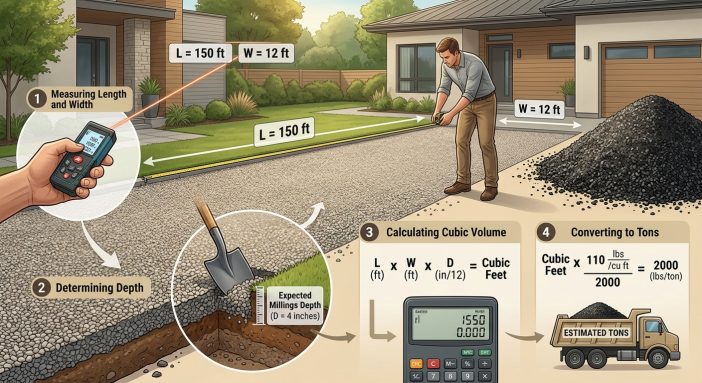
- Select your measurement system (US feet or metric meters).
- Enter the length and width of the area you plan to cover.
- Enter the desired milling depth in inches, typically 2 to 4 inches for a driveway.
- Adjust material density if you know your supplier’s compacted density, or keep the default.
- Set the waste and compaction allowance and enter your local cost per ton and truck capacity.
- Review the area, volume, weight, cost, and truckload results instantly.
Understanding Each Project Measurement
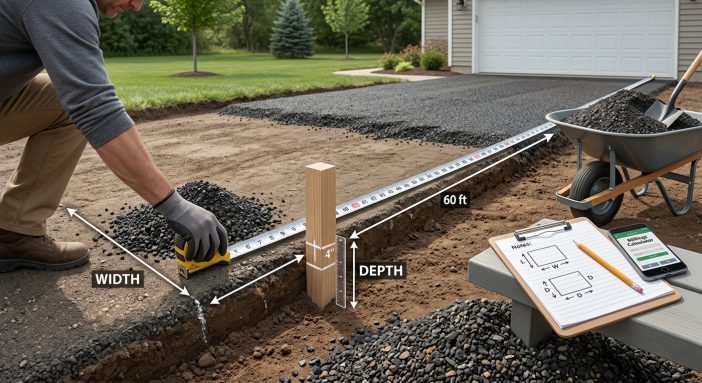
Measurement System lets you choose feet (US) or meters (metric) for length and width. Milling depth is always entered in inches regardless of this choice, since that is the standard convention in paving work.
Length and Width describe the footprint of the area you are covering, entered in whichever unit matches your selected measurement system.
Milling Depth is the compacted thickness of the millings layer. Most residential driveways use 2 to 4 inches, while base layers or heavy-traffic areas may use more.
Material Density reflects how much a cubic foot of compacted millings weighs, typically 130 to 150 pounds. Ask your supplier for a specific figure if you have one.
Waste and Compaction Allowance adds extra material to account for spreading loss, uneven grading, and settling after compaction.
Cost per Ton is your local price for recycled millings, which varies widely by region and supplier. Truck Capacity is the average tonnage a delivery truck can haul in your area.
How Area, Weight, and Cost Are Calculated
The calculator works in five linked steps. All length and width values are first converted to feet using a conversion factor of 3.28084 feet per meter when metric units are selected.
Project Area = length × width × (unit factor)^2, given in square feet.
Estimated Volume = (Area × depth in feet) / 27, converting cubic feet to cubic yards, where depth in feet equals depth in inches divided by 12.
Estimated Weight = (Area × depth in feet × density in lb per cubic foot × (1 + waste percent / 100)) / 2000, converting pounds to tons.
Estimated Material Cost = Estimated Weight × cost per ton.
Estimated Truckloads = the weight divided by truck capacity, rounded up to the next whole truckload since a partial truckload still requires a full trip.
These formulas assume uniform depth across the entire area and a single, consistent material density. Real sites with slopes, drainage dips, or variable sub-base conditions may need adjusted depth inputs to stay accurate.
Sample Driveway and Lot Calculations
Example 1: Standard residential driveway (US units). Given: length 20 ft, width 10 ft, depth 3 in, density 140 lb/ft3, waste 10%, cost $15/ton, truck capacity 20 tons. Formula: Area = length × width. Substitution: 20 × 10 = 200 sq ft. Volume = 200 × (3/12) / 27 = 1.85 cubic yards. Weight = (200 × 0.25 × 140 × 1.10) / 2000 = 3.85 tons. Cost = 3.85 × 15 = $57.75. Truckloads = ceil(3.85 / 20) = 1. Final result: about 3.85 tons costing roughly $57.75, needing 1 truckload.
Example 2: Metric residential lot. Given: length 15 m, width 8 m, depth 4 in, density 135 lb/ft3, waste 15%, cost $18/ton, truck capacity 18 tons. Substitution: Area = 15 × 8 × 10.764 = 1291.67 sq ft. Volume = 1291.67 × (4/12) / 27 = 15.95 cubic yards. Weight = (1291.67 × 0.3333 × 135 × 1.15) / 2000 = 33.42 tons. Cost = 33.42 × 18 = $601.56. Truckloads = ceil(33.42 / 18) = 2. Final result: about 33.42 tons costing roughly $601.56, needing 2 truckloads.
Example 3: Commercial parking lot. Given: length 200 ft, width 100 ft, depth 6 in, density 145 lb/ft3, waste 5%, cost $12/ton, truck capacity 25 tons. Substitution: Area = 200 × 100 = 20,000 sq ft. Volume = 20,000 × 0.5 / 27 = 370.37 cubic yards. Weight = (20,000 × 0.5 × 145 × 1.05) / 2000 = 761.25 tons. Cost = 761.25 × 12 = $9,135.00. Truckloads = ceil(761.25 / 25) = 31. Final result: about 761.25 tons costing roughly $9,135, needing 31 truckloads.
Example 4: Small garden path. Given: length 10 ft, width 3 ft, depth 2 in, density 130 lb/ft3, waste 20%, cost $20/ton, truck capacity 15 tons. Substitution: Area = 10 × 3 = 30 sq ft. Volume = 30 × (2/12) / 27 = 0.19 cubic yards. Weight = (30 × 0.1667 × 130 × 1.20) / 2000 = 0.39 tons. Cost = 0.39 × 20 = $7.80. Truckloads = ceil(0.39 / 15) = 1. Final result: about 0.39 tons costing roughly $7.80, needing 1 truckload.
Coverage per Ton at Common Depths
| Depth (inches) | Typical Use | Approx. Coverage per Ton* |
|---|---|---|
| 2 | Light-duty paths, temporary surfaces | ~86 sq ft |
| 3 | Standard residential driveways | ~57 sq ft |
| 4 | Heavier residential or light commercial use | ~43 sq ft |
| 6 | Base layers, parking lots, heavy traffic areas | ~29 sq ft |
*Based on a density of 140 lb per cubic foot and no waste allowance. Actual coverage varies with material density and site conditions.
Reading Your Volume, Weight, and Cost Results
Project Area shows the total surface size in square feet, useful for comparing supplier quotes that price by area.
Estimated Volume gives the loose cubic yardage of material, helpful when a supplier sells by volume rather than weight.
Estimated Weight is the primary ordering figure most millings suppliers use, already including your waste allowance.
Estimated Material Cost multiplies that weight by your entered price per ton, giving a budgeting estimate, not a final invoice.
Estimated Truckloads rounds up to the next whole truck since partial loads still require a full delivery trip. All results are estimates; confirm final order quantities with your supplier before purchasing.
What Changes Your Millings Estimate
Depth accuracy has the largest effect on results since weight and volume scale directly with depth. The calculator accounts for whatever depth you enter, but real compaction can vary the finished thickness slightly.
Material density changes weight and cost proportionally. The calculator uses your entered value, but actual millings density depends on source pavement, moisture, and compaction method.
Waste allowance is fully factored into the weight, cost, and truckload results, so a higher percentage will always raise those numbers.
Site grading and slope are not automatically accounted for. Uneven or sloped areas may need a higher effective depth entered manually.
Regional pricing and truck size vary widely and are entirely dependent on the values you enter, since the calculator has no built-in regional data.
Errors That Skew Millings Estimates
- Mixing units: entering length and width in meters while set to US feet, or vice versa, throws off every result. Always match your inputs to the selected measurement system.
- Ignoring compaction: loose millings compact after placement, so failing to include a waste allowance can lead to ordering too little material.
- Using an average depth without adjustment: sloped or uneven sites need a locally higher depth entered to avoid under-ordering.
- Assuming one density fits all suppliers: density can range from 130 to 150 lb per cubic foot, and using the wrong value skews weight and cost.
- Forgetting delivery minimums: some suppliers set minimum order tonnages regardless of the calculated truckload count.
- Treating cost estimates as final quotes: delivery fees, taxes, and spreading labor are not included in the material cost result.
- Overlooking depth units: milling depth is always in inches, even when using the metric measurement system for length and width.
Where This Estimate Falls Short
This calculator provides planning-level estimates based on simple geometric volume and average density figures. It does not model soil sub-base conditions, drainage requirements, compaction equipment needs, or slope-based depth variation across a site.
Material cost and truck capacity are user-supplied values and vary significantly by region, supplier, and delivery distance. Local regulations may also govern the use of recycled asphalt millings for certain applications, particularly near waterways or in specific municipalities.
For structural driveway design, drainage planning, or large commercial paving projects, consult a licensed paving contractor or civil engineer before finalizing material orders or installation methods.
Choosing the Right Milling Depth for Your Project
Light foot-traffic paths often work well with 2 inches of compacted millings. Standard vehicle driveways typically use 3 to 4 inches for adequate durability. Areas expecting heavier vehicles, such as parking lots or commercial entrances, often call for 5 to 6 inches or a layered base system. When unsure, consult a local paving contractor about depth requirements for your soil type and expected traffic.
Millings vs. Virgin Asphalt for Surfacing
Recycled asphalt millings are reclaimed from old pavement that has been ground up during resurfacing projects. They cost less than virgin asphalt and can be compacted into a durable driveway or lot surface, though they generally do not form as smooth or uniform a finish as freshly laid hot-mix asphalt. Millings are commonly used for budget-friendly driveways, temporary surfaces, and base layers under other pavement types.
Asphalt Millings Questions Answered
How much does a ton of asphalt millings cover?
Coverage depends on depth and density. At a typical 3-inch depth and 140 lb per cubic foot density, one ton covers roughly 57 square feet. Thinner layers cover more area per ton, while thicker layers cover less, so always check the depth used in any coverage estimate.
What is the typical density of asphalt millings?
Compacted asphalt millings usually weigh between 130 and 150 pounds per cubic foot, with 140 lb per cubic foot being a common planning default. Actual density depends on the original pavement mix, moisture content, and how well the material is compacted after placement.
How thick should asphalt millings be laid for a driveway?
Most residential driveways use 2 to 4 inches of compacted millings, with 3 inches being a common standard. Heavier vehicle traffic or commercial use often calls for greater depth, sometimes 5 to 6 inches or more, depending on soil conditions and expected loads.
How much do asphalt millings cost per ton or per yard?
Prices vary widely by region, supplier, and delivery distance, often ranging from a few dollars to over $30 per ton depending on local availability. This calculator uses your entered cost per ton for its estimate, so check current local pricing before finalizing a budget.
Can asphalt millings be installed without compaction equipment?
Millings perform best when properly compacted with a plate compactor or roller, since loose material shifts and ruts under vehicle traffic. Installing without compaction equipment is possible for light-use paths but is not recommended for driveways or parking areas that see regular vehicle weight.
How is the number of truckloads for a delivery calculated?
The calculator divides your estimated total weight in tons by the truck capacity you enter, then rounds up to the next whole number. This is because a partial truckload still requires a full delivery trip, so the result always represents complete truck deliveries.
What is the difference between recycled asphalt millings and virgin asphalt?
Recycled millings are ground-up material from old pavement removal, while virgin asphalt is freshly manufactured hot-mix material. Millings typically cost less and are compacted in place rather than poured hot, resulting in a slightly less smooth but often more budget-friendly surface option.
Are these calculator results exact enough for ordering material?
Results are planning estimates based on the dimensions, density, and allowances you enter. Actual material needs can vary due to site grading, compaction behavior, and supplier-specific density, so confirm final order quantities with your millings supplier before purchasing.
Planning Your Millings Order With Confidence
Estimating asphalt millings accurately starts with careful measurements of length, width, and depth, paired with a realistic density and waste allowance. Use this calculator to plan volume, weight, cost, and truckloads before contacting suppliers, and always confirm final quantities and pricing with a qualified paving professional for your specific project.
