
This calculator estimates the tons of asphalt needed for your project by combining the paved area, layer thickness, and material density, then applying a waste factor. Enter your measurements in feet or meters, choose your preferred units, and instantly get base tonnage, tonnage with waste, volume, and estimated material cost below.
Asphalt Tonnage Calculator: Estimate Tons & Paving Cost
Calculate the tons of asphalt needed for a driveway, road, or parking lot from area, thickness, and density, plus estimated material cost.
What This Asphalt Tonnage Tool Calculates
This tool calculates how much asphalt you need to pave a rectangular area, such as a driveway, parking lot, or road section. It works from three basic measurements: area, layer thickness, and material density, then adds a waste allowance for a more realistic order quantity. It also converts the result into cost and metric tonnes.
The tool helps homeowners planning a driveway, contractors preparing bids, and estimators cross-checking supplier quotes. Results are estimates, not exact delivery amounts, because actual asphalt density, compaction behavior, and site conditions vary by mix design and region.
Steps to Estimate Your Asphalt Order
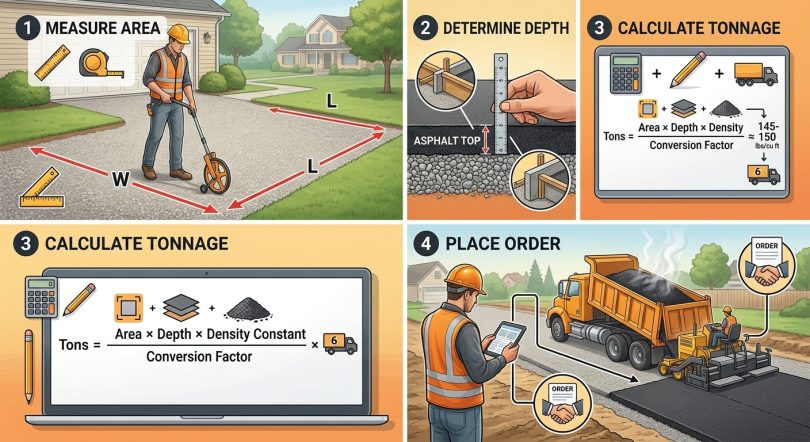
- Enter the length and width of the area you plan to pave, then select feet or meters.
- Enter the planned asphalt thickness and choose inches or millimeters.
- Enter the asphalt density, or use the default of 145 pounds per cubic foot for typical hot mix asphalt.
- Enter a waste and compaction allowance percentage, typically 5 to 10 percent.
- Enter your cost per ton if you want an estimated material cost.
- Review the tonnage, volume, and cost results shown below the calculator.
Understanding Each Measurement Field
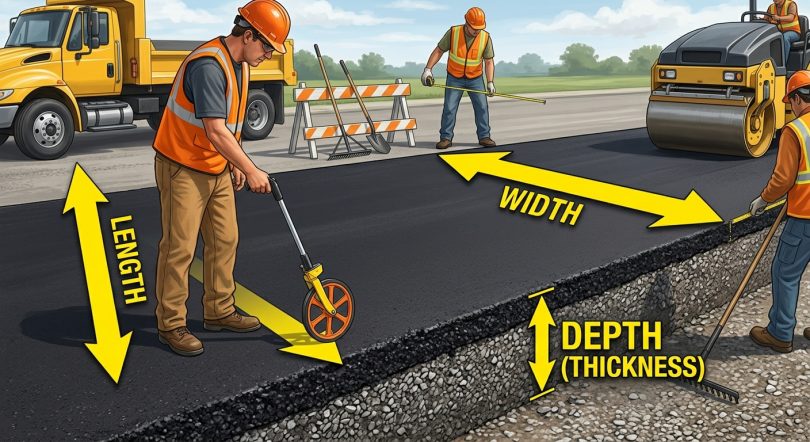
Length and Width: Enter the outer dimensions of the area you are paving. Choose feet or meters from the unit dropdown; both dimensions use the same unit.
Asphalt Thickness: Enter the planned compacted depth of the asphalt layer. Choose inches or millimeters. Typical driveways use 2 to 3 inches (50 to 75 millimeters); roads and lots often use thicker layers or multiple courses.
Asphalt Density: This is the weight of compacted asphalt per unit volume. The default, 145 pounds per cubic foot, represents a common hot mix asphalt value. You can enter pounds per cubic foot or switch to kilograms per cubic meter. Confirm the exact figure with your asphalt supplier when precision matters.
Waste / Compaction Allowance: A percentage added to cover material loss, spillage, and compaction variance. Five to ten percent is a common range for straightforward rectangular jobs.
Cost per Ton: The price your supplier charges per ton of asphalt mix, used only to estimate material cost.
How Area, Thickness, and Density Become Tons
The calculator first converts every input into consistent units: length and width into feet, thickness into feet, and density into pounds per cubic foot. It then applies the following formulas.
Volume (cubic feet) = length (ft) x width (ft) x thickness (ft).
Base Tonnage = Volume (cu ft) x Density (lb per cu ft) / 2000, since one ton equals 2000 pounds.
Tonnage with Waste = Base Tonnage x (1 + waste percent / 100).
Total Volume (cubic yards) = Volume (cu ft) / 27, since one cubic yard equals 27 cubic feet.
Estimated Material Cost = Tonnage with Waste x Cost per Ton.
Metric Tonnes Equivalent = Tonnage with Waste x 0.907185, since one US ton equals 0.907185 metric tonnes.
Unit conversions used internally: 1 meter equals 3.28084 feet, 1 inch equals 0.0833333 feet, 1 millimeter equals 0.00328084 feet, and 1 kilogram per cubic meter equals 0.0624279606 pounds per cubic foot. The formulas assume a uniform, flat layer of constant thickness across the entire area; irregular shapes or sloped surfaces require adjusted area inputs.
Sample Paving Jobs Calculated Step by Step
Example 1: Standard driveway in feet. Given: length 20 ft, width 10 ft, thickness 2 in, density 145 lb/cu ft, waste 5%, cost $120/ton. Volume = 20 x 10 x 0.166667 = 33.33 cu ft. Base tonnage = 33.33 x 145 / 2000 = 2.42 tons. With waste = 2.42 x 1.05 = 2.54 tons. Volume in cubic yards = 33.33 / 27 = 1.23 cu yd. Cost = 2.54 x 120 = $304.50. Final result: about 2.54 tons and roughly $304.50 in material cost.
Example 2: Metric parking area. Given: length 15 m, width 6 m, thickness 50 mm, density 2350 kg/cu m, waste 10%, cost $110/ton. Converted: length 49.21 ft, width 19.69 ft, thickness 0.164 ft, density 146.71 lb/cu ft. Volume = 49.21 x 19.69 x 0.164 = 158.92 cu ft. Base tonnage = 158.92 x 146.71 / 2000 = 11.66 tons. With waste = 11.66 x 1.10 = 12.82 tons. Volume in cubic yards = 5.89 cu yd. Cost = 12.82 x 110 = $1,410.42. Final result: about 12.82 tons, roughly $1,410 in material cost.
Example 3: Larger driveway with cooler-climate mix. Given: length 50 ft, width 12 ft, thickness 3 in, density 140 lb/cu ft, waste 8%, cost $100/ton. Volume = 50 x 12 x 0.25 = 150 cu ft. Base tonnage = 150 x 140 / 2000 = 10.50 tons. With waste = 10.50 x 1.08 = 11.34 tons. Volume in cubic yards = 5.56 cu yd. Cost = 11.34 x 100 = $1,134.00. Final result: about 11.34 tons, roughly $1,134 in material cost.
Example 4: Small patch repair. Given: length 8 ft, width 4 ft, thickness 1.5 in, density 145 lb/cu ft, waste 5%, cost $130/ton. Volume = 8 x 4 x 0.125 = 4 cu ft. Base tonnage = 4 x 145 / 2000 = 0.29 tons. With waste = 0.29 x 1.05 = 0.30 tons. Cost = 0.30 x 130 = $39.59. Final result: about 0.30 tons, roughly $39.59 in material cost.
Typical Asphalt Densities and Coverage Rates
| Thickness | Approx. Coverage per Ton (at 145 lb/cu ft) |
|---|---|
| 1 inch | about 165 sq ft |
| 2 inches | about 83 sq ft |
| 3 inches | about 55 sq ft |
| 4 inches | about 41 sq ft |
These coverage figures assume a density of 145 pounds per cubic foot, a common value for hot mix asphalt. Actual coverage changes with the density you enter, so use the calculator results for your specific project rather than this table alone.
Reading Your Tonnage, Volume, and Cost Results
Estimated Asphalt Tonnage (with waste) is the main number to give your supplier or use for budgeting. It already includes the waste and compaction allowance.
Base Tonnage shows the raw calculated weight before waste is added, useful for comparing against a supplier’s minimum order or for understanding how much the waste factor adds.
Total Volume in cubic yards helps cross-check quotes that are priced or measured by volume instead of weight.
Estimated Material Cost reflects tonnage with waste multiplied by your entered price per ton. It covers material only.
Metric Tonnes Equivalent converts the same tonnage with waste into metric tonnes for suppliers or specifications that use metric units. All results are rounded to two decimal places and should be treated as planning estimates rather than exact delivery figures.
What Changes Your Asphalt Requirement
- Paved area: Directly scales tonnage; the calculator accounts for this through length and width.
- Thickness: A major driver of volume and weight; the calculator accounts for this and lets you choose inches or millimeters.
- Asphalt density: Varies by mix design, aggregate type, and temperature; the calculator accounts for this through the density field, but you must supply an accurate value.
- Waste and compaction: Site conditions, crew experience, and paver settings affect real-world losses; the calculator accounts for this through the waste percentage you choose.
- Multiple courses: Base and surface layers with different densities are not combined automatically; you should run the calculator once per layer.
- Irregular shapes: The calculator assumes a rectangle; non-rectangular areas require you to estimate an equivalent area separately.
Common Errors When Ordering Asphalt
- Using loose density instead of compacted density: Loose asphalt density is lower than compacted density, which can understate tonnage. Use compacted density values for accurate results.
- Mixing units within one calculation: Entering length in meters and width in feet gives incorrect area. Keep both dimensions in the same unit.
- Skipping the waste allowance: Ordering exact base tonnage often leaves a shortfall on site. Include a reasonable waste percentage.
- Guessing thickness without checking specifications: Underestimating thickness understates tonnage significantly. Confirm design thickness from your plans or a paving professional.
- Ignoring multiple layers: Treating a two-layer job as a single course underestimates total material. Calculate each layer separately and add the results.
- Assuming the cost result is a full project bid: The cost figure covers material only, not labor, equipment, or site work.
- Using a generic density for every mix: Different asphalt mixes have different densities. Confirm the correct value with your supplier when the estimate matters financially.
What This Estimate Does Not Include
This calculator provides a material planning estimate based on simple geometry and a user-supplied density. It assumes a uniform rectangular area and a constant, flat thickness. It does not account for sloped grading, curves, irregular boundaries, sub-base preparation, tack coat, milling, or multiple asphalt layers unless you calculate each layer separately.
Density values, waste percentages, and material pricing vary by region, supplier, and mix design, so treat all outputs as estimates rather than guaranteed order quantities. For paving projects involving structural load requirements, drainage, or regulatory specifications, consult a qualified paving contractor or engineer before finalizing material orders or project budgets.
Compacted Versus Loose Asphalt Volume
Asphalt is delivered as a loose mix and becomes denser once compacted with a roller. Density values used for tonnage calculations should reflect the compacted state, since that is the final in-place weight per volume. If your supplier gives you a loose density instead, ask for the compacted equivalent to avoid underordering material.
Choosing a Waste Allowance for Your Project
A waste and compaction allowance covers small losses from truck-to-site handling, spreading, and trimming edges. Simple rectangular driveways often use 5 percent, while jobs with curves, patches, or multiple deliveries may warrant 8 to 10 percent. Adjust the waste percentage field based on the complexity of your layout.
Handling Base and Surface Course Layers
Many roads and commercial lots use a thicker base course topped with a thinner surface course, and each layer can have a different density. To estimate a multi-layer job, run the calculator once for the base course with its thickness and density, then again for the surface course, and add the two tonnage results together.
Asphalt Tonnage Questions Answered
How is asphalt tonnage calculated from area and thickness?
The calculator multiplies length by width to get area, then multiplies by thickness to get volume in cubic feet. That volume is multiplied by the asphalt density and divided by 2000 pounds to convert the weight into tons.
What density value should I use for hot mix asphalt?
A common default is 145 pounds per cubic foot, but actual density depends on the specific mix design, aggregate, and temperature. Ask your asphalt supplier for the compacted density of the mix you plan to use for a more accurate result.
Why add a waste or compaction allowance to my estimate?
Real paving jobs lose some material to spillage, trimming, and compaction variance. Adding 5 to 10 percent on top of the base tonnage gives a more realistic order quantity so you are less likely to run short during placement.
Can this calculator be used for metric measurements?
Yes. You can enter length and width in meters, thickness in millimeters, and density in kilograms per cubic meter. The calculator converts these internally to feet and pounds per cubic foot before computing tonnage, so results stay accurate regardless of unit choice.
How accurate is the estimated material cost?
The cost result is an estimate based on tonnage with waste multiplied by your entered price per ton. It reflects material cost only and does not include labor, equipment, delivery, taxes, or site preparation, so treat it as a starting budget figure.
What is the difference between base tonnage and tonnage with waste?
Base tonnage is the raw weight calculated from volume and density alone. Tonnage with waste adds your chosen waste and compaction percentage on top of that base figure, giving a more practical amount to order from your supplier.
How many square feet does one ton of asphalt cover?
Coverage depends on thickness and density. At a common density of 145 pounds per cubic foot, one ton covers roughly 165 square feet at 1 inch thick, about 83 square feet at 2 inches, and about 55 square feet at 3 inches.
Does this calculator work for both driveways and larger paving jobs?
Yes. It works for any rectangular paved area, from small patch repairs to driveways, parking lots, or road sections. For multi-layer projects, calculate each asphalt layer separately and add the tonnage results together.
Planning Your Next Paving Order
Estimating asphalt tonnage accurately starts with reliable measurements: area, thickness, and a realistic density value. This calculator turns those inputs into base tonnage, tonnage with waste, volume, and estimated cost, giving you a practical starting point for ordering material or budgeting a paving project. For final orders on large or complex jobs, confirm density and quantities with your asphalt supplier or a paving professional.
