
Enter your audiobook’s total length, how long you listen each day, and your playback speed to instantly find out how many days until you finish and your projected completion date. For example, a 12-hour audiobook played at 1.5× speed with 1 hour of daily listening takes just 8 days to complete — far less than most listeners expect.
Audiobook Finish Time Calculator: Find Your End Date
Estimate how many days until you finish an audiobook based on total runtime, daily listening time, and playback speed.
What This Audiobook Finish Time Calculator Does
This calculator tells you exactly how many active listening days and real calendar days you need to finish any audiobook. It accounts for three variables that most listeners overlook together: the book’s total runtime, the playback speed you choose, and how many hours you actually listen each day — and on how many days per week.
It is useful for anyone who wants to finish a book before a book-club meeting, a flight, a vacation, or a personal deadline. Students using audiobooks for coursework, commuters fitting in chapters during a drive, and casual listeners who want to pace themselves through a long title all benefit from a concrete finish estimate.
Results are estimates based on consistent daily listening. The calculator does not connect to any streaming platform, so you enter the runtime manually. All six outputs update instantly when you change any field.
How to Enter Your Listening Details
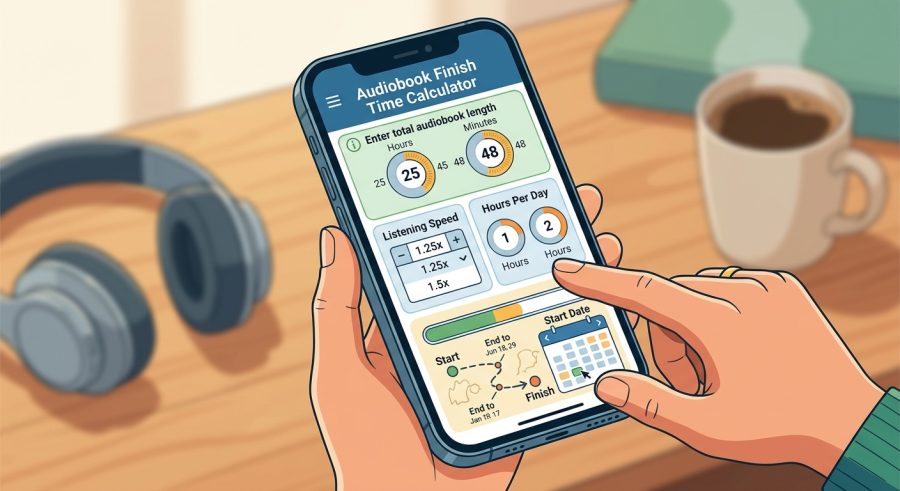
- Enter the audiobook’s total length in hours using the first field, then add any extra minutes in the second field — for example, 10 hours and 34 minutes.
- Select your playback speed from the dropdown. If you listen at normal speed, leave it at 1.0×. Speeds above 1× reduce your effective listening time.
- Enter your daily listening time in hours, then add any extra daily minutes — for example, 1 hour and 20 minutes per day.
- Choose how many days per week you listen from the dropdown. Commuters who only listen on weekdays should select 5 days/week.
- Read your results. The calculator shows your effective audiobook length, active listening days, calendar days to finish, and weeks to finish.
Understanding Each Input Field and Unit
Audiobook Total Length (hours) — Enter the full runtime in whole or decimal hours. Most platforms list runtime on the book’s detail page. If the listing shows hours and minutes separately, enter the hours here and the leftover minutes in the next field.
Additional Minutes Beyond Full Hours — Use this field for the minutes portion of a runtime like 14 h 22 min. Enter 22 here. Leave it at 0 if the runtime is a round number of hours. The valid range is 0–59 minutes.
Playback Speed — Choose the speed multiplier you use in your app. 1.0× is normal speed. At 1.5×, a 10-hour book plays back in about 6.67 hours of real listening time. At 2.0×, that same book takes only 5 hours. Speeds below 1.0× (such as 0.75×) slow playback and increase total listening time.
Daily Listening Time (hours) — Enter how many hours you listen on a typical active day. A 45-minute commute each way is 1.5 hours; enter 1 here and 30 in the extra-minutes field.
Additional Daily Minutes — The minutes portion of your daily session, from 0 to 59. This lets you enter a session like 1 h 20 min without doing decimal math.
Listening Days per Week — Select how many days per week you actually listen. Weekday-only commuters should choose 5. Weekend-only listeners should choose 2. This converts active listening days into real calendar days so your finish date reflects your actual schedule.
The Math Behind Your Finish Date
All formulas share a common first step: converting the audiobook runtime and daily session into consistent decimal-hour values.
Total runtime in decimal hours:
Total Hours + (Additional Minutes ÷ 60)
Effective audiobook length (hours):
Total Runtime ÷ Playback Speed
This is the actual clock time you will spend listening after speed adjustment.
Daily listening time (decimal hours):
Daily Hours + (Daily Extra Minutes ÷ 60)
Active listening days:
CEIL(Effective Length ÷ Daily Listening Time)
The CEIL function rounds up to the next whole day because you cannot finish a partial session and stop mid-sentence — you will need one more full day to complete the remainder.
Calendar days:
CEIL(Active Listening Days ÷ Days per Week × 7)
This scales active days to real calendar days. If you listen 5 days a week, every 5 active days spans 7 calendar days. The outer CEIL rounds up to the nearest whole calendar day.
Weeks to finish:
Calendar Days ÷ 7
A simple conversion for quick scheduling reference, shown to one decimal place.
All formulas assume consistent sessions. The final session may be shorter than your daily target because you finish the book before the session ends, but the day still counts as one active day.
Five Real Audiobook Finish Time Examples
Example 1 — Short commuter audiobook at normal speed
Given: 6 hours total, 0 extra minutes, 1.0× speed, 0.75 hrs/day (45 min), 0 extra daily minutes, 5 days/week.
Effective length: 6 ÷ 1.0 = 6.00 hrs
Active days: CEIL(6.00 ÷ 0.75) = CEIL(8) = 8 listening days
Calendar days: CEIL(8 ÷ 5 × 7) = CEIL(11.2) = 12 calendar days
Weeks: 12 ÷ 7 ≈ 1.7 weeks
Result: 8 listening days, 12 calendar days, about 1.7 weeks.
Example 2 — Long fantasy novel at 1.5× speed, daily listener
Given: 28 hours, 30 extra minutes, 1.5× speed, 1 hr/day, 0 extra daily minutes, 7 days/week.
Total runtime: 28 + 30/60 = 28.5 hrs
Effective length: 28.5 ÷ 1.5 = 19.00 hrs
Active days: CEIL(19.00 ÷ 1.0) = 19 listening days
Calendar days: CEIL(19 ÷ 7 × 7) = CEIL(19) = 19 calendar days
Weeks: 19 ÷ 7 ≈ 2.7 weeks
Result: 19 listening days, 19 calendar days, about 2.7 weeks.
Example 3 — Book-club deadline, 2× speed, heavy daily listening
Given: 12 hours, 0 extra minutes, 2.0× speed, 2 hrs/day, 0 extra daily minutes, 7 days/week.
Effective length: 12 ÷ 2.0 = 6.00 hrs
Active days: CEIL(6.00 ÷ 2.0) = CEIL(3) = 3 listening days
Calendar days: CEIL(3 ÷ 7 × 7) = CEIL(3) = 3 calendar days
Weeks: 3 ÷ 7 ≈ 0.4 weeks
Result: 3 listening days, 3 calendar days — finish in under half a week.
Example 4 — Weekend-only listener, normal speed
Given: 10 hours, 0 extra minutes, 1.0× speed, 1.5 hrs/day, 0 extra daily minutes, 2 days/week.
Effective length: 10 ÷ 1.0 = 10.00 hrs
Active days: CEIL(10.00 ÷ 1.5) = CEIL(6.67) = 7 listening days
Calendar days: CEIL(7 ÷ 2 × 7) = CEIL(24.5) = 25 calendar days
Weeks: 25 ÷ 7 ≈ 3.6 weeks
Result: 7 listening days spread over 25 calendar days — about 3.6 weeks.
Example 5 — Very long nonfiction at 1.25× speed, moderate daily listening
Given: 20 hours, 15 extra minutes, 1.25× speed, 1 hr/day, 15 extra daily minutes, 5 days/week.
Total runtime: 20 + 15/60 = 20.25 hrs
Effective length: 20.25 ÷ 1.25 = 16.20 hrs
Daily time: 1 + 15/60 = 1.25 hrs/day
Active days: CEIL(16.20 ÷ 1.25) = CEIL(12.96) = 13 listening days
Calendar days: CEIL(13 ÷ 5 × 7) = CEIL(18.2) = 19 calendar days
Weeks: 19 ÷ 7 ≈ 2.7 weeks
Result: 13 listening days, 19 calendar days, about 2.7 weeks.
Typical Audiobook Lengths by Genre
| Genre | Typical Runtime | Days at 1 hr/day, 1.0×, 7 days/wk | Days at 1 hr/day, 1.5×, 7 days/wk |
|---|---|---|---|
| Short memoir / essay | 3–5 hrs | 3–5 days | 2–4 days |
| Business / self-help | 5–8 hrs | 5–8 days | 4–6 days |
| Literary fiction | 8–14 hrs | 8–14 days | 6–10 days |
| Thriller / mystery | 10–16 hrs | 10–16 days | 7–11 days |
| Nonfiction / history | 12–20 hrs | 12–20 days | 8–14 days |
| Epic fantasy / sci-fi | 20–50+ hrs | 20–50+ days | 14–34+ days |
Reading and Applying Your Six Results
Effective Audiobook Length (hrs) — This is the real clock time you will spend listening after your speed adjustment is applied. A 15-hour book at 1.5× plays back in 10 hours of actual listening. Use this number to compare books or plan a road trip.
Effective Length in Minutes — The same value expressed in minutes. Useful when your daily session is measured in minutes and you want a quick mental comparison.
Daily Listening Time (hrs/day) — Your combined hours and extra minutes shown as a single decimal. Confirms the calculator received your session length correctly.
Active Listening Days to Finish — The number of days on which you actually listen before the book ends. This is always a whole number because the CEIL function rounds up any partial final session to a full day.
Calendar Days to Finish — The most practical result for scheduling. It accounts for the days of the week you do not listen. If you listen 5 days a week, 10 active days span 14 calendar days, not 10. Add this number to today’s date to find your projected finish date.
Weeks to Finish — Calendar days divided by 7, shown to one decimal. Handy for book-club planning or comparing two books side by side. A result of 2.1 weeks means you finish partway through the third week.
If any result seems unexpectedly large, check that your daily listening time is not set to zero and that your playback speed is correct. Very low daily listening times combined with low weekly frequency can push calendar days into the hundreds for long books.
What Most Affects How Fast You Finish
Playback speed is the single biggest lever. Switching from 1.0× to 2.0× cuts your effective listening time in half, which roughly halves your finish date. The calculator fully accounts for this.
Daily listening time has an equally large impact. Doubling your daily session from 30 minutes to 60 minutes halves the number of active days needed. The calculator accounts for this through the hours and extra-minutes fields.
Listening frequency (days per week) does not change how many active listening days you need, but it directly stretches or compresses the calendar. A 10-day active schedule takes 10 calendar days at 7 days/week but 14 calendar days at 5 days/week and 70 calendar days at 1 day/week. The calculator accounts for this.
Audiobook runtime accuracy matters. If you enter an estimated runtime rather than the exact figure from the platform, your finish date will drift. The calculator cannot verify the runtime you enter.
Consistency of sessions is assumed to be perfect. Real listeners skip days, listen longer on weekends, or pause mid-chapter. The calculator does not model variable schedules, so treat results as a planning baseline rather than a guarantee.
Comprehension re-listening is not modeled. Some listeners replay sections at high speed. If you regularly rewind, your actual finish date will be longer than the estimate.
Mistakes That Skew Your Finish Date Estimate
- Entering total runtime in minutes instead of hours. A 600-minute book is 10 hours. Always convert to hours (and leftover minutes) before entering values.
- Forgetting the extra-minutes field. A runtime of 10 h 45 min entered as just 10 hours underestimates the book by 45 minutes, which can shift your finish date by a full day for short daily sessions.
- Setting daily listening time to zero. The formula divides by daily listening time, so a zero entry produces an undefined result. Enter at least a small positive value.
- Choosing 7 days/week when you only listen on weekdays. This compresses your calendar estimate and makes the finish date look earlier than it really is. Select 5 days/week for weekday-only listening.
- Using the narrator’s speed instead of your app’s playback speed. The playback speed field refers to the speed multiplier in your listening app (Audible, Libby, Spotify, etc.), not how fast the narrator naturally speaks.
- Assuming the result is an exact finish date. The calculator gives a calendar-day count from today. You still need to add that number to today’s date manually, and real-life interruptions will shift the actual date.
- Entering a runtime from an abridged edition when you are listening to the unabridged version. Abridged audiobooks can be 30–60% shorter. Always confirm which edition’s runtime you are entering.
- Ignoring that the final session may be shorter. The last day’s listening session will likely end before your full daily time is up. The calculator still counts it as one full active day, which is correct for scheduling purposes.
What the Calculator Assumes and Cannot Do
This calculator assumes you listen for exactly the same amount of time on every active day. It does not model variable schedules, longer weekend sessions, or days when you listen more than usual to catch up before a deadline.
The calendar-day formula assumes you start on day 1 and listen on your chosen days every week without skipping entire weeks. A two-week vacation with no listening is not accounted for.
Playback speed is treated as a simple divisor. The model does not account for comprehension loss at high speeds, re-listening to missed sections, or the fact that some apps apply speed differently to music interludes within audiobooks.
The calculator does not connect to Audible, Libby, Spotify, or any other platform. You must enter the runtime manually. Runtimes listed on platforms are usually accurate to within a few minutes, but chapter gaps, intro music, and credits can add a small amount of unlisted time.
Results are planning estimates, not guarantees. Real finish dates depend on personal habits, life interruptions, and how consistently you follow your listening schedule. For time-sensitive commitments such as academic deadlines or professional certifications, build in buffer days beyond the calculator’s estimate.
Converting Hours and Minutes Without a Calculator
Most audiobook platforms display runtime as hours and minutes — for example, 14 hrs 22 min. To use this calculator accurately, enter 14 in the hours field and 22 in the extra-minutes field. The calculator handles the conversion internally, so you never need to divide 22 by 60 yourself.
If a platform shows runtime only in minutes — occasionally seen on podcast apps — divide the total minutes by 60 to get hours, then enter the remainder as extra minutes. For example, 874 minutes ÷ 60 = 14 hours with a remainder of 34 minutes: enter 14 and 34.
If you track your listening pace in words per minute rather than hours, a words per minute calculator can help you estimate reading or listening rates before converting to a time-based input here.
Using the Calculator to Hit a Book-Club Deadline
Start by finding today’s date and counting how many calendar days remain until your book-club meeting. Then work backward: enter the audiobook’s runtime and your available daily listening time, and adjust the playback speed or daily hours until the Calendar Days to Finish result is equal to or less than your remaining days.
For example, if your meeting is in 14 days and the calculator shows 18 calendar days at 1.0× speed and 1 hour per day, try increasing speed to 1.5× or adding 30 minutes to your daily session. The results update instantly, so you can find the combination that fits your schedule without any manual math.
Always add a one- or two-day buffer for unexpected interruptions. A result of 12 calendar days for a 14-day deadline gives you a comfortable margin.
Comparing Two Audiobooks Before You Start
If you are deciding between two titles — perhaps a 9-hour thriller and a 22-hour fantasy novel — run the calculator for each with your typical listening habits. The side-by-side calendar-day results make it easy to choose which book fits your current schedule and which to save for a longer stretch of free time.
This is especially useful before travel. A 6-hour flight with no other listening time means you need a book with an effective length of 6 hours or less. Enter 6 as both the total runtime and the daily listening time, set days per week to 7, and the calculator confirms you can finish in one session. For longer trips where you also want to plan your work schedule around listening, a work end time calculator can help you block out productive hours alongside your listening sessions.
What to Do When Your Listening Schedule Varies
The calculator models a consistent daily session. If your schedule varies — say, 30 minutes on weekdays and 2 hours on Saturdays — the best approach is to calculate a weighted daily average. Multiply each day’s listening time by the number of times per week it occurs, add the results, and divide by 7.
For the example above: (0.5 hrs × 5) + (2 hrs × 1) = 2.5 + 2 = 4.5 hrs per week ÷ 7 days = about 0.64 hrs/day. Enter 0 in the hours field and 38 in the extra-minutes field (since 0.64 × 60 ≈ 38 minutes), and set days per week to 7. This gives a reasonable average-based estimate even though your real schedule is uneven.
Audiobook Finish Time Questions Answered
How does playback speed change my finish date?
Playback speed divides the audiobook’s total runtime to give an effective listening length. At 1.5×, a 10-hour book becomes 6.67 effective hours; at 2.0×, it becomes 5 hours. The calculator applies this reduction before computing active and calendar days, so a higher speed directly shortens your finish date in proportion to the speed multiplier you choose.
What is the average audiobook length?
Most audiobooks run between 8 and 14 hours, with literary fiction and thrillers clustering around 10–12 hours. Business and self-help titles tend to be shorter at 5–8 hours, while epic fantasy and detailed nonfiction can exceed 20–30 hours. Runtime varies widely by genre and whether the edition is abridged or unabridged, so always check the platform listing for the specific title you are planning.
How do I find the exact runtime of an audiobook?
On Audible, the runtime appears on the book’s product page under the title and narrator. On Libby and OverDrive, it shows on the title detail screen. On Spotify and Apple Books, check the book’s description or chapter list. The runtime listed is almost always the unabridged total, including any author’s note or foreword read aloud. Enter that figure directly into the calculator’s hours and extra-minutes fields.
Can I use this calculator for podcasts or lecture series?
Yes, with a small adjustment. Add up the total runtime of all episodes you want to finish, enter that sum as the audiobook length, and proceed normally. The calculator does not know whether the content is a novel or a podcast — it only works with total runtime and your listening habits. For a single long episode, just enter its length directly.
What if I listen more on some days than others?
The calculator assumes a consistent daily session. For a variable schedule, calculate a weighted weekly average: multiply each session length by how many times per week it occurs, sum the results, and divide by 7. Enter that average as your daily listening time and set days per week to 7. The result will be a reasonable estimate, though actual finish dates may vary slightly from the projection.
Does listening at 2× speed hurt comprehension?
Research on this topic is mixed and depends heavily on the individual listener, the complexity of the material, and how much practice they have with accelerated listening. The calculator does not model comprehension — it assumes all listening at any speed is fully productive. If you regularly rewind sections at high speed, your actual finish date will be longer than the estimate. Start at a moderate speed increase and adjust based on your own experience.
Is it realistic to finish a 20-hour audiobook in one week?
Yes, if your schedule allows enough daily listening time. At 1.5× speed, a 20-hour book has an effective length of about 13.3 hours. Listening 2 hours per day, 7 days a week, gives an active-day count of CEIL(13.3 ÷ 2) = 7 days — exactly one week. At normal speed with the same daily time, you would need CEIL(20 ÷ 2) = 10 active days, or 10 calendar days at 7 days/week. Adjust speed and daily time in the calculator to find the combination that fits your week.
How do audiobook platforms display runtime, and does it match what I should enter?
Platforms like Audible and Libby display the total unabridged runtime in hours and minutes, which is exactly what this calculator expects. Enter the hours in the first field and the leftover minutes in the second. Some platforms round to the nearest 15 minutes, which introduces a small margin of error, but the effect on your finish date is usually less than one day for typical listening schedules.
Plan Your Next Listen With Confidence
This audiobook finish time calculator turns three simple inputs — runtime, daily listening time, and playback speed — into a concrete calendar plan. Whether you are racing to finish before a book-club meeting, choosing between two titles for a trip, or simply curious how long a 30-hour epic will take at your usual pace, the six results give you everything you need to listen with intention and finish on schedule.
