
This calculator estimates how many bags of blown-in insulation you need, along with the added depth and total volume required, to reach a target R-value in your attic or wall cavity. Enter your area dimensions, current insulation depth, target R-value, material type, bag yield, and waste factor to get an instant estimate of additional depth, insulation volume, and bags needed for your project.
Blown-In Insulation Calculator: Bags, Depth & R-Value
Estimate additional insulation depth, total volume, and bags needed to reach your target R-value for attics and wall cavities.
How This Blown-In Insulation Calculator Works
This tool calculates the additional insulation depth, total material volume, and number of bags needed to bring an attic or wall cavity up to a target R-value using blown-in fiberglass, cellulose, or rock wool. It helps homeowners planning a DIY top-up and contractors preparing material estimates for a job bid.
Results are estimates based on standard R-value-per-inch figures and the bag yield you enter. Actual coverage depends on the specific product, installed density, and application technique, so treat the output as a planning figure rather than an exact material order.
Steps to Estimate Your Insulation Needs
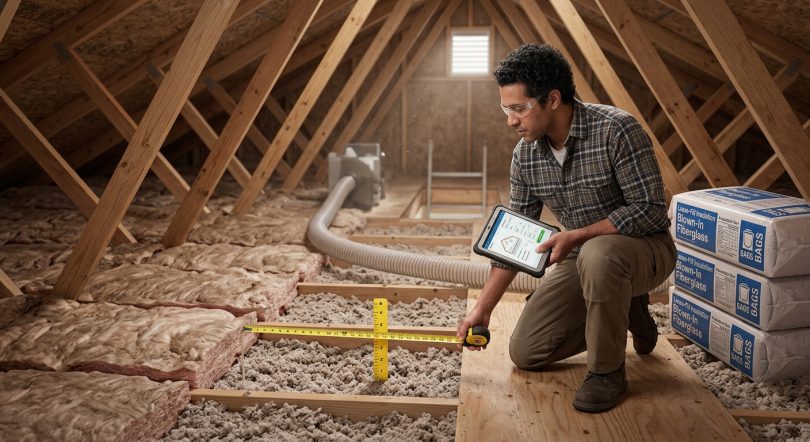
- Measure the length and width of the attic floor or wall cavity area you plan to insulate, in feet.
- Measure your current insulation depth in inches, or enter 0 if there is none.
- Choose your target R-value based on your climate zone or building code requirement.
- Select the insulation material type: fiberglass, cellulose, or rock wool.
- Enter the bag yield from your product’s coverage chart and adjust the waste factor if needed.
- Review the calculated depth, volume, and number of bags before purchasing materials.
Understanding Each Input Field
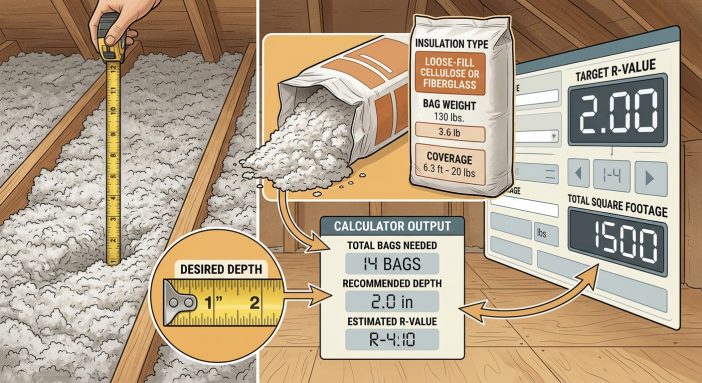
Area Length and Area Width (ft): The floor dimensions of the attic or the surface dimensions of the wall section you are insulating. Multiply together to get total square footage.
Current Insulation Depth (in): The depth of insulation already in place, measured with a ruler at several spots and averaged. Enter 0 if the space has no existing insulation.
Target R-Value (R): The R-value you want to achieve, often set by local building code or recommended for your climate zone.
Insulation Material Type: Choose fiberglass loose-fill, cellulose, or rock wool. Each option carries its own typical R-value per inch, which changes how deep the material must be installed.
Bag Yield (cu ft per bag): The coverage volume printed on the insulation bag’s coverage chart. This figure varies by brand, bag weight, and installed density, so check your specific product label.
Waste Factor (%): An allowance for settling, uneven blowing, and material loss during installation. Higher percentages account for more irregular framing or less experienced installers.
The Math Behind Depth, Volume, and Bag Count
The calculator uses five formulas, applied in sequence.
Total Coverage Area = length times width, in square feet.
Required Total Depth = target R-value divided by the material’s R-value per inch. This gives the total insulation depth, in inches, needed to reach the target R-value.
Additional Depth Needed = Required Total Depth minus Current Insulation Depth, with a minimum of zero. If existing insulation already meets or exceeds the target, no additional depth is needed.
Insulation Volume Needed = Total Coverage Area multiplied by (Additional Depth Needed divided by 12, to convert inches to feet), multiplied by (1 plus the waste factor as a decimal). This gives cubic feet of loose-fill material required.
Bags Needed = Insulation Volume Needed divided by Bag Yield, rounded up to the next whole bag, since you cannot purchase a partial bag.
These formulas assume even coverage across the full area with no obstructions such as ductwork, framing, or storage platforms subtracted from the square footage.
Four Real Attic and Wall Insulation Scenarios
Example 1: Standard attic top-up with cellulose. Given: length 20 ft, width 15 ft, current depth 2 in, target R-38, cellulose (R-3.5/in), bag yield 30 cu ft, waste 10%. Area = 20 x 15 = 300 sq ft. Required depth = 38 / 3.5 = 10.86 in. Additional depth = 10.86 – 2 = 8.86 in. Volume = 300 x (8.86 / 12) x 1.10 = 243.57 cu ft. Bags = ceil(243.57 / 30) = 9 bags.
Example 2: Large attic with fiberglass, higher R-value. Given: length 30 ft, width 40 ft, current depth 6 in, target R-49, fiberglass (R-2.5/in), bag yield 25 cu ft, waste 15%. Area = 1,200 sq ft. Required depth = 49 / 2.5 = 19.6 in. Additional depth = 19.6 – 6 = 13.6 in. Volume = 1,200 x (13.6 / 12) x 1.15 = 1,564.00 cu ft. Bags = ceil(1,564.00 / 25) = 63 bags.
Example 3: Small new attic with rock wool, no existing insulation. Given: length 10 ft, width 10 ft, current depth 0 in, target R-30, rock wool (R-3.0/in), bag yield 20 cu ft, waste 0%. Area = 100 sq ft. Required depth = 30 / 3 = 10 in. Additional depth = 10 – 0 = 10 in. Volume = 100 x (10 / 12) x 1.00 = 83.33 cu ft. Bags = ceil(83.33 / 20) = 5 bags.
Example 4: Existing insulation already exceeds target. Given: length 25 ft, width 20 ft, current depth 15 in, target R-30, rock wool (R-3.0/in), bag yield 20 cu ft, waste 10%. Required depth = 30 / 3 = 10 in. Since current depth (15 in) exceeds required depth (10 in), additional depth = 0 in, volume = 0 cu ft, and bags needed = 0.
R-Value Per Inch by Insulation Material
| Material | Typical R-Value per Inch | Common Use | Notes |
|---|---|---|---|
| Fiberglass loose-fill | R-2.5 | Attics, retrofits over existing insulation | Lighter weight, may settle less than cellulose |
| Cellulose | R-3.5 | Attics and enclosed wall cavities | Recycled paper fiber, denser fill, good draft resistance |
| Rock wool (mineral wool) | R-3.0 | Attics, fire-rated assemblies | Naturally fire resistant, heavier than fiberglass |
These figures are typical industry averages. Always confirm the exact R-value per inch and bag yield printed on your specific product’s coverage chart, since values vary by manufacturer and installed density.
Reading Your Depth, Volume, and Bag Results
Total Coverage Area shows the square footage of the space, calculated from your length and width entries.
Required Total Depth is the full insulation depth needed to reach your target R-value with the chosen material, regardless of what is already installed.
Additional Depth Needed is the extra depth you must add on top of existing insulation. This will read zero if your current insulation already meets or exceeds the target.
Insulation Volume Needed is the total cubic footage of loose-fill material to purchase, already including your chosen waste factor.
Bags Needed is the volume divided by bag yield, rounded up to a whole number, since partial bags cannot be purchased. Always round up when buying, even if the calculator’s figure is already rounded.
What Changes Your Insulation Estimate
Material type: Directly changes required depth through the R-value-per-inch figure. The calculator accounts for this through the material selection.
Bag yield variation: Coverage per bag differs by brand and installed density. The calculator uses whatever value you enter, so accuracy depends on matching it to your actual product label.
Settling over time: Loose-fill insulation compacts after installation, which can reduce effective depth and R-value. The calculator does not model long-term settling; it calculates initial installed depth only.
Obstructions and irregular framing: Ductwork, rafters, and storage areas reduce usable coverage area but are not automatically subtracted. Adjust your length and width inputs to reflect only the insulated area.
Waste factor: Higher waste allowances increase volume and bag counts to cover blowing inefficiency. The calculator lets you set this manually.
Common Errors When Estimating Blown-In Insulation
- Using the wrong bag yield: Bag yield varies by manufacturer and density setting; always use the figure from your specific product’s coverage chart, not a generic estimate.
- Forgetting to measure current depth accurately: Take several measurements across the area since insulation depth is rarely uniform, and average them.
- Ignoring settled R-value: Freshly blown insulation is deeper than it will be after several months of settling; check your product’s settled R-value rating if you need a long-term guarantee.
- Skipping the waste factor: Setting waste to 0% almost always underestimates material needs due to normal installation loss.
- Not subtracting obstructed areas: Large storage platforms or mechanical equipment reduce usable coverage; adjust your area inputs accordingly.
- Mixing incompatible materials: Blowing a different insulation type over old material can affect performance; confirm compatibility before starting.
- Rounding down bag counts: Always buy the rounded-up bag total shown, since running short mid-job wastes time and money.
What This Calculator Does Not Account For
This calculator provides a planning estimate, not an exact material order. R-value-per-inch figures are typical averages and can vary by specific product, batch, and installed density. Bag yield must come from your product’s actual coverage chart for accurate results.
The tool assumes even insulation distribution with no obstructions subtracted from the entered area, and it does not account for long-term settling, moisture damage to existing insulation, or local building code minimums, which vary by region and climate zone.
For structural, fire-safety, or code-compliance questions, consult a qualified insulation contractor or building inspector before starting a project.
Attic Floors Versus Enclosed Wall Cavities
Attic floors are open and easy to measure directly, making blown-in depth simple to verify with a ruler. Enclosed wall cavities are installed through small holes and cannot be checked visually, so contractors rely on calculated volume and known cavity dimensions to confirm proper fill. Use the same length, width, and depth logic for both, but expect wall installations to require more careful volume calculation since depth cannot be inspected after the fact.
Why Installed Depth Differs From Settled Depth
Blown-in insulation is installed slightly deeper than its long-term settled depth because loose fibers compact over weeks and months. Manufacturers often publish both an initial installed R-value and a settled R-value on the coverage chart. This calculator estimates initial installed depth and volume based on the R-value per inch you select; if your product specifies a settled R-value, you may need to increase your target R-value input slightly to compensate for expected compaction.
Setting a Realistic Waste Factor
A 5 to 10 percent waste factor generally suits open, unobstructed attics with straightforward access. Increase the waste factor toward 15 to 20 percent for cut-up spaces with many obstructions, steep roof pitches, or wall cavity blowing, where more material is lost to overspray, compaction around obstacles, or hard-to-reach corners. Contractors bidding larger jobs often build in a higher waste factor to avoid running short mid-installation.
Blown-In Insulation Calculator: Common Questions
How many bags of blown-in insulation do I need for my attic?
The number of bags depends on your attic's square footage, how much additional depth you need to reach your target R-value, and your product's bag yield. Enter these values into the calculator, and it will divide the total insulation volume by the bag yield and round up to a whole bag count.
How is R-value per inch different between fiberglass, cellulose, and rock wool?
Cellulose typically offers about R-3.5 per inch, rock wool about R-3.0 per inch, and fiberglass loose-fill about R-2.5 per inch. Because cellulose insulates more per inch, it generally requires less depth than fiberglass to reach the same target R-value.
How much does blown-in insulation settle over time?
Loose-fill insulation compacts naturally after installation, and the amount varies by material and product. Manufacturers often list a separate settled R-value on the coverage chart. This calculator estimates initial installed depth, so check your product's settled rating if long-term performance is a concern.
Can you blow new insulation over old existing insulation?
In most cases, yes, as long as the existing insulation is dry, uncompressed, and compatible with the new material. This calculator assumes existing insulation is in good condition when it calculates additional depth needed. If old insulation is damp, moldy, or compressed, address that before adding more.
How do you convert a desired R-value into insulation depth?
Divide your target R-value by the material's R-value per inch to get the total required depth in inches. For example, an R-38 target with cellulose at R-3.5 per inch requires about 10.86 inches of total depth, which this calculator computes automatically.
What waste factor should I use for blown-in insulation projects?
A common range is 5 to 15 percent for straightforward attic jobs, and up to 20 percent or more for cut-up spaces, wall cavities, or steep rooflines with many obstructions. Choose a higher factor if your space has irregular framing or limited access.
Does this calculator tell me the cost of blown-in insulation?
No, this tool calculates depth, volume, and bag count only. Material and labor costs vary by region, material type, and contractor rates, so you would need to multiply the bag count by your local price per bag or get a contractor quote for total project cost.
Why does my calculated additional depth show zero?
A zero result means your current insulation depth already meets or exceeds the depth required to reach your target R-value with the selected material, so no additional insulation is needed based on the inputs provided.
Planning Your Next Insulation Project
Reaching a target R-value comes down to knowing your area, current depth, material choice, and product coverage data. This calculator turns those inputs into a clear estimate of additional depth, total volume, and bags needed, helping you plan a purchase or bid with more confidence. Always confirm exact bag yield and settled R-value against your specific product label before finalizing an order.
