
This calculator estimates the clamp force (preload) a bolt achieves from a given tightening torque, along with the resulting bolt stress and percent of proof load used. Enter the bolt diameter, thread pitch, applied torque, nut factor, and bolt grade. The tool uses the standard torque-tension relationship, T equals K times D times F, to back-calculate preload, then compares that load against the bolt’s proof strength as an estimated safety check.
Bolt Preload Calculator: Torque-to-Clamp Force Estimator
Estimate bolt preload, clamp force, resulting stress, and percent of proof load from applied torque, bolt size, and nut factor.
What This Bolt Preload Tool Calculates
This calculator estimates the clamp force, or preload, a bolt develops when tightened to a chosen torque. It is meant for mechanical engineers, machine designers, maintenance technicians, and experienced DIY mechanics who need a quick planning check for a bolted joint. Use it to see whether a torque value will likely produce adequate clamping force, to compare bolt grades, or to audit an assembly procedure. Results are estimates based on the standard torque-tension relationship, not exact measured values, since actual friction conditions vary between individual fasteners and installations.
Steps to Estimate Your Bolt's Clamp Force
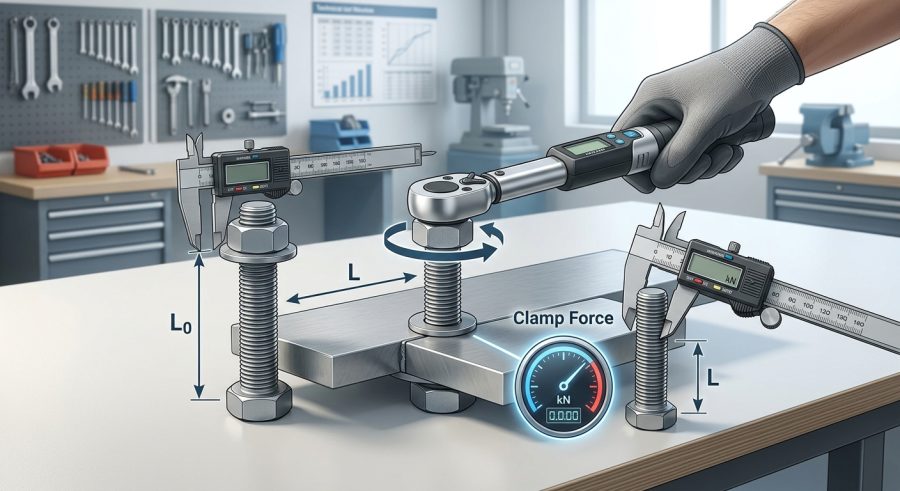
- Measure or confirm the bolt’s nominal diameter and thread pitch in millimeters, converting from inch sizes if needed.
- Enter the torque you plan to apply, or already applied, in newton-meters.
- Enter a nut factor that matches the fastener’s plating, lubrication, or dry condition.
- Select the bolt grade matching the head markings to set the correct proof strength.
- Review the achieved preload, resulting stress, proof load capacity, and percent of proof load used.
Entering Bolt Size, Torque, and Material Grade
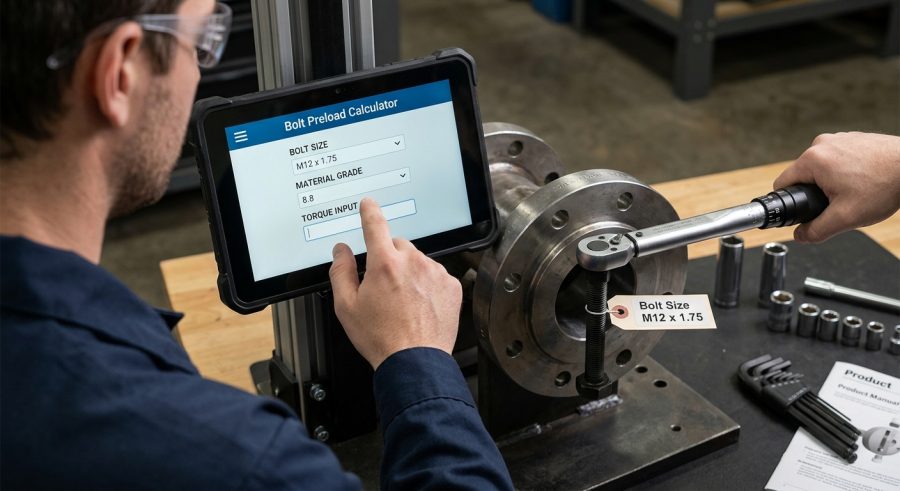
Nominal Bolt Diameter (mm): The major thread diameter, such as 12 for an M12 bolt. This value drives both the stress area and preload formulas.
Thread Pitch (mm): The distance between adjacent threads. A coarse M12 bolt typically uses 1.75 mm; fine-thread versions use a smaller value. Check the bolt spec or a thread chart if unsure.
Applied Tightening Torque (Nm): The torque actually applied, or planned, using a torque wrench. This is the main driver of the calculated preload.
Nut Factor (K): A dimensionless friction coefficient representing conditions under the bolt head and in the threads. It commonly ranges from about 0.10 for lubricated fasteners to 0.30 for dry, plated ones. See the reference table for starting values.
Bolt Grade (Proof Strength): Pick the option matching the markings on the bolt head, such as a 10.9 stamp or three radial lines for SAE Grade 5. This sets the proof strength used to judge the safety margin.
The Torque-to-Preload Equations Used
The calculator uses the widely applied short-form torque-tension equation, T = K x D x F, rearranged to solve for clamp force: F = (T x 1000) / (K x D), where torque is converted from newton-meters to newton-millimeters so units stay consistent with diameter in millimeters and force in newtons.
The tensile stress area approximates the effective cross-section resisting axial load, using As = 0.7854 x (D – 0.9382 x P)^2, a standard formula for ISO metric threads. Resulting bolt stress divides the achieved preload by this stress area. Proof load capacity multiplies the stress area by the selected proof strength, and percent of proof load used compares achieved preload to that capacity.
Four Sample Torque-to-Preload Calculations
Example 1 – M12 bolt, general assembly: Diameter 12 mm, pitch 1.75 mm, torque 50 Nm, nut factor 0.20, Grade 10.9 (830 MPa). Stress area works out to about 84.27 mm^2. Preload is 50000 / (0.20 x 12) = 20833.3 N. Resulting stress is roughly 247.2 MPa, proof load capacity is about 69941.1 N, and percent of proof load used is about 29.8%.
Example 2 – M8 bolt, automotive bracket: Diameter 8 mm, pitch 1.25 mm, torque 25 Nm, nut factor 0.20, Class 8.8 (660 MPa). Stress area is about 36.61 mm^2. Preload equals 25000 / 1.6 = 15625 N. Stress is around 426.8 MPa, proof load capacity is about 24162.6 N, and percent of proof used is about 64.7%.
Example 3 – M16 bolt, lubricated flange joint: Diameter 16 mm, pitch 2.0 mm, torque 150 Nm, nut factor 0.15, Class 10.9 (830 MPa). Stress area is about 156.67 mm^2. Preload is 150000 / 2.4 = 62500 N, stress is about 398.9 MPa, proof load capacity is about 130036.1 N, and percent used is about 48.1%.
Example 4 – M10 bolt, dry uncoated fastener: Diameter 10 mm, pitch 1.5 mm, torque 40 Nm, nut factor 0.30, SAE Grade 5 (580 MPa). Stress area is about 58.00 mm^2. Preload is 40000 / 3 = 13333.3 N, stress is about 229.9 MPa, proof load capacity is about 33640 N, and percent used is about 39.6%.
Typical Nut Factor Values by Fastener Condition
| Fastener Condition | Typical Nut Factor (K) |
|---|---|
| Waxed or lubricated, plated threads | 0.10 – 0.14 |
| Machine oil lubricated | 0.15 – 0.17 |
| Zinc-plated, mildly lubricated | 0.17 – 0.20 |
| As-received, black oxide, dry | 0.20 – 0.25 |
| Dry, uncoated, galled-prone threads | 0.25 – 0.30 |
| Anti-seize compound applied | 0.10 – 0.15 |
Reading Your Clamp Force and Proof Load Results
Tensile Stress Area: The effective cross-section of the threaded bolt used for stress calculations, smaller than the full nominal diameter area.
Achieved Preload Force: The estimated clamp force generated in the joint by the applied torque.
Resulting Bolt Stress: Preload divided by stress area, showing how hard the bolt shank is being stretched.
Proof Load Capacity: The maximum load the bolt can theoretically sustain elastically before yielding, based on its grade.
Percent of Proof Load Used: A quick safety check; most structural joints target roughly 65-90% of proof load for reusable, non-permanent connections, while lower percentages leave more margin but may under-clamp the joint.
Variables That Change the Achieved Preload
Several variables shift the actual preload achieved beyond what any single torque figure suggests. Surface finish and lubrication change friction dramatically, which is why the nut factor has such a wide practical range. Thread condition, including corrosion, galling, or damaged threads, can raise effective friction unpredictably. Washer material and hardness under the bolt head also affect friction at that interface. Tightening method matters too: click-type wrenches, angle-based tightening, and impact tools each introduce different accuracy and repeatability.
Common Torque Wrenching Errors to Avoid
A frequent error is reusing a generic nut factor of 0.20 for every fastener regardless of coating or lubrication, which can misstate preload by 30% or more. Another mistake is confusing nominal diameter with pitch diameter or stress area when checking stress limits. Users sometimes apply the torque value from one bolt grade to a different grade bolt without checking proof strength, risking overload or under-clamping. Skipping thread pitch entry, or entering coarse pitch for a fine-thread bolt, also introduces meaningful stress area error.
What This Estimate Does Not Account For
This tool provides an engineering estimate, not a certified design value. It assumes clean, undamaged ISO metric threads and does not model bolt bending, non-axial loading, gasket creep, joint stiffness, or dynamic loosening from vibration. Actual nut factors vary between individual bolts even with identical coatings, so measured results can differ from this estimate by a wide margin. For safety-critical or highly loaded joints, follow the manufacturer’s torque specification or a qualified engineer’s calculation rather than relying solely on this calculator.
Bolt Preload Questions Answered
What is bolt preload and why does it matter?
Preload is the clamping force generated inside a bolted joint when the fastener is tightened. Adequate preload keeps joint members compressed together, resists loosening from vibration, and prevents fatigue failure from cyclic loading.
Why does the same torque produce different preload on different bolts?
Friction under the head and in the threads varies with lubrication, coating, and surface condition. This friction is captured by the nut factor, so the same torque value produces different preload when the nut factor changes.
Is a higher percent of proof load always better?
Not necessarily. Many joints are designed to reach roughly 65-90% of proof load for good clamping without risking yield during installation. Exceeding proof load can permanently stretch the bolt and reduce its clamping ability.
How accurate is the torque-tension formula used here?
The short-form formula is a widely used approximation with typical accuracy of plus or minus 25-35% due to friction variability, even when a reasonable nut factor is chosen. It is suitable for planning, not for final certification.
Can I use this calculator for inch-based bolts?
Yes, but convert diameter and pitch to millimeters first, or convert threads-per-inch to an equivalent pitch in millimeters (25.4 divided by threads per inch), and convert torque from foot-pounds or inch-pounds to newton-meters.
What nut factor should I use if the fastener specification is unknown?
A commonly cited default for as-received, non-lubricated steel fasteners is around 0.20, but this is only a rough starting point; refer to the reference table for more specific conditions.
Does this calculator account for reused or damaged bolts?
No. It assumes clean, undamaged threads. Reused, corroded, or galled bolts behave less predictably and may achieve less clamp force than the same torque on a fresh fastener.
How does thread pitch affect the stress area result?
Finer pitch (smaller pitch value) slightly increases the tensile stress area compared to a coarse thread of the same diameter, which lowers resulting stress for the same preload.
Putting Preload Estimates Into Practice
Use this calculator as a quick planning check to estimate clamp force, stress, and proof load margin from a torque value. Because friction assumptions drive much of the result, choose the nut factor carefully and treat outputs as engineering estimates. For critical joints, always follow documented torque specifications or verified engineering calculations rather than relying on this tool alone.
