
This bolt torque calculator estimates the tightening torque needed for a bolted joint based on your bolt’s diameter, thread pitch, strength grade, friction condition, and target preload percentage. It calculates the thread tensile stress area, the resulting clamp force, and the recommended torque in both newton-meters and foot-pounds, helping you achieve a properly preloaded connection without overstressing the fastener.
Bolt Torque Calculator – Find Torque, Preload & Clamp Force
Calculate the correct bolt tightening torque, clamp force, and preload from bolt diameter, thread pitch, grade, and friction condition.
What This Bolt Torque Tool Calculates
This calculator estimates the tightening torque required to properly preload a threaded fastener. It is built for mechanical engineers, machinists, automotive technicians, and hobbyists who need a quick, standards-based starting point for torque specs when a manufacturer value is not available.
The tool combines the ISO metric thread stress-area formula with the standard torque-tension relationship (T = K x D x F). Results are engineering estimates, not exact values, because actual friction and material behavior vary between individual bolted joints.
Steps to Get an Accurate Torque Estimate
- Enter the nominal bolt diameter in millimeters, measured across the outside of the threads.
- Enter the thread pitch in millimeters, the distance between adjacent thread crests.
- Select the bolt property class that matches the marking on the bolt head.
- Choose your target preload as a percentage of proof strength, typically 65 to 90 percent.
- Select the friction condition that best matches the bolt, nut, and washer surface finish or lubrication.
- Review the tensile stress area, clamp force, and recommended torque shown in both newton-meters and foot-pounds.
Understanding Each Input Field
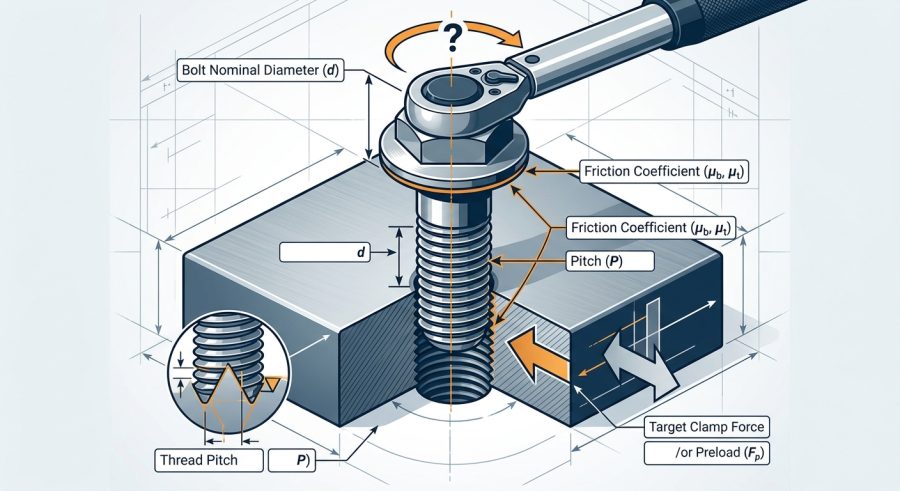
Nominal Bolt Diameter (mm): the outer diameter of the bolt threads, such as 10 for an M10 bolt.
Thread Pitch (mm): the distance between two adjacent thread crests. Coarse threads have a larger pitch than fine threads of the same diameter.
Bolt Property Class: a standardized metric grade marking (4.6, 5.8, 8.8, 10.9, or 12.9) that sets the proof strength used in the calculation, in megapascals.
Target Preload (%): the percentage of proof strength you want the clamp force to reach. Most structural and mechanical joints target 65 to 90 percent.
Friction Condition (Nut Factor K): a dimensionless number representing friction between threads and under the bolt head or nut face. Lubricated joints use a lower K value than dry or plated joints.
The Torque, Stress Area, and Clamp Force Formulas
Tensile Stress Area (As): As = 0.7854 x (D – 0.9382 x P)^2, where D is the nominal diameter in millimeters and P is the thread pitch in millimeters. This is the standard ISO approximation for the load-bearing cross-section of a threaded fastener.
Clamp Force (F): F = As x Sp x (Preload% / 100), where Sp is the proof strength in megapascals. This gives the axial force, in newtons, generated in the bolt shank at the chosen preload level.
Recommended Torque (T): T = K x D x F, then divided by 1000 to convert the diameter from millimeters and force from newtons into a torque value in newton-meters. K is the nut factor, D is the nominal diameter in millimeters, and F is the clamp force in newtons.
Imperial Torque: the newton-meter result is multiplied by 0.737562 to convert to foot-pounds.
These formulas assume standard ISO metric threads, static tightening, and a clean, undamaged joint with no gasket or washer stack-up effects.
Sample Calculations for Common Bolt Sizes
Example 1: M10 x 1.5, Class 8.8, 75% preload, zinc-plated (K=0.20)
Formula: As = 0.7854 x (10 – 0.9382 x 1.5)^2
Substitution: 0.7854 x (8.5927)^2 = 0.7854 x 73.83
Calculation: As = 57.99 mm2; Clamp Force = 57.99 x 660 x 0.75 = 28,705 N; Torque = 0.20 x 10 x 28,705 / 1000
Final result: 57.41 Nm (42.35 ft-lb)
Example 2: M12 x 1.75, Class 8.8, 75% preload, zinc-plated (K=0.20)
Formula: As = 0.7854 x (12 – 0.9382 x 1.75)^2
Substitution: 0.7854 x (10.358)^2 = 0.7854 x 107.29
Calculation: As = 84.27 mm2; Clamp Force = 84.27 x 660 x 0.75 = 41,712 N; Torque = 0.20 x 12 x 41,712 / 1000
Final result: 100.11 Nm (73.85 ft-lb)
Example 3: M8 x 1.25, Class 10.9, 70% preload, PTFE lubricant (K=0.12)
Formula: As = 0.7854 x (8 – 0.9382 x 1.25)^2
Substitution: 0.7854 x (6.827)^2 = 0.7854 x 46.61
Calculation: As = 36.61 mm2; Clamp Force = 36.61 x 940 x 0.70 = 24,088 N; Torque = 0.12 x 8 x 24,088 / 1000
Final result: 23.12 Nm (17.05 ft-lb)
Example 4: M16 x 2.0, Class 12.9, 80% preload, stainless dry (K=0.30)
Formula: As = 0.7854 x (16 – 0.9382 x 2)^2
Substitution: 0.7854 x (14.124)^2 = 0.7854 x 199.48
Calculation: As = 156.67 mm2; Clamp Force = 156.67 x 1100 x 0.80 = 137,868 N; Torque = 0.30 x 16 x 137,868 / 1000
Final result: 661.77 Nm (488.16 ft-lb)
Typical Torque Values by Bolt Size (Grade 8.8)
| Bolt Size | Pitch (mm) | Tensile Area (mm2) | Torque (Nm) | Torque (ft-lb) |
|---|---|---|---|---|
| M6 | 1.00 | 20.12 | 11.95 | 8.82 |
| M8 | 1.25 | 36.61 | 28.99 | 21.39 |
| M10 | 1.50 | 57.99 | 57.41 | 42.35 |
| M12 | 1.75 | 84.27 | 100.11 | 73.85 |
| M16 | 2.00 | 156.67 | 248.16 | 183.06 |
Table assumes Class 8.8 bolts, 75% preload of proof strength, and a nut factor of K=0.20 (zinc-plated, dry). Actual specifications may differ; always confirm against a manufacturer torque chart when one is available.
Interpreting the Torque and Clamp Force Results
Tensile Stress Area shows the effective cross-section of the threaded shank, in square millimeters, used to convert stress into force.
Recommended Clamp Force is the axial preload, in newtons, generated in the bolt at your chosen percentage of proof strength.
Recommended Torque is the primary output. It appears in both newton-meters and foot-pounds so you can match whichever unit your torque wrench uses.
All results are rounded for readability: stress area and torque to two decimal places, clamp force to the nearest whole newton. Because K values and proof strengths are typical estimates, treat the torque figure as a planning value rather than a certified specification.
Variables That Change Your Torque Number
Bolt diameter and pitch: directly change the stress area and are fully accounted for in the calculation.
Friction condition (nut factor K): has one of the largest effects on torque for a given clamp force; the calculator lets you select from common surface conditions.
Target preload percentage: higher percentages increase clamp force and torque proportionally; the calculator applies your chosen value directly.
Bolt property class: sets the proof strength ceiling and is fully accounted for through the selected grade.
Not accounted for: washer or gasket compression, joint stiffness, thread damage, tightening speed, temperature, and reused or corroded fasteners. These can shift real-world torque needs beyond this estimate.
Common Torque Calculation Errors
- Confusing diameter with thread size labels: always enter the nominal outer diameter in millimeters, not a fractional or gauge size.
- Using the wrong pitch for coarse vs fine threads: check the actual thread spec, since fine threads have a smaller pitch than coarse threads of the same diameter.
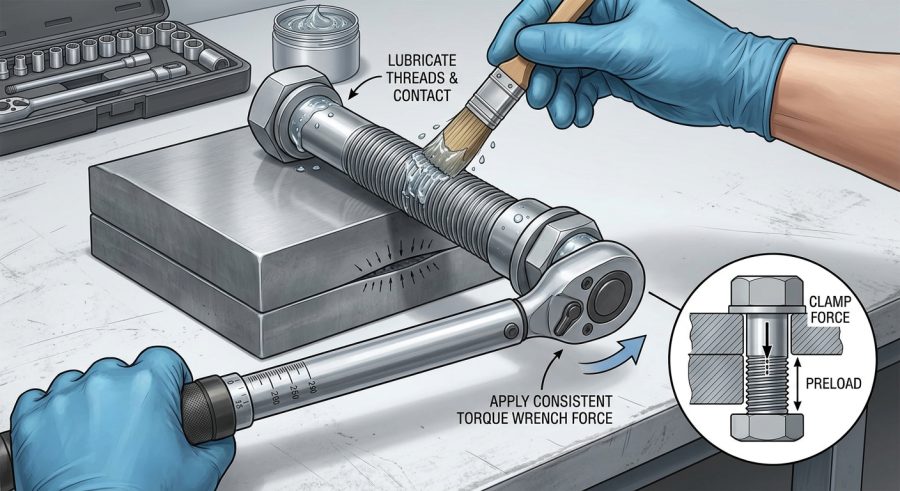
- Ignoring lubrication: applying anti-seize but selecting a dry friction condition will overstate the torque needed.
- Assuming higher torque always means a stronger joint: over-torquing can yield or snap a bolt instead of increasing clamp force.
- Skipping torque wrench calibration: an uncalibrated wrench can apply the wrong torque even with correct calculator inputs.
- Reusing torque-to-yield bolts: these fasteners are designed for one-time use and this calculator does not account for yield-based reuse limits.
- Mixing unit systems: entering an imperial diameter into a metric field will produce an incorrect stress area.
Assumptions and Limits of This Estimate
This calculator provides a general engineering estimate based on the ISO metric thread stress-area formula and the standard torque-tension equation. Proof strength values are typical figures for common property classes and may vary slightly by manufacturer or standard. Nut factor values are industry-typical approximations; actual friction can vary by 25 percent or more depending on surface finish, lubrication, and tightening speed.
The tool does not account for gasket compression, washer stack-up, joint stiffness, temperature extremes, thread damage, or repeated reuse of fasteners. It assumes static, non-impact tightening of a single bolted joint under axial load. For critical, safety-related, or structural applications, always confirm torque specifications with the manufacturer’s service documentation or consult a qualified engineer before assembly.
Choosing the Right Nut Factor for Your Joint
The nut factor K represents combined friction under the bolt head and within the threads. Dry, non-plated steel typically falls near K=0.20, while zinc plating behaves similarly. Cadmium plating and light oiling reduce friction slightly, and PTFE or anti-seize compounds can drop K to around 0.12, meaning far less torque is needed to reach the same clamp force. Stainless steel bolts run dry often need more torque, since their K value can reach 0.30 or higher due to galling tendencies. Choosing the wrong condition is one of the biggest sources of torque error, so match your selection to the bolt’s actual finish and lubrication state whenever possible.
Reading Metric Bolt Grade Markings
Metric bolt heads are usually stamped with two numbers separated by a dot, such as 8.8 or 10.9. The first number, multiplied by 100, roughly indicates the minimum tensile strength in megapascals. The second number, divided by 10, gives the ratio of yield to tensile strength. Multiplying these figures together gives an approximate yield strength, while the proof strength used in this calculator is a related but slightly lower value defined by fastener standards. Always verify the marking on the actual bolt head before selecting a property class, since mismatched grades are a common assembly error.
When Torque Alone Isn't the Best Method
Torque-based tightening estimates clamp force indirectly through friction, so it carries built-in uncertainty even with accurate inputs. For critical joints, some manufacturers specify torque-plus-angle or torque-to-yield methods, which track bolt elongation more precisely than torque alone. This calculator supports standard torque-based planning but does not model angle-based or yield-tracking procedures. If your application specifies one of these advanced methods, follow the manufacturer’s exact procedure instead of relying solely on a torque value.
Bolt Torque Questions Answered
What is the nut factor (K) and how does it affect torque?
The nut factor K represents the friction between the fastener threads and the bearing surface under the head or nut. A lower K value, such as with lubricant, means less torque is needed to reach the same clamp force. A higher K value, common with dry or stainless steel bolts, requires more torque for the same preload.
How is bolt torque related to clamp force or preload?
Torque is the input you apply with a wrench, while clamp force (preload) is the actual tension created inside the bolt. They are connected through the formula T = K x D x F, so the same torque can produce different clamp forces depending on friction and bolt diameter.
Why do lubricated bolts need less torque than dry bolts?
Lubrication reduces friction between the threads and under the bolt head, so more of the applied torque converts into actual stretching (clamp force) rather than being lost to friction. This is why lubricated joints use a lower nut factor and reach the same preload with less torque.
How do I convert bolt torque between Nm and ft-lb?
Multiply a newton-meter value by 0.737562 to get foot-pounds, or divide a foot-pound value by 0.737562 to get newton-meters. This calculator shows both units automatically so no manual conversion is needed.
What happens if a bolt is over-torqued or under-torqued?
Over-torquing can stretch a bolt past its yield point, causing permanent deformation or fracture, while under-torquing leaves insufficient clamp force, risking joint loosening, fatigue failure, or leaks in sealed connections. Both conditions compromise the safety and reliability of the assembly.
How do I choose the correct bolt property class or grade?
Check the numbers stamped on the bolt head, such as 8.8 or 10.9, and match them to the corresponding option in the calculator. If no marking is visible or the bolt came from an unknown source, do not assume a grade; consult the fastener supplier or a reference standard first.
Why should I calibrate my torque wrench regularly?
A torque wrench can drift out of calibration with use, leading to actual applied torque that differs from the wrench's displayed value. Regular calibration, typically annually or per the manufacturer's schedule, keeps your real-world torque application aligned with calculated targets.
Does thread pitch really change the required torque?
Yes. Thread pitch affects the tensile stress area, which changes both the clamp force at a given preload percentage and the resulting torque. Fine-pitch threads generally have a slightly larger stress area than coarse threads of the same diameter, which can modestly increase the calculated torque.
Putting the Numbers to Work Safely
Correct bolt torque depends on diameter, pitch, grade, friction, and target preload working together, not on any single number alone. This calculator combines those variables using standard thread and torque-tension formulas to give a practical starting estimate. For critical, safety-related, or high-load joints, confirm the final torque against manufacturer specifications or have the application reviewed by a qualified engineer.
