
This calculator estimates how much decomposed granite you need for a landscaping project based on your area’s length, width, and depth. Enter those dimensions along with a waste allowance, material density, and price per ton, and it returns volume in cubic yards and cubic meters, weight in tons and tonnes, and an estimated material cost, all based on standard density approximations and unit conversions.
Decomposed Granite Calculator: Volume, Weight & Cost
Estimate decomposed granite volume in cubic yards and cubic meters, weight in tons and tonnes, and total material cost for pathways, patios, and driveway base layers.
What This Decomposed Granite Estimator Calculates
This tool calculates the volume, weight, and estimated cost of decomposed granite needed to cover a rectangular area at a chosen depth. It is built for homeowners planning a garden path, landscapers estimating patio base material, and contractors pricing driveway sub-base layers.
Results are estimates, not exact delivery figures. Actual decomposed granite density varies by quarry source, moisture content, and how tightly it is compacted, so the calculator uses a selectable density range to reflect that variation. Use it for planning and budgeting, and confirm final order quantities with your material supplier.
Steps to Estimate Your Decomposed Granite Needs
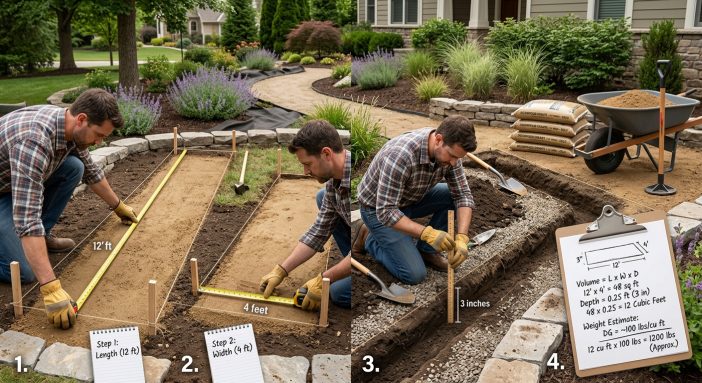
- Measure the length and width of the area in feet and enter both values.
- Enter the planned depth of decomposed granite in inches, based on whether you are building a walkway, patio, or driveway base.
- Adjust the waste and compaction allowance if your site has uneven grading or you expect extra material loss.
- Select a material density that matches whether your granite will be loose, standard, or compacted.
- Enter your local price per ton to see an estimated material cost.
- Review the volume, weight, and cost results before placing your order.
Understanding Each Project Input
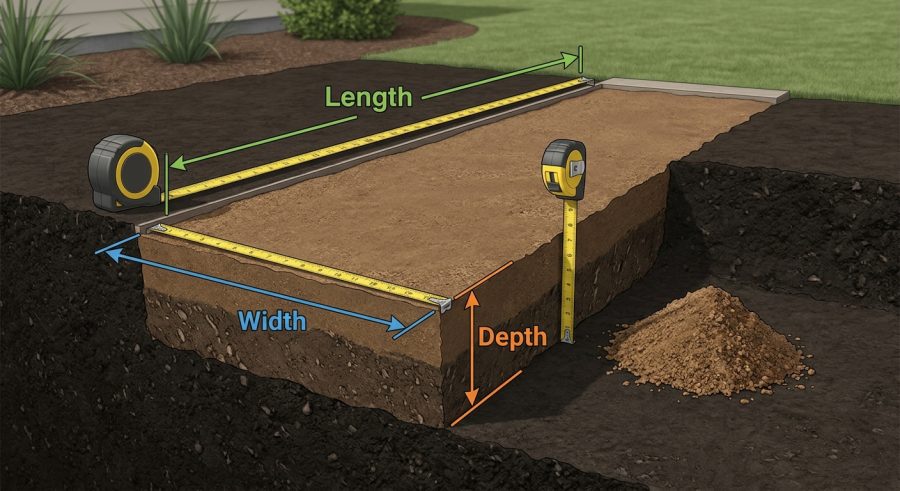
Length and Width (ft): The two horizontal measurements of the area you plan to cover. Multiplying them gives the project area in square feet.
Depth (in): How thick the layer of decomposed granite will be once placed. This is entered in inches because most suppliers and installation guides specify depth that way, even though the rest of the calculation uses feet.
Waste and Compaction Allowance (%): An extra percentage added to your raw volume to cover material lost during spreading, grading irregularities, and settling after compaction. Ten percent is a common starting point.
Material Density (lb per cubic ft): Choose loose, standard, or compacted decomposed granite. Denser material weighs more per cubic foot, which increases the estimated weight and cost for the same volume.
Price per Ton (USD): The delivered price your supplier charges per ton. This is multiplied by the estimated tonnage to project total material cost.
How Volume, Weight, and Cost Are Calculated
All calculations start by converting depth from inches to feet, since length and width are already in feet.
Project Area = length × width, in square feet.
Volume Needed (cubic yards) = (length × width × (depth / 12) / 27) × (1 + waste_factor / 100). Dividing by 27 converts cubic feet to cubic yards, and the waste factor is applied as a percentage multiplier.
Volume Needed (Metric) = Volume Needed in cubic yards × 0.764554857, which is the standard conversion from cubic yards to cubic meters.
Estimated Weight (tons) = ((length × width × (depth / 12)) × (1 + waste_factor / 100) × density) / 2000. This takes the cubic-foot volume with waste included, multiplies by density in pounds per cubic foot, then divides by 2000 to convert pounds to US tons.
Estimated Weight (Metric) = Estimated Weight in tons × 0.907184, the standard conversion from US tons to metric tonnes.
Estimated Material Cost = Estimated Weight in tons × price_per_ton.
These formulas assume uniform depth across the entire area and a single, consistent material density. They do not account for slopes, curves, or layered base systems that use different materials at different depths.
Sample Decomposed Granite Projects Calculated
Example 1: Garden Walkway. Given length 20 ft, width 3 ft, depth 2 in, waste 10 percent, density 100 lb per cubic ft, price $45 per ton.
Area = 20 × 3 = 60 sq ft. Volume = (60 × (2/12) / 27) × 1.10 = 0.41 cubic yards, or about 0.31 cubic meters. Weight = ((60 × (2/12)) × 1.10 × 100) / 2000 = 0.55 tons, or about 0.50 tonnes. Cost = 0.55 × 45 = $24.75.
Example 2: Backyard Patio Base. Given length 15 ft, width 12 ft, depth 3 in, waste 15 percent, density 110 lb per cubic ft, price $50 per ton.
Area = 180 sq ft. Volume = (180 × 0.25 / 27) × 1.15 = 1.92 cubic yards, or about 1.47 cubic meters. Weight = (45 × 1.15 × 110) / 2000 = 2.85 tons, or about 2.58 tonnes. Cost = 2.85 × 50 = $142.31.
Example 3: Driveway Base Layer. Given length 50 ft, width 12 ft, depth 4 in, waste 10 percent, density 90 lb per cubic ft, price $40 per ton.
Area = 600 sq ft. Volume = (600 × 0.3333 / 27) × 1.10 = 8.15 cubic yards, or about 6.23 cubic meters. Weight = (200 × 1.10 × 90) / 2000 = 9.9 tons, or about 8.98 tonnes. Cost = 9.9 × 40 = $396.00.
Example 4: Small Side Path. Given length 8 ft, width 2 ft, depth 1.5 in, waste 5 percent, density 100 lb per cubic ft, price $55 per ton.
Area = 16 sq ft. Volume = (16 × 0.125 / 27) × 1.05 = 0.08 cubic yards, or about 0.06 cubic meters. Weight = (2 × 1.05 × 100) / 2000 = 0.105 tons, or about 0.10 tonnes. Cost = 0.105 × 55 = $5.78.
Typical Depth Guidelines by Project Type
| Project Type | Typical Depth | Notes |
|---|---|---|
| Garden path or stepping stone base | 1 to 2 inches | Light foot traffic, decorative use |
| Walkway or patio surface | 2 to 3 inches | Regular foot traffic, may need edging |
| Patio or courtyard base layer | 3 to 4 inches | Supports pavers or furniture loads |
| Driveway sub-base | 4 to 6 inches | Needs proper compaction for vehicle loads |
These depths are general planning guidelines. Local soil conditions, drainage needs, and expected traffic can require different depths, so confirm specifications with a qualified contractor for structural applications like driveways.
Reading Your Volume, Weight, and Cost Results
Project Area shows the flat square footage of your site, useful for comparing supplier pricing that is sometimes quoted per square foot.
Volume Needed and its metric equivalent tell you how much decomposed granite to order by volume, already including your waste allowance. Most suppliers sell by weight, not volume, so the weight results are often more directly useful for ordering.
Estimated Weight and its metric equivalent convert that volume into tons and tonnes using your selected density. This is the number most bulk suppliers will ask for.
Estimated Material Cost multiplies the estimated tonnage by your entered price per ton. It reflects material cost only and does not include delivery, labor, base preparation, or edging materials. All results are estimates and should be confirmed against a supplier quote before ordering.
What Changes Your Decomposed Granite Estimate
Depth accuracy: Small depth errors have a large effect on volume and weight since depth is part of every formula. The calculator accounts for whatever depth you enter, but it cannot correct an inaccurate measurement.
Material density: Loose, standard, and compacted decomposed granite differ by roughly 20 percent in weight per cubic foot. The calculator accounts for this through the density selector, but actual quarry material can still vary.
Waste and compaction allowance: Uneven ground, tight curves, and material settling after installation all increase the amount needed. The calculator accounts for this through the adjustable waste percentage, but the right value depends on your specific site.
Area shape: The calculator assumes a simple rectangle. Irregular or curved areas need to be broken into smaller rectangular sections and calculated separately, which this tool does not do automatically.
Local pricing: Price per ton varies significantly by region and supplier. The calculator only uses the price you enter and does not include or estimate regional averages.
Common Errors When Estimating Decomposed Granite
- Entering depth in feet instead of inches: The depth field expects inches; entering feet will produce a wildly oversized volume.
- Skipping the waste allowance: Setting waste to zero often leads to running short on material, since spreading and compaction always cause some loss.
- Using the wrong density setting: Choosing loose density for material that will be heavily compacted underestimates the final weight and cost.
- Treating volume as the order unit: Most suppliers sell decomposed granite by the ton, so use the weight results, not the volume results, when placing an order.
- Ignoring irregular areas: Calculating one rectangle for an L-shaped or curved space will misstate area and volume; split the space into rectangles first.
- Assuming exact delivered weight: Actual truck-scale weights can differ from the estimate due to moisture content and natural density variation in the material.
- Forgetting delivery and labor costs: The cost result covers material only, not delivery fees, spreading labor, or base preparation.
Assumptions and Limits of This Estimate
This calculator provides a planning-level estimate, not a certified measurement. It assumes a uniform rectangular area, a single consistent depth, and one selected density value across the entire project. It does not model soil compaction rates, drainage requirements, or the structural needs of a driveway base.
Decomposed granite pricing and density vary by region, quarry, and supplier, so treat the price and density inputs as adjustable placeholders rather than fixed standards. For driveway bases, retaining walls, or any load-bearing application, consult a qualified contractor or engineer before finalizing depth and material specifications, since incorrect base preparation can affect long-term stability and drainage.
Choosing the Right Depth for Your Project
Depth should match how the surface will be used. Light foot-traffic paths generally need only 1 to 2 inches, while patios and seating areas typically use 2 to 3 inches for stability. Driveway sub-base layers usually call for 4 to 6 inches, often combined with proper base compaction. When in doubt, check with a landscaping supplier familiar with your local soil and drainage conditions.
Loose vs Compacted Density Explained
Decomposed granite is sold and delivered loose, but it compacts once installed and walked or driven on. Loose material near 90 pounds per cubic foot will settle to a denser state after compaction, sometimes reaching 110 pounds per cubic foot or more. Selecting the compacted density option can help estimate the final in-place weight after installation, while the loose option better reflects the material as delivered.
Converting Between US and Metric Volume and Weight
This calculator reports results in both US and metric units. Cubic yards convert to cubic meters by multiplying by 0.764554857, and US tons convert to metric tonnes by multiplying by 0.907184. These are standard mathematical conversion factors, useful if your supplier quotes material in metric units or if you are working from metric project drawings.
Decomposed Granite Calculator Questions Answered
How much decomposed granite do I need per square foot of coverage?
It depends on depth. At a 2 inch depth, one square foot needs about 0.0062 cubic yards of decomposed granite. Multiply your total square footage by that figure, then add a waste allowance, or simply enter your dimensions into the calculator for an automatic result.
What depth of decomposed granite is recommended for walkways versus driveways?
Walkways typically use 2 to 3 inches of depth for stable foot traffic, while driveway base layers often need 4 to 6 inches to support vehicle weight. Exact depth depends on soil conditions and expected use, so confirm driveway specifications with a qualified contractor.
How does compaction affect the amount of decomposed granite required?
Compacted material is denser, so a given volume weighs more once compacted than it did loose. This calculator lets you select loose, standard, or compacted density so the weight and cost results reflect the compaction state you expect after installation.
Why is a waste factor added to decomposed granite volume calculations?
Some material is always lost during spreading, grading, and edge trimming, and additional settling happens after compaction. Adding a waste percentage, commonly around 10 percent, helps avoid ordering too little material and needing a second delivery.
How do I convert decomposed granite volume into weight or tons?
Multiply the volume in cubic feet by the material density in pounds per cubic foot, then divide by 2000 to get US tons. This calculator performs that conversion automatically using your selected density and entered dimensions.
What is the difference between loose and compacted decomposed granite density?
Loose decomposed granite is lighter, around 90 pounds per cubic foot, because it has more air gaps between particles. Compacted material settles tighter, reaching around 110 pounds per cubic foot, which increases weight and cost for the same volume.
How accurate is a decomposed granite calculator compared to actual delivery weight?
It provides a reasonable planning estimate, but actual delivered weight can differ because of moisture content, quarry-specific density, and grading variations at your site. Always confirm final order quantities and pricing directly with your material supplier.
Can this calculator be used for metric measurements?
The input fields use feet and inches, but the results include cubic meters and metric tonnes automatically. If your project is measured in meters, convert to feet before entering your length, width, and depth values.
Planning Your Decomposed Granite Order
Use this calculator to get a realistic starting estimate for decomposed granite volume, weight, and material cost before you order. Adjust the depth, waste allowance, and density to match your specific project, and confirm final quantities and pricing with your material supplier, especially for larger or load-bearing installations.
