
This calculator estimates how many gallons and containers of drywall mud you need by multiplying your wall area by the number of coats, dividing by the product’s coverage rate, and adding a waste allowance. Enter your area, coats, and mud coverage details below to get an instant material and cost estimate.
Drywall Mud Calculator: Estimate Joint Compound Needed
Calculate how many gallons, containers, and dollars of drywall mud you need based on wall area, coats, coverage rate, and waste allowance.
What This Joint Compound Estimator Does
This tool estimates how much premixed joint compound, commonly called drywall mud, you need to finish a wall or ceiling area. It multiplies your surface area by the number of coats you plan to apply, divides by the mud’s coverage rate, and adds a waste allowance for spillage and sanding.
It helps homeowners planning a small patch job and contractors bidding on larger drywall finishing projects. Results are estimates based on the coverage rate and waste percentage you enter, not exact figures, since actual mud usage depends on application technique, wall texture, and product type.
Steps to Estimate Your Mud Needs
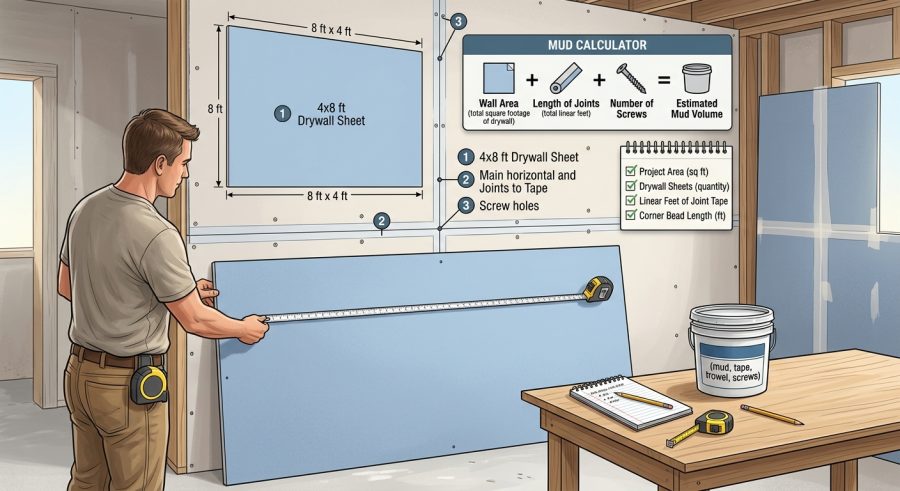
- Measure your wall or ceiling area and enter it in the Wall/Ceiling Area field.
- Select the unit that matches your measurement: square feet, square meters, square yards, or square inches.
- Enter the number of mud coats you plan to apply, usually two or three for standard finishing.
- Enter the coverage rate listed on your mud product, or use a typical estimate like 100 square feet per gallon.
- Choose your container size and add a waste allowance percentage for spillage and sanding loss.
- Enter the cost per container to see an estimated total material cost.
Understanding Each Input Field
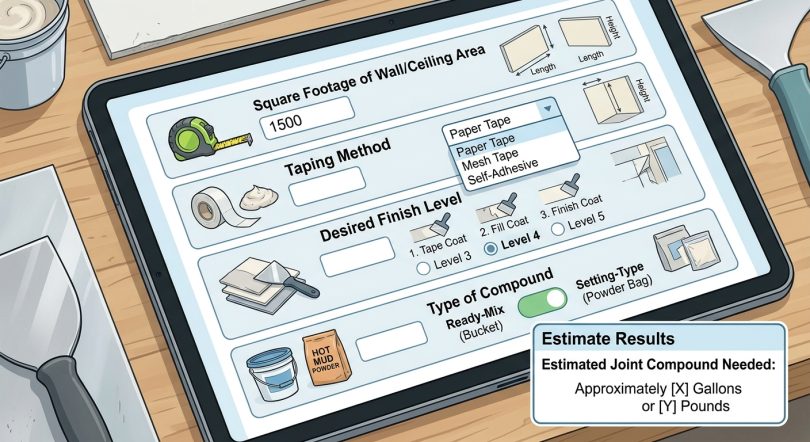
Wall/Ceiling Area: The total surface area you plan to finish, entered as a single number.
Area Unit: Choose square feet, square meters, square yards, or square inches to match how you measured. The calculator converts your entry to square feet internally.
Number of Mud Coats: How many separate coats of mud you plan to apply. Standard finishing typically uses two to three coats.
Mud Coverage Rate: How much area one gallon of mud covers per coat, usually listed on the product label or estimated from experience.
Mud Container Size: The package size you intend to buy, from a quart up to a 5-gallon bucket.
Waste/Overage Allowance: A percentage added to cover spillage, sanding loss, and touch-ups.
Cost per Container: The price of one container at your chosen size, used to estimate total material spend.
How Mud Volume and Cost Are Calculated
The calculator converts your area to square feet, applies the number of coats, divides by coverage rate, and adds waste. All formulas below use plain arithmetic.
Total Area to Finish = wall_area multiplied by area_unit conversion factor. This gives the base surface area in square feet.
Total Coated Area = Total Area multiplied by number_of_coats, since each coat covers the same surface again.
Mud Needed (gallons) = (Total Coated Area divided by coverage_rate) multiplied by (1 plus waste_factor_percent divided by 100). Coverage_rate is in square feet per gallon per coat.
Containers to Purchase = Mud Needed divided by mud_container_size, rounded up to the next whole container using the ceiling function, since partial containers cannot be purchased.
Estimated Material Cost = Containers to Purchase multiplied by cost_per_container.
These formulas assume premixed mud measured in gallons and uniform coverage across the entire area for every coat. They do not account for dry-mix setting compound, which is measured by weight and mixed with water.
Sample Mud Calculations for Different Jobs
Example 1: Standard bedroom, imperial units
Given: 200 sq ft area, area unit square feet (1), 3 coats, coverage 100 sq ft/gallon, 5-gallon container, 10% waste, $15 per container.
Formula: Mud Needed = (200 * 1 * 3 / 100) * 1.10
Substitution: (600 / 100) * 1.10 = 6 * 1.10
Calculation: 6.6 gallons needed; containers = ceil(6.6 / 5) = 2; cost = 2 * $15
Final result: 6.6 gallons, 2 containers, $30.00 estimated cost.
Example 2: Basement remodel, metric units
Given: 50 sq m area, area unit 10.7639, 2 coats, coverage 150 sq ft/gallon, 3.5-gallon pail, 15% waste, $12 per container.
Formula: Mud Needed = (50 * 10.7639 * 2 / 150) * 1.15
Substitution: (1076.39 / 150) * 1.15 = 7.1759 * 1.15
Calculation: 8.25 gallons needed; containers = ceil(8.25 / 3.5) = 3; cost = 3 * $12
Final result: 8.25 gallons, 3 containers, $36.00 estimated cost.
Example 3: Small skim coat patch
Given: 80 sq ft area, 1 coat, coverage 200 sq ft/gallon, 1-gallon container, 5% waste, $10 per container.
Formula: Mud Needed = (80 * 1 / 200) * 1.05
Substitution: 0.40 * 1.05
Calculation: 0.42 gallons needed; containers = ceil(0.42 / 1) = 1; cost = 1 * $10
Final result: 0.42 gallons, 1 container, $10.00 estimated cost.
Example 4: Large commercial job
Given: 5,000 sq ft area, 3 coats, coverage 100 sq ft/gallon, 5-gallon container, 10% waste, $18 per container.
Formula: Mud Needed = (5000 * 3 / 100) * 1.10
Substitution: 150 * 1.10
Calculation: 165 gallons needed; containers = ceil(165 / 5) = 33; cost = 33 * $18
Final result: 165 gallons, 33 containers, $594.00 estimated cost.
Example 5: Garage finishing, square yards
Given: 300 sq yd area, area unit 9, 2 coats, coverage 120 sq ft/gallon, 3.5-gallon pail, 10% waste, $14 per container.
Formula: Mud Needed = (300 * 9 * 2 / 120) * 1.10
Substitution: (5400 / 120) * 1.10 = 45 * 1.10
Calculation: 49.5 gallons needed; containers = ceil(49.5 / 3.5) = 15; cost = 15 * $14
Final result: 49.5 gallons, 15 containers, $210.00 estimated cost.
Typical Coverage Rates by Mud Type
| Mud Type | Typical Coverage per Gallon per Coat | Common Use |
|---|---|---|
| All-purpose premixed | 100 to 125 sq ft | Taping, filling, and finish coats in one product |
| Taping compound (green lid) | 80 to 100 sq ft | Embedding tape and first coat, higher bond strength |
| Topping compound (blue lid) | 100 to 125 sq ft | Final smoothing coats, easier to sand |
| Lightweight all-purpose | 100 to 135 sq ft | Easier handling, slightly lower shrinkage |
| Dry-mix setting compound | Varies by mix ratio and bag weight | Fast-setting repairs, not measured in gallons |
These figures are general estimates. Always check the coverage rate on your specific product label, since manufacturers vary.
Reading Your Gallons, Containers, and Cost
Total Area to Finish shows your entered area converted to square feet, so you can confirm the conversion is correct.
Total Coated Area reflects the cumulative surface area across all coats, which is what actually consumes mud.
Mud Needed is your primary output in gallons, already including the waste allowance you entered.
Containers to Purchase rounds up to a whole number since you cannot buy a fraction of a container. This means your actual purchase may include slightly more mud than the calculated gallon figure.
Estimated Material Cost multiplies containers by your entered price and does not include tax, delivery, tools, or tape.
Treat all outputs as planning estimates. Confirm final quantities against your specific product’s label and your project’s actual conditions before purchasing.
What Changes Your Mud Requirement
Coverage rate: This has the biggest effect on results. All-purpose, taping, topping, and lightweight muds all cover different areas per gallon. The calculator uses whatever rate you enter, so accuracy depends on that input.
Number of coats: More coats directly increase mud needed since each coat is calculated as covering the full area again. The calculator accounts for this through the coats field.
Application thickness and technique: Thicker application or heavy texture work uses more mud per square foot than the standard coverage rate assumes. The calculator does not adjust automatically for thickness, so you may need to lower your coverage rate estimate for heavy applications.
Wall condition and joint count: Walls with more seams, corners, or repairs use more mud than open flat areas of the same square footage. This is not separately modeled and should be reflected in a higher waste allowance.
Waste allowance: Spillage, sanding removal, and touch-ups are captured through the waste percentage field, which directly scales the final gallon figure.
Common Errors When Estimating Joint Compound
- Forgetting to multiply by coats: Entering only the base wall area without accounting for multiple coats understates the true mud volume. The calculator handles this automatically once you enter the correct number of coats.
- Using the wrong area unit: Entering a metric measurement while leaving the unit set to square feet will produce an inaccurate result. Always match the area unit selector to your measurement.
- Ignoring the actual product coverage rate: Using a generic 100 sq ft per gallon default when your product’s label states a different rate leads to over- or under-buying.
- Skipping the waste allowance: Setting waste to zero rarely reflects real job conditions and can leave you short on mud mid-project.
- Rounding containers down: The calculator rounds up container counts intentionally; manually rounding down to save money can leave you without enough mud to finish the last coat.
- Mixing premixed and dry-mix assumptions: This calculator is built for premixed mud measured in gallons. Dry-mix setting compound sold by weight requires a separate conversion not covered here.
- Not accounting for texture or skim coating: Heavier texture or full skim coats use significantly more mud than standard taping, so a higher coverage estimate is needed for those jobs.
Assumptions and Estimate Boundaries
This calculator provides a planning estimate based on the coverage rate, coat count, and waste allowance you supply. It does not measure your actual walls, verify product specifications, or account for regional product formulation differences.
It assumes premixed joint compound in gallons and does not convert dry-mix setting compound sold in bags by weight. It also does not include costs for drywall tape, corner bead, sandpaper, tools, delivery, or sales tax.
Coverage rates vary by brand, mud type, humidity, and application method, so treat the gallon and container figures as a starting point rather than a guaranteed purchase quantity. For large commercial bids or structural drywall work, consult a qualified contractor or supplier before finalizing material orders.
Estimating Mud by Number of Drywall Sheets
If you know your sheet count instead of exact wall area, you can estimate coverage first. A standard 4 by 8 foot drywall sheet covers 32 square feet. Multiply your sheet count by 32 to get an approximate wall area, then enter that figure into the Wall/Ceiling Area field. This method is less precise than direct measurement since it does not subtract door and window openings, but it works as a quick planning estimate for straightforward rooms.
Choosing Between Buckets and Smaller Containers
Larger containers like 5-gallon buckets usually cost less per gallon than quarts or 1-gallon tubs, making them more economical for whole-room or whole-house jobs. Smaller containers reduce waste on patch repairs or touch-up work where a full bucket would dry out before you use it. Compare the Estimated Material Cost result across container sizes to see which option better matches your project size and budget.
Adjusting for Skim Coats and Heavy Texture
A full skim coat over an entire wall uses considerably more mud than standard taping and finishing since it adds a thin layer across the whole surface rather than just at joints. For skim coating, lower your coverage rate input, since one gallon will cover less area than it would for typical seam finishing. Increasing the waste allowance slightly also helps account for the extra sanding and touch-up work skim coating usually requires.
Drywall Mud Questions Answered
How much drywall mud do I need per sheet of drywall?
A standard 4 by 8 foot sheet covers 32 square feet. For three coats at a typical rate of 100 square feet per gallon, one sheet needs roughly 0.96 gallons before waste. Enter your total sheet area into the calculator for a project-wide estimate rather than calculating sheet by sheet.
How many coats of joint compound are typically required?
Most standard drywall finishing uses three coats: an embedding coat, a fill coat, and a finish coat. Simple patch jobs may need only one or two coats, while higher-end finish levels or skim coating can require additional passes. Enter the number that matches your planned finishing schedule.
What is a realistic coverage rate for premixed versus dry-mix mud?
Premixed all-purpose or topping compound typically covers 100 to 125 square feet per gallon per coat, while taping compound often covers 80 to 100 square feet. Dry-mix setting compound is sold by weight, not gallons, so it is not directly compatible with this calculator’s coverage rate input.
How do I convert square meters or square yards into the calculator?
You do not need to convert manually. Enter your measured area as-is and select the matching unit from the Area Unit dropdown, whether square feet, square meters, square yards, or square inches. The calculator applies the correct conversion factor internally to produce results in square feet and gallons.
Does texture, skim coating, or level of finish change mud usage?
Yes. Heavier texture, full skim coats, and higher finish levels use more mud per square foot than standard taping and finishing. This calculator does not automatically detect texture type, so you should lower your entered coverage rate to reflect a thicker or more extensive application.
Should I buy mud in gallons, pails, or buckets for large jobs?
Larger containers like 5-gallon buckets generally offer a lower cost per gallon and are more efficient for whole-room or whole-house projects. Smaller containers make sense for small patches or touch-ups where a full bucket would go to waste. Compare container options in the calculator to see which minimizes estimated cost for your job size.
How accurate is this drywall mud calculator?
This calculator gives a planning estimate, not an exact figure. Accuracy depends on the coverage rate and waste allowance you enter, both of which vary by product brand, mud type, and application technique. Always compare results against your product’s label and adjust before making a final purchase.
Why does the calculator round up the number of containers?
Containers are only sold in fixed sizes, so the calculator rounds the calculated gallon requirement up to the next whole container using a ceiling function. This ensures you buy enough mud to complete the job, even if it means having a small amount left over.
Planning Your Drywall Finishing Purchase
Estimating drywall mud accurately starts with a reliable area measurement, a realistic coverage rate, and an honest waste allowance. This calculator turns those three inputs into a gallon figure, a container count, and an estimated cost so you can shop with confidence. Always confirm the coverage rate against your specific product before finalizing a large purchase.
