
This calculator estimates how much epoxy coating and primer your floor project needs, based on the floor’s length and width, number of coats, coverage rate, and a waste allowance for spillage or touch-ups. Enter your measurements in feet or meters, along with product pricing, to see total gallons required, the number of kits to buy, and an estimated total material cost including optional primer.
Epoxy Floor Calculator: Coverage, Cost & Coats Estimator
Estimate epoxy and primer gallons needed, kits to buy, and total material cost for any floor project using length, width, coats, and coverage rate.
What This Epoxy Coverage Tool Calculates
This tool helps homeowners, garage owners, and flooring contractors figure out how much epoxy coating and primer a floor project requires. It converts your floor dimensions into a total area, applies a waste allowance, and multiplies by the number of coats to estimate gallons of material needed. From there it calculates how many pre-mixed kits to buy and the total material cost.
Results are estimates based on the coverage rates and prices you enter. Actual material use can vary depending on surface porosity, application method, and product thickness, so this calculator is best used for budgeting and shopping purposes rather than as a guaranteed final quantity.
Steps to Estimate Your Epoxy Flooring Needs
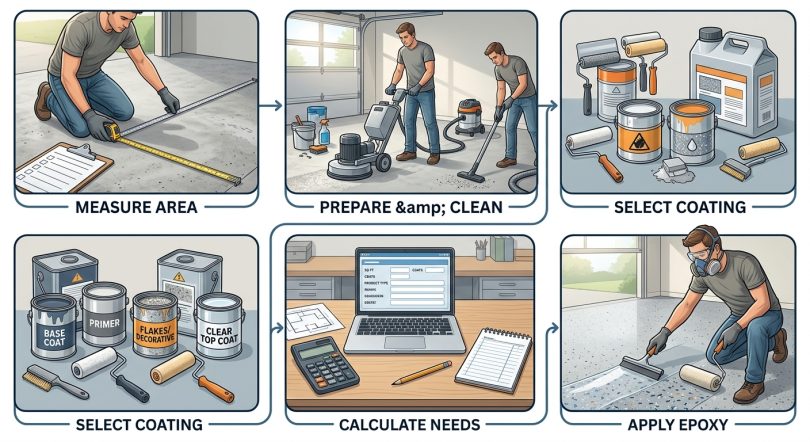
- Select whether you are measuring in feet or meters.
- Enter your floor’s length and width.
- Set the number of epoxy coats you plan to apply and choose a waste allowance percentage.
- Enter the coverage rate and price per gallon for your specific epoxy product.
- Choose whether to include a primer coat and fill in its coverage rate and price if applicable.
- Enter your epoxy kit size to see instant results for total area, gallons, kits, and cost.
Understanding Each Measurement and Cost Input
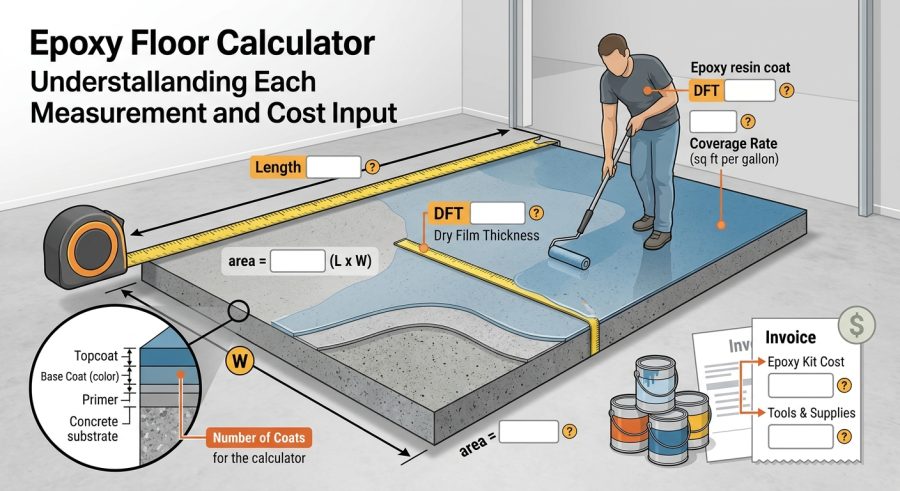
Measurement Unit: Choose feet or meters for your length and width entries. The calculator automatically converts meters to square feet internally so all area-based results stay consistent.
Floor Length and Width: Enter the two dimensions of your rectangular floor area in the unit you selected.
Number of Epoxy Coats: Most floors use two coats for durability, though some products or high-traffic areas call for more. Each additional coat increases total epoxy volume proportionally.
Waste and Overage Allowance: A percentage added to your base area to cover spillage, uneven application, roller loss, and touch-ups. Ten percent is a common starting point for a typical DIY project.
Epoxy Coverage Rate per Coat: The square footage one gallon of your chosen epoxy covers per coat. Check your product’s technical data sheet since this varies widely by brand and formulation.
Epoxy Price per Gallon: The cost of your topcoat product, used to calculate total material spend.
Include Primer Coat: Choose yes if your project uses a separate primer or sealer coat before the topcoat epoxy.
Primer Coverage Rate and Price per Gallon: Primer typically spreads further than topcoat epoxy because it soaks into porous concrete, so it usually has its own coverage rate and price.
Epoxy Kit Size: Most epoxy is sold as a two-part kit combining resin and hardener in a fixed total gallon volume. Enter the combined size listed on the kit packaging.
How Coverage, Coats, and Cost Are Calculated
The calculator uses the following formulas, where all area values are expressed in square feet after unit conversion.
Total Floor Area = length × width × (area_unit factor)^2, where the area_unit factor is 1 for feet or 3.28084 for meters, converting meter dimensions into square feet.
Adjusted Area with Waste Allowance = Total Floor Area × (1 + waste_percent / 100).
Total Epoxy Needed (gallons) = (Adjusted Area × coats) / coverage_rate.
Estimated Kits Needed = the Total Epoxy Needed divided by kit_size_gallons, rounded up to the next whole kit since partial kits cannot be purchased.
Estimated Total Material Cost = (Total Epoxy Needed × price_per_gallon) plus, if primer is included, (Adjusted Area / primer_coverage_rate) × primer_price_per_gallon.
These formulas assume a single rectangular floor, a uniform coverage rate for all coats of topcoat epoxy, and one primer coat when primer is selected. If your primer needs more than one coat, increase the primer coverage rate value accordingly to reflect the extra material.
Sample Garage and Warehouse Floor Calculations
Example 1: Standard garage floor (feet, with primer)
Given: length 20 ft, width 15 ft, 2 coats, 10% waste, coverage rate 200 sq ft/gal, price $45/gal, primer coverage 300 sq ft/gal, primer price $35/gal, kit size 2 gal.
Formula: Area = length × width; Adjusted Area = Area × 1.10; Epoxy = Adjusted Area × coats / coverage_rate.
Substitution: Area = 20 × 15 = 300 sq ft; Adjusted = 300 × 1.10 = 330 sq ft; Epoxy = 330 × 2 / 200 = 3.3 gal.
Calculation: Kits = ceil(3.3 / 2) = 2 kits; Epoxy cost = 3.3 × 45 = $148.50; Primer gallons = 330 / 300 = 1.1; Primer cost = 1.1 × 35 = $38.50.
Final result: Total Epoxy 3.30 gallons, 2 kits, total cost $187.00.
Example 2: Metric basement floor (no primer)
Given: length 10 m, width 8 m, 1 coat, 5% waste, coverage rate 180 sq ft/gal, price $50/gal, no primer, kit size 5 gal.
Substitution: Area = 10 × 8 × 3.28084^2 = 80 × 10.7639 = 861.11 sq ft; Adjusted = 861.11 × 1.05 = 904.17 sq ft; Epoxy = 904.17 × 1 / 180 = 5.02 gal.
Calculation: Kits = ceil(5.02 / 5) = 2 kits; Cost = 5.02 × 50 = $251.16.
Final result: Total Epoxy 5.02 gallons, 2 kits, total cost $251.16.
Example 3: Warehouse floor with primer, three coats
Given: length 50 ft, width 40 ft, 3 coats, 15% waste, coverage rate 225 sq ft/gal, price $40/gal, primer coverage 350 sq ft/gal, primer price $30/gal, kit size 3 gal.
Substitution: Area = 50 × 40 = 2000 sq ft; Adjusted = 2000 × 1.15 = 2300 sq ft; Epoxy = 2300 × 3 / 225 = 30.67 gal.
Calculation: Kits = ceil(30.67 / 3) = 11 kits; Epoxy cost = 30.67 × 40 = $1226.67; Primer gallons = 2300 / 350 = 6.57; Primer cost = 6.57 × 30 = $197.14.
Final result: Total Epoxy 30.67 gallons, 11 kits, total cost $1423.81.
Example 4: Small bathroom floor, thick coating, no waste
Given: length 8 ft, width 6 ft, 2 coats, 0% waste, coverage rate 100 sq ft/gal, price $60/gal, no primer, kit size 1 gal.
Substitution: Area = 8 × 6 = 48 sq ft; Adjusted = 48 sq ft (no waste added); Epoxy = 48 × 2 / 100 = 0.96 gal.
Calculation: Kits = ceil(0.96 / 1) = 1 kit; Cost = 0.96 × 60 = $57.60.
Final result: Total Epoxy 0.96 gallons, 1 kit, total cost $57.60.
Typical Coverage Rates by Epoxy Product Type
| Coating Type | Typical Coverage (sq ft per gallon, per coat) | Notes |
|---|---|---|
| Water-based epoxy | 250 to 300 | Thinner film, easier DIY application, less durable long-term |
| Solvent-based epoxy | 200 to 250 | Moderate thickness with good chemical resistance |
| 100% solids epoxy | 150 to 200 | Thick, durable, common for garages and industrial floors |
| Epoxy primer or sealer | 250 to 400 | Penetrates porous concrete; coverage drops on very rough surfaces |
These ranges are general estimates only. Always check your specific product’s technical data sheet for the manufacturer’s recommended coverage rate.
Reading Your Gallons, Kits, and Cost Results
Total Floor Area is your raw measured area in square feet before any waste is added. Use this figure to compare against your actual room dimensions.
Adjusted Area with Waste Allowance reflects the area used for all downstream gallon and cost calculations, since it builds in extra material for spillage and touch-ups.
Total Epoxy Needed is the estimated gallons of topcoat epoxy required across all coats. This does not include primer, which is calculated separately.
Estimated Kits Needed rounds the gallon requirement up to the next whole kit, since epoxy is sold in fixed-size two-part kits and partial kits are not available for purchase.
Estimated Total Material Cost combines epoxy and, if selected, primer costs into one budget figure. It excludes labor, tools, and surface preparation supplies, so treat it as a materials-only estimate.
What Changes Actual Epoxy Coverage on Site
Coverage rate accuracy: This is the single biggest variable. The calculator uses whatever coverage rate you enter, so checking the manufacturer’s data sheet for your exact product improves accuracy significantly.
Floor porosity: Older, rougher, or unsealed concrete absorbs more epoxy than a smooth sealed surface, which the calculator cannot detect automatically; you should increase the waste allowance or lower the coverage rate to compensate.
Number of coats: Adding coats increases total gallons and cost proportionally, and this is fully accounted for in the formulas.
Waste allowance: Higher waste percentages account for spillage or an inexperienced applicator, but the calculator only applies the percentage you choose; it does not estimate waste automatically.
Kit size rounding: Because kits are sold in fixed sizes, the calculator always rounds up, which can leave small amounts of leftover material.
Primer coats: The calculator assumes one primer coat by default; if your project needs two primer coats, adjust the primer coverage rate to reflect the extra material.
Common Epoxy Estimating Errors to Avoid
- Skipping the waste allowance: Setting it to zero often leads to running short mid-project; a modest allowance of 5 to 15 percent is safer.
- Using topcoat coverage rate for primer: Primer usually spreads further per gallon, so enter its own coverage rate rather than reusing the topcoat figure.
- Guessing the coverage rate: Coverage varies by product and thickness; always check the manufacturer’s label instead of relying on a generic number.
- Rounding kits down: Buying only the exact calculated gallons instead of full kits can leave you short before the second coat.
- Mixing unit systems: Entering meters while the unit selector is set to feet will produce an incorrect area, so confirm the selected unit matches your measurements.
- Ignoring extra coats for high-traffic areas: Garages and industrial floors often need more coats than living spaces, which increases total material needed.
- Not subtracting fixed obstructions: Built-in cabinets, drains, or columns reduce usable floor area and should be subtracted from length and width measurements before entry.
What This Estimate Does Not Cover
This calculator provides material estimates only and does not include labor, surface preparation, tools, tape, or shipping costs. It assumes a single rectangular or approximately rectangular floor; irregular layouts, multiple rooms, or L-shaped spaces require you to calculate area manually and enter the combined total.
Coverage rates and prices vary by brand, region, and supplier, so treat all cost figures as planning estimates rather than final quotes. Surface conditions such as cracks, moisture, or heavy porosity can significantly change actual material use beyond what any calculator can predict. For large commercial installations or floors with structural concerns, consult a qualified flooring contractor before purchasing materials or beginning work.
Converting Feet and Meters Automatically
When you select meters, the calculator multiplies your length and width by a conversion factor before squaring it, turning your metric dimensions into an equivalent area in square feet. This keeps every downstream result, including gallons and cost, in the same unit system regardless of how you entered your measurements. You do not need to convert anything manually before entering your numbers.
Handling Irregular or Multi-Room Floors
This calculator works best for a single rectangular area. If your floor has an irregular shape, an alcove, or spans multiple rooms, break the space into smaller rectangles, calculate each area separately using length times width, add them together, and enter the combined total as a single equivalent rectangle by adjusting your length or width input. This keeps the coverage and cost math accurate even for non-rectangular spaces.
Choosing a Realistic Coverage Rate
Coverage rate is the most sensitive input in this calculator. Manufacturers publish a recommended range on the product data sheet, often expressed as square feet per gallon at a specific film thickness. Thicker 100% solids epoxy typically covers less area per gallon than a thinner water-based product. When unsure, use a lower coverage rate within the manufacturer’s range to avoid underestimating how much epoxy you need to buy.
Epoxy Floor Coverage and Cost Questions
How much epoxy do I need per square foot of floor?
It depends on the product's coverage rate, typically listed as square feet per gallon on the label. Divide your adjusted floor area by that coverage rate, then multiply by the number of coats to find total gallons needed.
How many coats of epoxy are recommended for garage floors?
Two coats are common for most garage floors, balancing durability and cost. High-traffic or industrial floors sometimes use three coats, which you can enter directly into the coats field to see the updated material and cost estimate.
Does this calculator account for primer separately from topcoat?
Yes. When you select yes for include primer, the calculator uses a separate primer coverage rate and price to calculate primer gallons and cost, then adds that to the topcoat epoxy cost for a combined total.
How accurate is the waste percentage allowance?
The waste allowance is a planning estimate you control, not a measured value. Ten percent is a reasonable starting point for most DIY projects, but rougher surfaces or less experienced applicators may need a higher percentage to avoid running short.
What is the difference between coverage rate for primer versus epoxy topcoat?
Primer typically spreads further per gallon because it soaks into porous concrete rather than forming a thick surface film, so its coverage rate is usually higher than the topcoat epoxy's coverage rate.
Can I use this calculator for metric floor dimensions?
Yes. Select meters from the measurement unit option, and the calculator automatically converts your length and width into square feet internally so all gallon and cost results stay accurate.
How many gallons come in a typical epoxy kit?
Kit sizes vary by manufacturer, commonly ranging from one to several gallons combining resin and hardener. Enter your specific kit's total gallon size in the kit size field to get an accurate kit count.
Does the cost estimate include labor or surface preparation?
No. The total material cost only covers epoxy and, if selected, primer. It does not include labor, grinding, patching, tape, rollers, or other tools needed to complete the project.
Planning Your Epoxy Floor Purchase
Estimating epoxy floor materials accurately starts with a correct area measurement, a realistic coverage rate, and a sensible waste allowance. Use this calculator as a starting point for budgeting your gallons, kits, and total material cost, then confirm coverage rates against your chosen product’s data sheet before purchasing. For large or unusual floors, consider consulting a flooring professional to fine-tune your final material order.
