
This calculator finds how much gravel a French drain trench needs by multiplying trench length, width, and depth, then subtracting pipe volume if a perforated pipe is used. Enter your trench dimensions, pipe details, and waste allowance to get total cubic feet, bag count, weight, and estimated cost. Results are practical estimates based on the measurements and material settings you provide.
French Drain Gravel Calculator: Volume, Bags & Cost
Estimate the cubic feet of gravel, bag count, weight, and material cost for a French drain trench, with optional pipe displacement and waste allowance.
What This Gravel Calculator Figures Out
This calculator estimates the volume of gravel needed to fill a French drain trench, along with the number of bags, total weight, and rough material cost. It is meant for homeowners planning a drainage project, landscapers quoting jobs, and contractors double-checking material orders before delivery.
Use it after you have measured your trench or planned its dimensions, but before buying gravel. The results are estimates based on the numbers you enter. Actual gravel needed can vary with soil conditions, trench shape, and material settling, so treat the output as a planning figure rather than an exact purchase order.
Steps To Get An Accurate Estimate
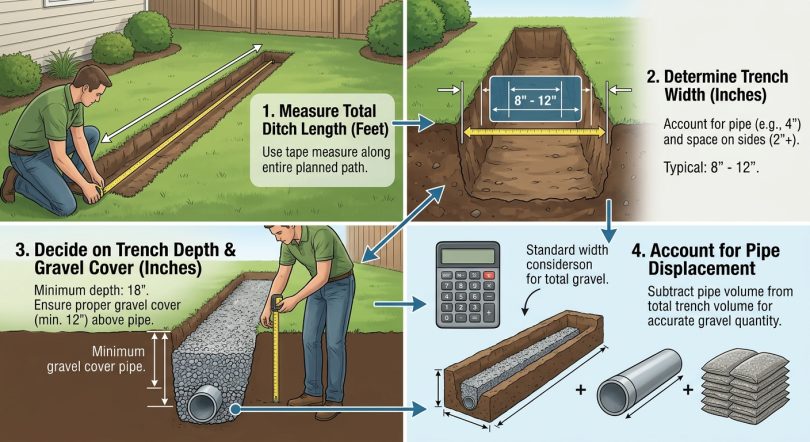
- Measure your trench length, width, and depth in feet and enter them into the calculator.
- Select whether you are installing a perforated drain pipe, and if so, enter its diameter in inches.
- Enter a waste and compaction allowance percentage to cover settling and spillage.
- Enter your gravel bag size, cost per bag, and gravel density, or use the defaults as a starting point.
- Review the calculated volume, bag count, weight, and estimated total cost before ordering material.
Understanding Each Measurement You Enter
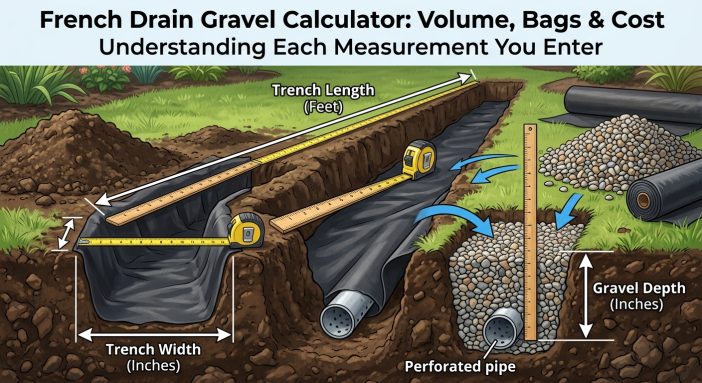
Trench Length is the total run of the drain in feet, measured along its path. Trench Width and Trench Depth are the trench’s cross-sectional dimensions in feet, based on how wide and deep you dig or plan to dig.
Include Perforated Pipe Displacement lets you subtract the space taken up by a drain pipe if you are laying one inside the gravel bed. If you select Yes, enter the Pipe Diameter in inches; common sizes are 4 or 6 inches.
Waste and Compaction Allowance is a percentage added to cover gravel that settles, spills, or gets wasted during backfill. Gravel Bag Size is how many cubic feet one bag holds, printed on most bagged gravel products. Cost per Bag is your local price per bag. Gravel Density is the weight of gravel per cubic foot, which varies by stone type and moisture; 90 to 110 pounds per cubic foot is typical for crushed stone.
How Trench Volume And Pipe Displacement Are Calculated
The core volume formula treats the trench as a uniform rectangular channel:
Base Volume = trench_length × trench_width × trench_depth, in cubic feet.
When pipe displacement is included, the pipe is treated as a cylinder running the full trench length. Its cross-sectional area is calculated as pi × (pipe_diameter_in / 24)^2, where dividing by 24 converts the diameter in inches to a radius in feet. This area is multiplied by trench_length to get pipe volume, which is subtracted from the base volume.
Gravel Volume With Waste Allowance = (Base Volume minus pipe volume) × (1 + waste_percent/100).
Bags Needed = that adjusted volume divided by bag_size_cf, rounded up to the next whole bag since partial bags are not sold.
Estimated Gravel Weight = adjusted volume × gravel_density_lb_per_cf.
Estimated Material Cost = bags needed × cost_per_bag.
This assumes a consistent rectangular trench shape from end to end. Sloped, tapered, or curved trenches will have a somewhat different actual volume.
Sample Trench Calculations Checked By Hand
Example 1: Standard residential drain, no pipe. Given: length 20 ft, width 1 ft, depth 2 ft, waste 10%, bag size 0.5 cu ft, cost $5 per bag. Formula: length × width × depth, then add waste. Substitution: 20 × 1 × 2 = 40 cu ft; 40 × 1.10 = 44 cu ft. Bags: 44 / 0.5 = 88 bags. Cost: 88 × $5 = $440. Final result: 44 cu ft, 88 bags, $440.
Example 2: Same trench with a 4-inch pipe. Given: same dimensions, include_pipe set to Yes, pipe diameter 4 in. Formula: pipe area = pi × (4/24)^2 = 0.0873 sq ft; pipe volume = 0.0873 × 20 = 1.745 cu ft. Substitution: 40 minus 1.745 = 38.255 cu ft; times 1.10 = 42.08 cu ft. Bags: 42.08 / 0.5 = 84.16, rounded up to 85 bags. Weight: 42.08 × 100 = 4,208 lb. Cost: 85 × $5 = $425. Final result: 42.08 cu ft, 85 bags, $425.
Example 3: Larger perimeter drain. Given: length 50 ft, width 1.5 ft, depth 1.5 ft, no pipe, waste 15%, bag size 0.75 cu ft, cost $6, density 95 lb per cu ft. Substitution: 50 × 1.5 × 1.5 = 112.5 cu ft; times 1.15 = 129.375 cu ft. Bags: 129.375 / 0.75 = 172.5, rounded up to 173 bags. Weight: 129.375 × 95 = 12,290.6 lb. Cost: 173 × $6 = $1,038. Final result: 129.38 cu ft, 173 bags, $1,038.
Example 4: Small drain with pipe. Given: length 10 ft, width 0.75 ft, depth 1 ft, pipe 4 in, waste 5%, bag size 0.5 cu ft, cost $4.50, density 105 lb per cu ft. Substitution: base volume 10 × 0.75 × 1 = 7.5 cu ft; pipe volume 0.0873 × 10 = 0.873 cu ft; adjusted 7.5 minus 0.873 = 6.627 cu ft; times 1.05 = 6.96 cu ft. Bags: 6.96 / 0.5 = 13.92, rounded up to 14 bags. Cost: 14 × $4.50 = $63. Final result: 6.96 cu ft, 14 bags, $63.
Example 5: Commercial-scale drain with 6-inch pipe. Given: length 100 ft, width 2 ft, depth 2.5 ft, pipe 6 in, waste 10%, bag size 1 cu ft, cost $8, density 110 lb per cu ft. Substitution: base volume 100 × 2 × 2.5 = 500 cu ft; pipe area pi × (6/24)^2 = 0.1963 sq ft; pipe volume 0.1963 × 100 = 19.63 cu ft; adjusted 500 minus 19.63 = 480.37 cu ft; times 1.10 = 528.40 cu ft. Bags: 528.40 / 1 = 528.4, rounded up to 529 bags. Weight: 528.40 × 110 = 58,124.2 lb. Cost: 529 × $8 = $4,232. Final result: 528.40 cu ft, 529 bags, $4,232.
Typical Trench Sizes And Gravel Volume Per Foot
| Trench Width | Trench Depth | Volume Per Linear Foot | Typical Use |
|---|---|---|---|
| 6 in (0.5 ft) | 12 in (1 ft) | 0.5 cu ft | Small drainage swale |
| 12 in (1 ft) | 18 in (1.5 ft) | 1.5 cu ft | Light residential foundation drain |
| 12 in (1 ft) | 24 in (2 ft) | 2 cu ft | Standard French drain |
| 18 in (1.5 ft) | 24 in (2 ft) | 3 cu ft | Heavy-duty perimeter drain |
These figures assume no pipe displacement or waste allowance. Multiply by your trench length in feet, then apply your waste percentage for a rough starting estimate.
Reading Your Volume, Bags, Weight, And Cost
Gravel Volume Needed is the raw cubic footage based on trench dimensions, minus pipe space if included. Gravel Volume With Waste Allowance adds your chosen percentage for settling and spillage, and is the number to use when ordering material.
Bags Needed rounds the adjusted volume up to a whole number of bags, since suppliers do not sell partial bags. Estimated Gravel Weight converts that volume to pounds using your gravel density, useful for checking delivery truck capacity or how much your vehicle can carry. Estimated Material Cost multiplies bag count by price per bag and does not include delivery, labor, fabric, or pipe cost.
All results update instantly as you change inputs, so you can test different trench sizes or waste allowances before finalizing an order.
What Changes Your Gravel Quantity
- Trench dimensions: Length, width, and depth directly set the base volume; this calculator accounts for all three.
- Pipe diameter and inclusion: A pipe reduces the gravel needed; this is accounted for only when you select Yes and enter a diameter.
- Gravel type and density: Crushed stone, river rock, and pea gravel differ in weight per cubic foot; you must enter the correct density for an accurate weight estimate.
- Waste and compaction: Real trenches rarely have perfectly even walls; the waste percentage input accounts for this, but actual site conditions may need a higher allowance.
- Bag size variation: Bag sizes differ by brand and region; entering the wrong size will skew bag count and cost, so check the bag label.
- Trench shape: This calculator assumes a uniform rectangular cross-section; tapered, curved, or irregular trenches are not directly modeled.
Errors That Throw Off Gravel Orders
- Entering width or depth in inches instead of feet: Convert inches to feet first, since all length fields expect feet.
- Forgetting to include pipe displacement: If you are laying perforated pipe, select Yes or your gravel estimate will be too high.
- Using a generic bag size: Bag volumes vary between 0.5 and 1 cubic foot or more; check your specific product.
- Skipping the waste allowance: Ordering exact volume often leaves you short after compaction and spillage.
- Assuming all gravel weighs the same: Density varies by stone type and moisture content, which changes weight estimates.
- Ignoring trench irregularities: Sloped or uneven trenches will need more material than a flat rectangular estimate suggests.
- Mixing unit systems: Entering metric measurements without converting to feet will produce incorrect results.
What This Tool Does Not Cover
This calculator assumes a uniform rectangular trench and a straight length of pipe if included. It does not model sloped trenches, curved drain paths, multiple pipe sizes, drainage fabric thickness, or layered fill such as sand cushions under the pipe. Gravel density and bag size are user-supplied estimates and vary by supplier and material type.
Results are planning estimates, not guaranteed purchase quantities. Site conditions, soil type, local drainage codes, and slope requirements affect proper French drain design and are not evaluated here. For drainage systems tied to foundation waterproofing, grading, or structural concerns, consult a qualified contractor or engineer before construction.
Choosing The Right Gravel Size For Drainage
French drains typically use washed, angular crushed stone between three-quarters of an inch and one and a half inches in size. Smooth river rock is not ideal because it compacts less predictably and drains slower. Avoid gravel with fine particles or dust, since these can clog pore spaces and reduce drainage performance over time. This calculator does not select gravel size for you; it only estimates volume, weight, and cost based on the dimensions and density you provide.
Accounting For Fabric And Pipe Bedding Layers
Many French drains use filter fabric lining the trench and a thin bedding layer of gravel beneath the pipe before backfilling. This calculator estimates total gravel volume for the trench but does not separately calculate fabric yardage or a distinct bedding layer thickness. If your design calls for a bedding layer, you can approximate it by adjusting your depth input or by calculating that layer’s volume separately and adding it to your total order.
Adjusting For Sloped Or Irregular Trenches
Real trenches are not always a perfect rectangle. If your trench varies in depth or width along its run, take measurements at several points and average them, or split the trench into segments and calculate each segment separately using the same inputs. Adding your waste allowance helps absorb small inconsistencies, but significant slope or width changes should be measured and calculated in sections for a more reliable total.
French Drain Gravel Questions Answered
How much gravel do I need per linear foot of French drain?
It depends on trench width and depth. For a common 1 foot wide, 2 foot deep trench, you need about 2 cubic feet of gravel per linear foot before waste allowance. Multiply your trench length by width and depth in feet to get your own figure, then add a waste percentage.
Do I need to subtract pipe volume from my gravel calculation?
Only if you are installing a perforated pipe inside the gravel bed. Select Yes for pipe displacement and enter the pipe diameter, and the calculator will subtract the pipe's volume from the total gravel needed. If there is no pipe, leave this set to No.
What size gravel is best for French drains?
Washed, angular crushed stone between three-quarters of an inch and one and a half inches is commonly used because it drains well and resists clogging. This calculator does not choose gravel size; it only estimates volume, weight, and cost based on your trench dimensions and gravel density.
How does trench depth affect the amount of gravel needed?
Depth has a direct, linear effect on volume. Doubling trench depth roughly doubles the gravel needed, assuming length and width stay the same. Deeper trenches also increase the weight and cost estimates proportionally.
Should I add extra gravel for fabric or backfill layers?
This calculator estimates gravel for the trench volume only. If your design includes a separate bedding layer under the pipe or additional backfill layers, calculate those volumes separately and add them to the total, since they are not automatically included.
How accurate is this calculator for irregular or sloped trenches?
It assumes a uniform rectangular trench along its full length, so irregular, tapered, or sloped trenches will not be perfectly represented. For uneven trenches, measure several sections separately and calculate each one, or use the waste allowance to help cover minor inconsistencies.
What gravel density should I use if I do not know the exact value?
A typical crushed stone density is around 100 pounds per cubic foot, which is the calculator's default. Actual density varies by stone type, size, and moisture content, so check with your supplier if you need a more precise weight estimate.
Can I use this calculator for metric measurements?
The calculator's length fields are set up for feet. If you have measurements in meters or centimeters, convert them to feet before entering values, since mixing unit systems will produce incorrect volume, weight, and cost results.
Getting Your Drainage Project Right
Getting French drain gravel quantities right starts with accurate trench measurements and a realistic waste allowance. This calculator turns your length, width, and depth into a clear volume, bag count, weight, and cost estimate, adjusted for pipe displacement when needed. Use the results as a solid planning figure, but confirm gravel type, density, and design details with your supplier or a qualified contractor before finalizing your order.
