
This paver sand calculator estimates the volume, weight, and number of bags of bedding sand needed to prepare a base for your patio, walkway, or driveway. Simply enter your paved area’s length, width, and desired sand depth, and the tool instantly returns results in cubic feet, cubic yards, pounds, tons, and bags, accounting for a compaction and waste allowance so you order enough material without overbuying.
Paver Sand Calculator: Estimate Volume, Weight & Bags
Estimate how much bedding sand you need for a paver patio, walkway, or driveway in cubic feet, cubic yards, pounds, tons, and bags.
What This Sand Estimator Calculates
This tool figures out how much bedding sand you need to lay under pavers for a patio, walkway, or driveway. It works for homeowners planning a weekend project and for contractors ordering bulk material for larger jobs. Enter the dimensions of your paved area and a target sand depth, and the calculator returns volume, weight, and bag counts. Results are estimates based on standard construction assumptions, not exact figures, because real-world sand density and site conditions vary.
Steps to Estimate Your Paver Sand Order
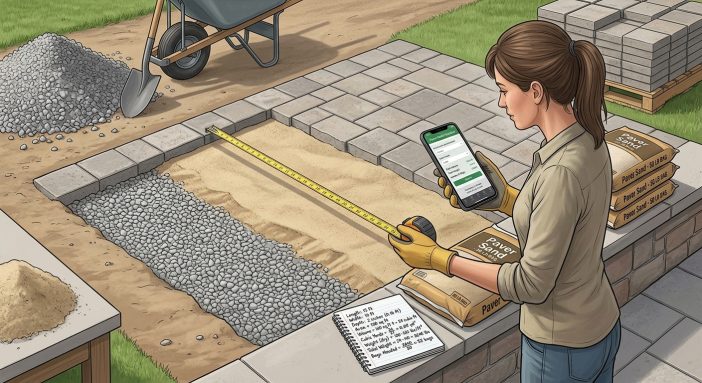
- Measure the length and width of the area you plan to pave, then select feet or meters.
- Enter your target sand bedding depth, usually about 1 inch, and choose inches or centimeters.
- Adjust the sand density if you know your supplier’s specification, or leave the default of 100 lb per cubic foot.
- Set the waste and compaction allowance to match your project’s difficulty; 10 percent works for most flat sites.
- Pick your bag size if you are buying bagged sand instead of bulk material.
- Review the volume, weight, and bag count results, then round up when ordering from a supplier.
Understanding Each Input Field
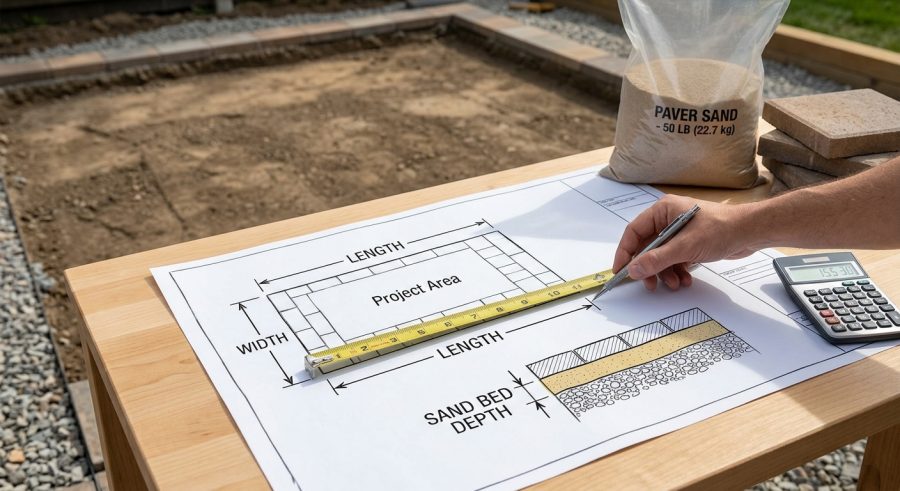
Area Length and Width: Measure the outer dimensions of the space you plan to pave. Choose feet or meters from the unit dropdown next to each field.
Sand Bedding Depth: This is the thickness of the compacted sand layer beneath the pavers, commonly about 1 inch. Select inches or centimeters as needed.
Sand Density: Bedding sand typically weighs 80 to 120 pounds per cubic foot depending on moisture content and how tightly it is packed. Use 100 lb per cubic foot if you are unsure.
Waste and Compaction Allowance: This percentage adds extra sand to cover settling, uneven subgrade, and material lost during spreading. A 10 percent allowance suits most flat sites; rougher or sloped areas may need more.
Sand Bag Size: Choose the bag weight sold by your supplier, typically 40, 50, or 60 pounds, so the calculator can convert total weight into a bag count.
How the Volume and Weight Formulas Work
Paved Area (sq ft) = length x length_unit x width x width_unit. The unit multipliers convert meters to feet when metric inputs are chosen, since 1 meter equals 3.28084 feet.
Sand Volume (cu ft) = Area x (depth x depth_unit / 12) x (1 + waste_percent / 100). Depth is converted to inches, then divided by 12 to get feet, and multiplied by area to get raw volume. The waste factor scales up the volume to account for compaction and spillage.
Sand Volume (cu yd) = Sand Volume (cu ft) / 27, since one cubic yard equals 27 cubic feet.
Estimated Sand Weight (lb) = Sand Volume (cu ft) x sand_density. This assumes uniform density throughout the sand layer.
Estimated Sand Weight (tons) = Weight (lb) / 2000.
Bags Needed = ceiling of Weight (lb) / bag_weight, rounded up to the next whole bag since partial bags are not sold.
These formulas assume a simple rectangular area and a consistent bedding depth. They calculate bedding sand only, not gravel base or joint sand between pavers.
Sample Sand Calculations for Common Project Sizes
Example 1: Small patio. Given length 10 ft, width 10 ft, depth 1 in, density 100 lb/cu ft, 10% waste, 50 lb bags.
Formula: Area = 10 x 10 = 100 sq ft. Volume = 100 x (1/12) x 1.10 = 9.17 cu ft.
Calculation: Weight = 9.17 x 100 = 916.7 lb. Bags = ceil(916.7 / 50) = 19 bags.
Final result: about 9.17 cu ft, 0.34 cu yd, 917 lb, 0.46 tons, and 19 bags.
Example 2: Metric walkway. Given length 5 m, width 4 m, depth 2.5 cm, density 95 lb/cu ft, 15% waste, 40 lb bags.
Substitution: Length in feet = 5 x 3.28084 = 16.40 ft; Width in feet = 4 x 3.28084 = 13.12 ft; Area = 215.28 sq ft. Depth in inches = 2.5 x 0.393701 = 0.98 in.
Calculation: Volume = 215.28 x (0.98/12) x 1.15 = 20.31 cu ft. Weight = 20.31 x 95 = 1929.1 lb. Bags = ceil(1929.1 / 40) = 49 bags.
Final result: about 20.31 cu ft, 0.75 cu yd, 1929.1 lb, 0.96 tons, and 49 bags.
Example 3: Driveway. Given length 30 ft, width 20 ft, depth 1.5 in, density 105 lb/cu ft, 10% waste, 60 lb bags.
Formula: Area = 600 sq ft. Volume = 600 x (1.5/12) x 1.10 = 82.5 cu ft.
Calculation: Weight = 82.5 x 105 = 8662.5 lb. Bags = ceil(8662.5 / 60) = 145 bags.
Final result: about 82.5 cu ft, 3.06 cu yd, 8662.5 lb, 4.33 tons, and 145 bags.
Example 4: Small walkway. Given length 3 ft, width 2 ft, depth 1 in, density 100 lb/cu ft, 5% waste, 50 lb bags.
Formula: Area = 6 sq ft. Volume = 6 x (1/12) x 1.05 = 0.53 cu ft.
Calculation: Weight = 0.53 x 100 = 52.5 lb. Bags = ceil(52.5 / 50) = 2 bags.
Final result: about 0.53 cu ft, 0.02 cu yd, 52.5 lb, 0.03 tons, and 2 bags.
Quick Reference: Sand Needed per 100 Square Feet
| Bedding Depth | Volume per 100 sq ft | Estimated Weight |
|---|---|---|
| 0.5 in | 4.58 cu ft | 458.3 lb |
| 1 in | 9.17 cu ft | 916.7 lb |
| 1.5 in | 13.75 cu ft | 1375.0 lb |
| 2 in | 18.33 cu ft | 1833.3 lb |
Figures assume 100 sq ft of paved area, a sand density of 100 lb per cubic foot, and a 10 percent waste allowance. Adjust for your actual area, density, and waste settings.
Reading Your Volume, Weight, and Bag Results
The Paved Area confirms the total surface you entered, converted to square feet. Sand Volume Needed in cubic feet and cubic yards tells you how much loose sand to order; cubic yards are the standard unit for bulk delivery quotes. Estimated Sand Weight in pounds and tons helps when a supplier prices sand by weight instead of volume. Bags Needed rounds up to the next whole bag so you have enough material, since suppliers do not sell partial bags. Treat all figures as planning estimates; actual sand needs can shift with subgrade unevenness, moisture, and how tightly the sand compacts once screeded.
What Changes Your Sand Quantity
Area dimensions: Larger or irregular areas directly increase volume and weight; the calculator accounts for length and width but assumes a rectangle.
Bedding depth: Even small depth changes affect total volume significantly since volume scales linearly with depth. The calculator accounts for this through the depth input.
Sand density: Moist or compacted sand weighs more per cubic foot than dry, loose sand. The calculator accounts for this through the adjustable density field.
Waste and compaction allowance: Rougher subgrades or hand-spreading typically waste more material. The calculator accounts for this through the waste percentage input.
Bag size availability: Local suppliers may only stock certain bag weights. The calculator accounts for this by letting you choose 40, 50, or 60 lb bags, but it does not track price differences between sizes.
Base gravel and joint sand: These are separate materials not included in this calculator’s results, since it estimates bedding sand only.
Ordering Errors to Avoid
- Confusing bedding sand with joint sand: This calculator estimates the base layer under pavers, not the fine sand swept into joints afterward.
- Skipping the waste allowance: Ordering the exact calculated volume often leaves you short after compaction and spillage; keep some allowance in place.
- Using default density for all sand types: Wet or coarse sand can weigh more or less than 100 lb per cubic foot, changing your weight and bag results.
- Measuring only one section of an irregular patio: Break L-shaped or curved areas into rectangles, calculate each separately, and add the results together.
- Rounding down bag counts: Always round up, since a partial bag still requires purchasing a full one.
- Mixing unit systems by mistake: Double-check that the length, width, and depth unit dropdowns match your actual measurements.
- Ignoring bulk versus bag pricing: For large volumes, bulk sand by the ton or cubic yard is often more economical than buying many small bags.
What This Tool Does Not Cover
This calculator provides planning estimates for bedding sand volume, weight, and bag count based on the dimensions and settings you enter. It does not calculate base gravel depth, joint sand quantities, edge restraint materials, or paver counts. It assumes a simple rectangular area and a uniform, flat bedding depth; sloped or curved sites may need adjusted depth or additional material. Sand density and pricing vary by region, supplier, and moisture content, so actual purchase amounts may differ from these estimates. For structural base design, drainage planning, or large commercial installations, consult a qualified landscaping or paving professional before ordering materials.
Bedding Sand Compared to Joint Sand
Bedding sand is the layer spread and screeded under the pavers to create a flat, stable surface before installation. This calculator estimates that layer only. Joint sand, often a fine or polymeric sand, is swept into the gaps between pavers after they are laid to lock them in place and resist weed growth. Joint sand quantities depend on paver spacing and joint width, so they must be calculated separately from bedding sand.
Working with Bulk Sand versus Bags
For small projects, bagged sand is convenient and widely available at hardware stores. For larger patios or driveways, buying sand in bulk by the cubic yard or ton is usually cheaper and reduces the number of trips needed. Use the cubic yard and ton results from this calculator when requesting a bulk delivery quote, and use the bag count when shopping for individual bags.
Calculating Sand for L-Shaped or Multi-Section Patios
If your paved area is not a simple rectangle, divide it into two or more rectangular sections that together cover the full footprint. Run this calculator separately for each section using the same depth and settings, then add the resulting volumes, weights, and bag counts together for your total order.
Paver Sand Questions Answered
How much sand do I need per square foot for pavers?
At a typical 1 inch bedding depth with a 10 percent waste allowance, you need roughly 0.092 cubic feet of sand per square foot, or about 9.2 pounds per square foot at 100 lb per cubic foot density. This calculator applies your exact area and depth to give a precise figure.
What is the ideal depth for paver bedding sand?
Most paver projects use a compacted bedding sand layer between 1 and 1.5 inches thick. Thinner layers may not provide enough leveling ability, while much thicker layers can shift under load. Check your specific paver manufacturer’s guidance for the recommended depth.
What is the difference between bedding sand and polymeric joint sand?
Bedding sand supports pavers from underneath and is calculated by this tool. Polymeric joint sand fills the gaps between pavers after installation and hardens to resist erosion and weeds. They serve different purposes and are calculated using separate methods.
How does sand density affect the weight results?
Weight is calculated by multiplying volume by density, so denser sand produces a higher weight estimate for the same volume. Moist or well-compacted sand can weigh closer to 110 to 120 pounds per cubic foot, while dry, loose sand may weigh closer to 80 to 90 pounds per cubic foot.
How do I calculate sand for an irregularly shaped patio?
Split the area into rectangular sections, run the calculator for each section using the same bedding depth, and add the volume, weight, and bag results together to get your total sand requirement for the whole space.
Should I buy paver sand in bags or order it in bulk?
Bags are practical for small areas under a few hundred square feet, while bulk sand by the ton or cubic yard is usually more cost-effective for larger patios or driveways. Compare the cubic yard, ton, and bag results this calculator provides to decide which purchase option fits your project.
How much extra sand should I order for waste and compaction?
A 10 percent allowance covers typical spillage, settling, and minor subgrade irregularities for most flat sites. Rougher terrain, hand-spreading, or larger crews may benefit from a higher allowance of 15 to 20 percent to avoid running short mid-project.
Can this calculator convert between metric and imperial units?
Yes. You can enter length and width in feet or meters and depth in inches or centimeters. The calculator converts all values internally to a common unit system before computing volume, weight, and bag results.
Planning Your Paver Base with Confidence
Estimating paver sand correctly helps you avoid multiple supply runs or paying for material you never use. By entering your area dimensions, bedding depth, sand density, and a reasonable waste allowance, this calculator gives you volume, weight, and bag figures you can take straight to a supplier. Always round up slightly and confirm final quantities with your material provider before purchase.
