This calculator estimates how much polymeric sand you need to fill paver or flagstone joints by calculating the joint fill volume from your paver size, joint width, and joint depth, then converting that volume into weight, bag count, and total cost. Enter your paved area and paver details, and the calculator returns the joint area ratio, sand weight, number of bags to buy, and an approximate material cost including a waste allowance.
Polymeric Sand Calculator: Estimate Bags, Weight & Cost
Calculate how much polymeric sand you need for paver or flagstone joints, including total weight, bag count, and estimated material cost.
What This Polymeric Sand Estimator Figures Out
This tool calculates the volume, weight, bag count, and cost of polymeric sand needed to fill the joints between pavers or flagstones. It works by figuring out what percentage of your paved surface is actually joint space, then converting that joint area into a fill volume and weight.
It is useful for homeowners planning a patio or walkway project, and for landscapers or contractors preparing material lists and quotes. The results are estimates based on the measurements you provide. Actual usage can vary due to paver shape, joint consistency, and installation technique, so treat the numbers as a solid planning baseline rather than an exact order quantity.
Steps to Estimate Your Sand Needs
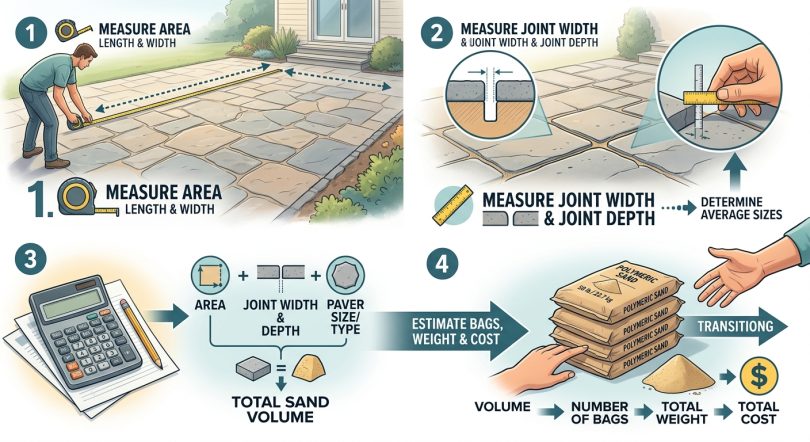
- Measure your total paved area in square feet and enter it in the Paved Area field.
- Enter the length and width of a single paver in inches.
- Enter the joint width, which is the gap between pavers, and the joint depth, usually equal to the paver thickness.
- Enter the polymeric sand density from the product label, or use the default if unknown.
- Choose your bag size, add a waste allowance percentage, and enter the price per bag.
- Review the calculated joint volume, sand weight, bag count, and total estimated cost.
Understanding Each Measurement You Enter
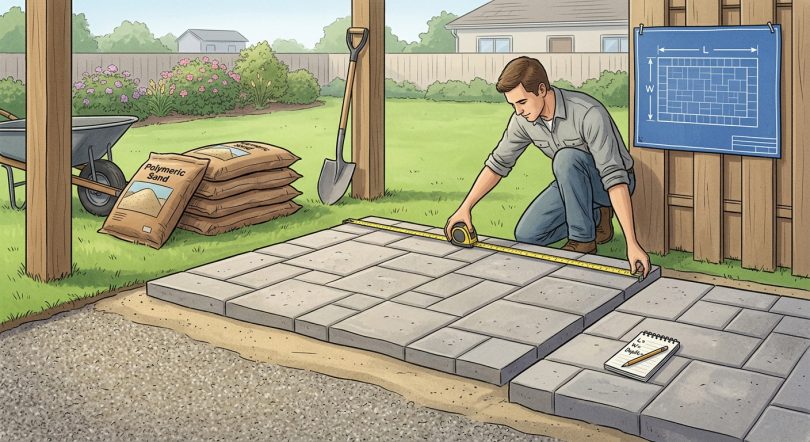
Paved Area is the total surface area of your project in square feet, including the pavers and the joints between them.
Paver Length and Paver Width are the dimensions of one paver unit in inches. Square and rectangular pavers both work with this formula.
Joint Width is the gap between adjacent pavers in inches, commonly between one-sixteenth and one-half inch depending on the paver style.
Joint Depth is how deep the sand needs to go, in inches. This usually matches the paver thickness unless the manufacturer recommends a shallower fill.
Polymeric Sand Density is the compacted weight of the sand per cubic foot, found on the product bag or technical sheet. It typically falls between 90 and 110 pounds per cubic foot.
Bag Size lets you choose between common 25, 40, and 50 pound bags sold at most retailers.
Waste and Spillage Allowance is a percentage added to cover material lost during sweeping and compaction.
Price per Bag is the cost of a single bag in your local currency, used to estimate the total material budget.
How Joint Volume Becomes Bags and Cost
The calculator first finds what fraction of the paved surface is joint space rather than solid paver. It does this by comparing the paver area to the total area of one paver plus its surrounding joint.
Joint Area Ratio = 1 minus (paver length times paver width) divided by ((paver length plus joint width) times (paver width plus joint width)), expressed as a percentage.
Joint Area to Fill = total paved area multiplied by the joint area ratio, in square feet.
Joint Fill Volume = joint area to fill multiplied by joint depth converted from inches to feet (depth divided by 12), giving cubic feet.
Sand Weight Needed = joint fill volume multiplied by sand density, in pounds.
Bags Required = sand weight needed, increased by the waste percentage, divided by bag weight, then rounded up to the next whole bag since partial bags cannot be purchased.
Estimated Material Cost = bags required multiplied by price per bag.
This method assumes uniform paver size, consistent joint width and depth across the whole area, and sand density that matches the actual compacted product. It does not model irregular flagstone shapes, curved cuts, or borders with different joint sizes.
Sample Projects and Their Sand Requirements
Example 1: Standard patio. Given: 200 sq ft area, 12 by 12 inch pavers, 0.125 inch joints, 1.5 inch depth, 100 lbs/cu ft density, 50 lb bags, 10% waste, $45 per bag. Joint area ratio: 1 minus (144 divided by 147.02) equals about 2.05%. Joint fill volume: 200 times 0.0205 times (1.5 divided by 12) equals about 0.513 cu ft. Sand weight: 0.513 times 100 equals about 51.3 lbs. With 10% waste that is about 56.4 lbs, divided by 50 gives 1.13, rounded up to 2 bags. Cost: 2 times $45 equals $90.
Example 2: Small pavers, wider joints. Given: 150 sq ft area, 6 by 6 inch pavers, 0.375 inch joints, 1.25 inch depth, 95 lbs/cu ft density, 40 lb bags, 10% waste, $38 per bag. Joint area ratio: 1 minus (36 divided by 40.64) equals about 11.4%. Fill volume: 150 times 0.114 times (1.25 divided by 12) equals about 1.782 cu ft. Sand weight: 1.782 times 95 equals about 169.3 lbs. With waste, about 186.2 lbs, divided by 40 gives 4.66, rounded up to 5 bags. Cost: 5 times $38 equals $190.
Example 3: Large driveway pavers. Given: 600 sq ft area, 18 by 24 inch pavers, 0.1875 inch joints, 2.5 inch depth, 105 lbs/cu ft density, 50 lb bags, 5% waste, $50 per bag. Joint area ratio: 1 minus (432 divided by 438.32) equals about 1.44%. Fill volume: 600 times 0.0144 times (2.5 divided by 12) equals about 1.80 cu ft. Sand weight: 1.80 times 105 equals about 189 lbs. With waste, about 198.5 lbs, divided by 50 gives 3.97, rounded up to 4 bags. Cost: 4 times $50 equals $200.
Example 4: Flagstone-style walkway. Given: 100 sq ft area, 16 by 16 inch pavers, 0.5 inch joints, 2 inch depth, 100 lbs/cu ft density, 25 lb bags, 15% waste, $22 per bag. Joint area ratio: 1 minus (256 divided by 272.25) equals about 5.97%. Fill volume: 100 times 0.0597 times (2 divided by 12) equals about 0.995 cu ft. Sand weight: 0.995 times 100 equals about 99.5 lbs. With waste, about 114.4 lbs, divided by 25 gives 4.58, rounded up to 5 bags. Cost: 5 times $22 equals $110.
Typical Joint Ratios by Paver and Joint Size
| Paver Size (in) | Joint Width (in) | Approx. Joint Area Ratio |
|---|---|---|
| 6 x 6 | 0.125 | 4.0% |
| 12 x 12 | 0.125 | 2.1% |
| 12 x 12 | 0.375 | 5.9% |
| 18 x 24 | 0.1875 | 1.4% |
| 16 x 16 | 0.5 | 6.0% |
These ratios assume square joint spacing on all sides of each paver. Actual layouts with running bond patterns or mixed paver sizes will vary slightly from these figures.
Reading Your Sand Weight, Bag Count, and Cost
The Joint Area Ratio shows what portion of your paved surface is actually joint space. Smaller pavers and wider joints produce a higher ratio, meaning more sand per square foot.
The Joint Area to Fill and Joint Fill Volume are intermediate results showing the physical space the sand must occupy in square feet and cubic feet.
Sand Weight Needed is the raw material weight before waste is added. Bags Required is your primary shopping number, already including the waste allowance and rounded up to a whole bag. Estimated Material Cost gives a budget figure based on that bag count, but it does not include tax, delivery, or labor.
If your joints vary in width across the project, run the calculator separately for each section and add the bag totals together for a more accurate order.
What Changes How Much Sand You Need
- Paver size: Smaller pavers create more total joint length per square foot, increasing sand use. The calculator accounts for this directly.
- Joint width and depth: Both increase joint volume linearly and are fully included in the formula.
- Sand density: Denser compacted sand weighs more per cubic foot, increasing total pounds needed for the same volume. Enter the density from your specific product for best accuracy.
- Waste allowance: Higher waste percentages increase the bag count to cover spillage and sweeping loss. This is a user-adjustable estimate, not a fixed physical constant.
- Paver shape irregularity: Irregular or hand-cut stones create uneven joint widths that this calculator cannot model directly, since it assumes uniform rectangular pavers and joints.
- Sub-base moisture or joint depth variation: Uneven installation depth changes actual sand consumption but is not something the calculator can detect from area measurements alone.
Sand Estimating Errors That Lead to Shortages
- Measuring only the paver dimension, not the paved area: Enter your total project area, not just one paver’s footprint.
- Guessing joint width instead of measuring: A difference of even one-eighth inch can noticeably change sand volume across a large area.
- Using paver thickness instead of actual fill depth: Some products recommend leaving a small gap below the surface; check the manufacturer’s guidance before setting joint depth.
- Skipping the waste allowance: Ordering the exact calculated amount often leaves you short after sweeping and compaction losses.
- Ignoring density differences between brands: Using a default density that does not match your actual product can shift bag counts by several bags on large projects.
- Forgetting to round up bag purchases: Retailers sell whole bags only, so the calculator always rounds bag count upward, and you should too if calculating manually.
- Applying one ratio to mixed paver sizes: If your project uses multiple paver sizes or a border pattern, calculate each section separately.
What This Estimate Does Not Cover
This calculator provides a planning estimate based on uniform paver dimensions, consistent joint width and depth, and a single sand density value. It does not account for irregular flagstone shapes, curved layouts, borders with different joint sizes, or sand lost due to poor weather conditions during installation.
Sand density and coverage can vary by brand, moisture content, and manufacturing batch, so figures printed on your specific product bag should take priority over the default value used here. Regional product availability and pricing also vary, so the cost estimate should be treated as a starting budget figure rather than a final quote.
This tool does not replace guidance from the polymeric sand manufacturer or a qualified paving contractor. Always follow the product’s instructions for joint depth, water activation, and curing before starting installation.
Adjusting for Irregular or Mixed Paver Layouts
If your project mixes paver sizes, such as a field area with a border, calculate each section separately using its own average paver dimensions and joint width, then add the resulting bag counts together. For flagstone with highly irregular shapes, use an average joint width based on several measurements around the project, since true joint width can vary significantly from stone to stone.
Why Joint Depth Should Match Product Guidelines
Manufacturers often specify a minimum and maximum joint depth for proper polymeric sand performance. Filling joints too shallow can lead to sand washing out over time, while overfilling can leave sand haze on the paver surface after activation. Confirm the recommended depth range for your specific product before finalizing this input.
Converting Results for Metric Measurements
If you prefer metric units, convert your area to square feet by multiplying square meters by 10.764, and convert millimeter measurements to inches by dividing by 25.4 before entering paver and joint dimensions. The calculator’s internal formulas use inches and square feet, so all inputs should be converted to those units first.
Polymeric Sand Questions Homeowners Ask
How much polymeric sand do I need per square foot?
It depends on your paver size, joint width, and joint depth rather than a fixed rate per square foot. Larger pavers with narrow joints need far less sand per square foot than small pavers with wide joints, which is why this calculator uses all three measurements together.
Should I include a waste allowance when ordering sand?
Yes. A waste allowance between 5 and 15 percent is common to cover spillage, sweeping loss, and uneven joint filling during compaction. The default in this calculator is 10 percent, but you can adjust it based on your experience level and site conditions.
What joint depth should I enter?
Joint depth usually equals the paver thickness, but some manufacturers recommend a slightly shallower fill depth. Check your specific polymeric sand product instructions and enter that recommended depth for the most accurate estimate.
Does bag size affect the total cost estimate?
Yes. Since bags are rounded up to whole units, choosing a smaller bag size like 25 pounds can sometimes result in more total pounds purchased than choosing 50 pound bags, which can slightly change your total estimated cost.
How accurate is this calculator’s bag count?
The bag count is a close estimate based on your entered measurements and rounds up to the next whole bag. Actual usage can vary slightly due to paver shape irregularities, uneven joint depth, and product-specific density, so treat the result as a reliable planning figure rather than an exact guarantee.
Can I use this calculator for flagstone instead of rectangular pavers?
You can use average dimensions for flagstone, but because flagstone joints are naturally irregular, treat the result as a rougher estimate. Measuring several representative joint widths and averaging them will improve accuracy for irregular stone layouts.
What sand density should I use if I don’t know my product’s value?
The default of 100 pounds per cubic foot represents a common compacted density for polymeric sand, but actual values typically range from 90 to 110 pounds per cubic foot depending on brand. Check your product packaging for the most accurate figure.
Does the cost result include tax or delivery fees?
No. The estimated material cost only multiplies the number of bags required by the price you enter per bag. It does not include sales tax, delivery charges, or labor costs, which you should add separately when budgeting.
Buying the Right Amount the First Time
Using accurate paver dimensions, joint measurements, and product-specific sand density gives you a dependable starting point for ordering polymeric sand. This calculator turns those measurements into a clear bag count and cost estimate, helping you avoid running short mid-project or overspending on excess material. For final purchasing decisions, confirm your numbers against the specific product’s coverage chart and consult a paving professional for large or complex installations.
