
This spray foam insulation calculator estimates the board feet, total R-value, material cost, and number of kits needed for your project. Enter the area, foam thickness, foam type, waste allowance, and pricing details to get an instant breakdown you can use for budgeting, quoting, or ordering the right amount of spray foam before installation starts.
Spray Foam Insulation Calculator: Cost, R-Value & Kits
Estimate board feet, total R-value, material cost, and the number of spray foam kits needed for attics, walls, or crawl spaces before you buy materials.
What This Spray Foam Calculator Figures Out
This tool calculates the board feet of spray foam needed to cover a given area, the resulting total R-value, the estimated material cost, and how many kits or sets to buy. It helps homeowners planning an insulation upgrade, contractors drafting a material quote, and DIYers sizing a kit purchase for an attic, wall, or crawl space.
The results are planning estimates based on the numbers you enter. They are not exact quotes, since actual foam yield, coverage, and pricing depend on the applicator’s technique, ambient temperature, substrate condition, and the specific product used.
Steps to Estimate Your Spray Foam Job
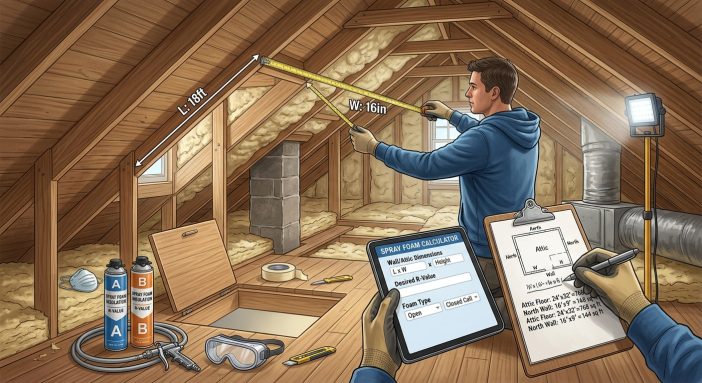
- Measure the total square footage of the area you plan to insulate, such as an attic floor, wall cavity, or crawl space ceiling.
- Enter that square footage into the Area to Insulate field.
- Select your target foam thickness in inches and choose Open Cell or Closed Cell foam type.
- Adjust the waste and overspray allowance if your job has tight corners, obstructions, or an inexperienced applicator.
- Enter your local material cost per board foot and the coverage yield of the kit or set you plan to buy.
- Review the board feet, R-value, cost, and number of sets needed shown in the results.
Understanding Each Input Field
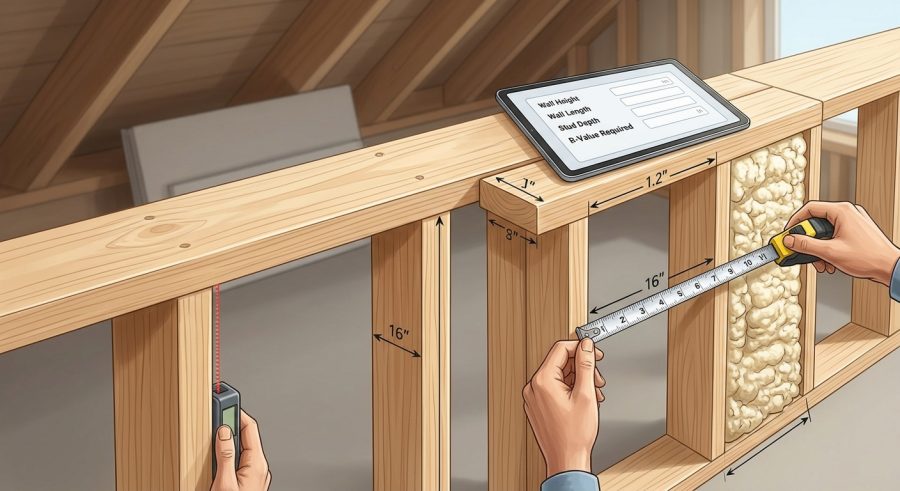
Area to Insulate (sq ft): the total square footage of the surface you plan to spray, such as attic floor area or wall cavity face area. Measure length times width for flat sections and add up irregular sections separately.
Desired Foam Thickness (in): how thick the cured foam layer will be, measured in inches. Thicker applications use more material and raise the R-value proportionally.
Foam Type: choose open cell foam (about R-3.6 per inch) or closed cell foam (about R-6.5 per inch). Closed cell foam is denser, costs more per board foot, and provides higher R-value per inch.
Waste and Overspray Allowance (%): an adjustment for material lost to overspray, uneven framing, or trimming. Rougher job sites and less experienced applicators typically need a higher allowance.
Material Cost per Board Foot ($/bf): your local price for the foam chemicals, which varies by supplier, region, and foam type. Check with your supplier or contractor for current pricing.
Coverage Yield per Kit or Set (bf/set): how many board feet one kit or set of foam chemicals produces, based on the manufacturer’s yield specification for that product.
How Board Feet, R-Value, and Cost Are Calculated
A board foot is the standard spray foam industry unit, equal to one square foot of surface covered at one inch of thickness.
- Total Board Feet = area (sq ft) x thickness (in)
- Adjusted Board Feet = area x thickness x (1 + waste_factor / 100)
- Estimated Total R-Value = thickness (in) x foam type R-value per inch
- Estimated Material Cost = Adjusted Board Feet x cost per board foot
- Estimated Kits or Sets Needed = Adjusted Board Feet / coverage per set, rounded up to the next whole set
These formulas assume foam is applied at a uniform thickness across the whole area, and that the R-value per inch and yield figures you use match the product you actually purchase. Published R-values per inch are typical averages and can vary by manufacturer and formulation.
Sample Projects: Attic, Wall, and Crawl Space Estimates
Example 1: Small attic touch-up. Given: 500 sq ft, 2 in thickness, open cell foam, 10% waste, $0.45/bf, 4,000 bf per set. Total board feet = 500 x 2 = 1,000 bf. Adjusted = 1,000 x 1.10 = 1,100 bf. R-value = 2 x 3.6 = R-7.2. Cost = 1,100 x $0.45 = $495.00. Sets needed = ceil(1,100 / 4,000) = 1 set.
Example 2: Closed cell wall job. Given: 1,000 sq ft, 3 in, closed cell foam, 15% waste, $0.65/bf, 5,000 bf per set. Total = 1,000 x 3 = 3,000 bf. Adjusted = 3,000 x 1.15 = 3,450 bf. R-value = 3 x 6.5 = R-19.5. Cost = 3,450 x $0.65 = $2,242.50. Sets needed = ceil(3,450 / 5,000) = 1 set.
Example 3: Full attic floor. Given: 1,200 sq ft, 5.5 in, open cell foam, 10% waste, $0.45/bf, 4,000 bf per set. Total = 1,200 x 5.5 = 6,600 bf. Adjusted = 6,600 x 1.10 = 7,260 bf. R-value = 5.5 x 3.6 = R-19.8. Cost = 7,260 x $0.45 = $3,267.00. Sets needed = ceil(7,260 / 4,000) = 2 sets.
Example 4: Small crawl space. Given: 200 sq ft, 2 in, closed cell foam, 20% waste, $0.55/bf, 2,000 bf per set. Total = 200 x 2 = 400 bf. Adjusted = 400 x 1.20 = 480 bf. R-value = 2 x 6.5 = R-13.0. Cost = 480 x $0.55 = $264.00. Sets needed = ceil(480 / 2,000) = 1 set.
Example 5: Larger wall project. Given: 3,000 sq ft, 3 in, closed cell foam, 10% waste, $0.60/bf, 6,000 bf per set. Total = 3,000 x 3 = 9,000 bf. Adjusted = 9,000 x 1.10 = 9,900 bf. R-value = 3 x 6.5 = R-19.5. Cost = 9,900 x $0.60 = $5,940.00. Sets needed = ceil(9,900 / 6,000) = 2 sets.
Typical R-Value per Inch by Foam Type
| Foam Type | R-Value per Inch | Typical Use | Assumption |
|---|---|---|---|
| Open Cell | R-3.6 | Interior walls, attics, sound dampening | Published average; may vary by manufacturer |
| Closed Cell | R-6.5 | Exterior walls, crawl spaces, roof decks | Published average; may vary by manufacturer |
Reading Your Board Feet, R-Value, and Cost Results
Total Board Feet Needed shows the raw amount of foam required before accounting for waste. Adjusted Board Feet with Waste adds your chosen overspray allowance and is the more realistic purchase quantity.
Estimated Total R-Value tells you the thermal resistance the finished foam layer should provide at the thickness and foam type you chose. Compare this to your target R-value for the climate zone and building code requirement in your area.
Estimated Material Cost covers foam chemicals only, based on the adjusted board feet and your entered price per board foot. Estimated Kits or Sets Needed rounds up to the next full kit, since partial kits usually cannot be purchased or reused.
All results are estimates. Actual results depend on installer technique, ambient temperature and humidity during spraying, and the true yield of the specific foam product used.
What Changes Your Foam Quantity and Price
Foam type: closed cell foam has a higher R-value per inch and costs more per board foot than open cell foam. The calculator accounts for this through the foam type selection.
Thickness: increasing thickness raises both board feet used and total R-value in direct proportion. The calculator accounts for this in every result.
Waste allowance: tight framing, obstructions, and applicator skill affect how much foam is lost to overspray. The calculator lets you adjust this percentage, but the right value depends on the job site.
Temperature and humidity: spray foam yield and cure quality can shift with weather conditions during application. This calculator does not adjust for site conditions and assumes standard manufacturer yield.
Substrate condition: uneven or porous surfaces can absorb more foam than a smooth surface. This is not directly modeled and should be reflected in a higher waste allowance if relevant.
Estimating Errors That Waste Money
- Confusing square footage with board feet: board feet always include thickness; entering only square footage without setting the correct thickness understates material needs.
- Ignoring waste allowance: setting waste to 0% on a complex job often leads to running short of material mid-project.
- Mixing up open cell and closed cell R-values: using the wrong foam type in the calculator gives an inaccurate R-value estimate for your actual product.
- Using outdated pricing: material costs change by supplier and season, so an old cost-per-board-foot figure can throw off the budget significantly.
- Assuming kit coverage is fixed: coverage yield varies by manufacturer, thickness applied, and spray technique, not just kit size.
- Forgetting labor and equipment costs: this calculator estimates material cost only, not spray equipment, labor, or disposal fees.
- Rounding down on kits: always round up to the next full set, since spray foam kits generally cannot be split or partially reused later.
What This Estimate Does Not Cover
This calculator estimates material quantities, R-value, and cost based on the numbers you provide. It does not calculate labor hours, equipment rental, code compliance, vapor barrier requirements, or fire-rating coatings that some jurisdictions require over exposed spray foam.
Published R-values per inch are typical manufacturer averages and can vary between specific foam products and formulations. Local material pricing, kit sizes, and coverage yields differ by region and supplier, so the figures you enter directly affect accuracy.
Spray foam installation involves flammable chemicals, specialized equipment, and ventilation requirements. Always consult a licensed insulation contractor for job-site evaluation, code requirements, and safe installation, especially for whole-house or structural insulation projects.
Choosing Thickness for Walls, Attics, and Crawl Spaces
Recommended spray foam thickness depends on the target R-value for your climate zone and the space being insulated. Attics often use thicker applications to reach higher R-values, while wall cavities are limited by the depth of the stud bay. Crawl spaces frequently use closed cell foam at moderate thickness because of its moisture resistance. Check your local building code or a qualified insulation contractor for the minimum R-value required in your area before setting the thickness input.
Open Cell Versus Closed Cell: Which to Model
Open cell foam is lighter, less expensive per board foot, and better suited for sound dampening and interior applications where moisture exposure is low. Closed cell foam is denser, more expensive, offers a higher R-value per inch, and adds some structural rigidity and moisture resistance, making it common for exterior walls, roof decks, and crawl spaces. Select the foam type that matches your actual project material to get an accurate R-value estimate.
Converting Kit Coverage to Your Project Size
Manufacturers rate spray foam kits by total board feet of coverage at a reference thickness, not by square footage alone. If your kit label states coverage at a specific thickness different from your project, recalculate the board foot yield first. Divide the labeled board feet by the reference thickness to get square feet per inch, then use that figure to set the coverage per set field accurately for your chosen thickness.
Spray Foam Insulation Questions Answered
What is a board foot in spray foam insulation?
A board foot is the standard unit used to measure spray foam material. It equals one square foot of surface area covered at one inch of thickness. This calculator multiplies your entered area by thickness to find total board feet needed.
How is R-value calculated for spray foam insulation?
R-value is calculated by multiplying the foam thickness in inches by the R-value per inch for the foam type you select, either R-3.6 for open cell or R-6.5 for closed cell. This gives an estimated total thermal resistance for the finished foam layer.
What is the difference between open cell and closed cell spray foam?
Open cell foam is lighter and less expensive with a lower R-value per inch, around R-3.6. Closed cell foam is denser, costs more, and offers a higher R-value per inch, around R-6.5, along with better moisture resistance and some added structural rigidity.
How much does a typical spray foam insulation kit cover?
Coverage varies widely by kit size and manufacturer, often ranging from a few hundred to several thousand board feet per kit. Check your specific kit’s labeled coverage yield and enter that figure into the coverage per set field for an accurate estimate.
Why is a waste factor included in spray foam estimates?
Spray foam application always loses some material to overspray, uneven surfaces, and trimming. Adding a waste percentage, commonly 10 to 20 percent, helps ensure you purchase enough material to finish the job without running short.
Does this calculator include labor and installation costs?
No. This calculator estimates material quantities, R-value, and material cost only. It does not include labor, spray equipment rental, disposal fees, or contractor markup, which should be requested separately from an insulation professional.
How thick should spray foam insulation be for walls versus attics?
Recommended thickness depends on your target R-value, climate zone, and local building code, and it differs for walls versus attics. Wall thickness is also limited by stud cavity depth. Consult local code requirements or a licensed contractor before finalizing thickness.
Are the R-values used in this calculator exact for every foam product?
No. The R-3.6 and R-6.5 per inch figures used here are typical published averages for open cell and closed cell foam. Actual R-value per inch varies by manufacturer and specific product formulation, so check your product’s technical data sheet for precise figures.
Planning Your Spray Foam Purchase
Use this calculator as a starting point for budgeting and ordering spray foam materials, based on the area, thickness, foam type, waste allowance, and pricing you provide. Because actual coverage, yield, and installation requirements vary by product and job site, confirm final quantities and code compliance with a licensed insulation contractor before purchasing materials or beginning work.
