
Thread engagement length is the minimum depth a bolt or screw must be threaded into a nut or tapped hole so the joint develops the fastener’s full tensile strength without stripping. Enter the nominal diameter, thread pitch, and material strengths below to instantly calculate the recommended engagement length, thread count, and estimated shear area for your connection.
Thread Engagement Calculator: Minimum Length & Strength
Calculate the minimum thread engagement length, thread count, and shear area needed for a bolted or tapped joint based on diameter, pitch, and material strength.
What This Thread Engagement Tool Calculates
This calculator estimates the minimum thread engagement length a bolted or tapped joint needs to reach the fastener’s full tensile strength before the threads strip. It compares the tensile strength of the external thread (the bolt) to the internal thread (the nut or tapped hole) and scales the common one-diameter engagement rule to match that strength ratio. Engineers, machinists, and designers can use it during early design or field checks to see whether a hole depth or nut length looks adequate. Because real threads involve tolerances, thread form details, and manufacturing variation not captured here, the results are planning-level estimates rather than a certified strength calculation.
Steps to Find Your Minimum Engagement Length
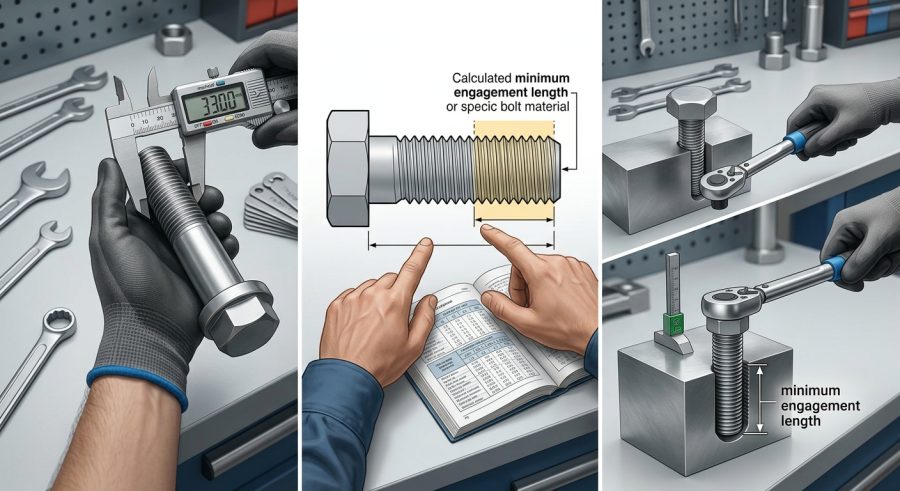
- Enter the nominal thread diameter, keeping all length inputs in the same unit (mm or inches).
- Enter the thread pitch, the distance between adjacent thread crests.
- Enter the tensile strength of the external thread (the bolt or screw).
- Enter the tensile strength of the internal thread material (the nut or tapped hole).
- Adjust the safety factor for extra margin, and set the shear area factor to match your thread standard.
- Read the five results: minimum length, recommended length, thread count, percent of diameter, and shear area.
Understanding Each Input Field
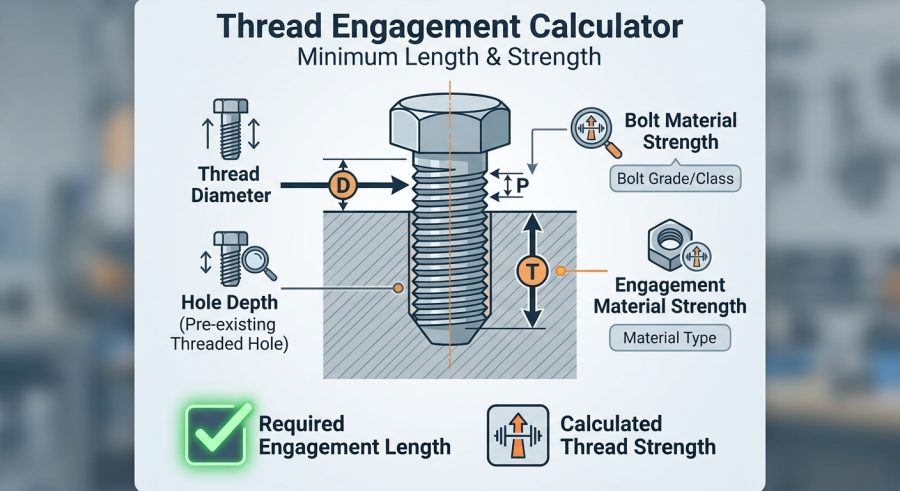
Nominal Thread Diameter is the major diameter of the bolt or screw, entered in millimeters (or inches, as long as every input stays in the same unit). Thread Pitch is the distance between two adjacent thread crests, also in mm or inches. External Thread Tensile Strength is the rated tensile strength of the bolt material in MPa (or psi). Internal Thread Tensile Strength is the tensile strength of the nut or tapped hole material. Safety Factor is a multiplier above 1.0 for extra margin on critical joints. Thread Shear Area Factor approximates the fraction of the engagement cylinder that actually resists shear, typically between 0.3 and 0.8 depending on thread standard.
The Engineering Formulas Behind the Results
The baseline engagement rule assumes that when the bolt and nut materials have equal strength, an engagement length equal to one diameter (1D) is enough to develop full bolt strength. When the internal thread material is weaker, more length is needed in direct proportion to the strength mismatch.
Minimum Engagement Length = the larger of (diameter times safety factor) and (diameter times the strength ratio times safety factor), where the strength ratio equals external tensile strength divided by internal tensile strength.
Recommended Engagement Length rounds the minimum length up to the next full increment of the thread pitch, since a joint can only engage whole or partial threads in practice.
Number of Engaged Threads divides the minimum engagement length by the thread pitch.
Engagement as Percent of Diameter divides the minimum engagement length by the nominal diameter and multiplies by 100, letting you compare against the classic 1x-diameter guideline.
Estimated Thread Shear Area models the engaged threads as a cylinder: pi times diameter times minimum engagement length times the shear area factor, giving an approximate shear-resisting area in square mm.
Sample Calculations for Common Bolt Sizes
Example 1 – Default steel bolt into a moderate-strength nut: diameter 10 mm, pitch 1.5 mm, bolt strength 830 MPa, nut strength 400 MPa, safety factor 1, shear factor 0.5. Strength ratio = 830/400 = 2.075. Minimum length = 10 x 2.075 x 1 = 20.75 mm. Recommended length rounds up to 21.00 mm. Threads engaged = 20.75/1.5 = 13.8. Percent of diameter = 207.5%. Shear area = 3.14159265 x 10 x 20.75 x 0.5 = 325.9 mm2.
Example 2 – Small bolt into aluminum with added margin: diameter 6 mm, pitch 1.0 mm, bolt strength 800 MPa, nut strength 300 MPa, safety factor 1.2, shear factor 0.5. Ratio = 2.667. Minimum length = 6 x 2.667 x 1.2 = 19.20 mm. Recommended length rounds up to 20.00 mm. Threads engaged = 19.2. Percent of diameter = 320.0%. Shear area = 3.14159265 x 6 x 19.2 x 0.5 = 181.0 mm2.
Example 3 – Equal-strength steel on steel: diameter 12 mm, pitch 1.75 mm, both materials at 830 MPa, safety factor 1, shear factor 0.5. Ratio = 1.0, so minimum length equals the diameter: 12.00 mm. Recommended length rounds up to 12.25 mm. Threads engaged = 6.9. Percent of diameter = 100.0%. Shear area = 226.2 mm2.
Example 4 – High-strength bolt into soft plastic: diameter 8 mm, pitch 1.25 mm, bolt strength 1000 MPa, internal strength 150 MPa, safety factor 1.5, shear factor 0.4. Ratio = 6.667. Minimum length = 8 x 6.667 x 1.5 = 80.00 mm. Recommended length also rounds to 80.00 mm. Threads engaged = 64.0. Percent of diameter = 1000.0%. Shear area = 804.2 mm2. This shows how a large strength mismatch forces a very long engagement.
Typical Engagement Ratios by Material Pairing
This table shows how the required engagement length scales with the strength ratio between external and internal threads, assuming a safety factor of 1.0. Multiply the ratio by your actual diameter to estimate the minimum length.
| Strength Ratio (External/Internal) | Engagement Length | Typical Example |
|---|---|---|
| 1.0 | 1.0 x diameter | Steel bolt into steel nut of equal strength |
| 1.5 | 1.5 x diameter | Steel bolt into cast iron |
| 2.0 | 2.0 x diameter | Steel bolt into aluminum |
| 2.5 | 2.5 x diameter | High-strength bolt into mild steel |
| 3.0 | 3.0 x diameter | High-strength bolt into brass |
| 4.0+ | 4.0+ x diameter | High-strength bolt into plastic or soft alloy |
Reading Your Five Calculated Results
The Minimum Engagement Length is the primary result and the shortest depth that should still let the bolt reach its rated tensile strength before the internal threads strip. The Recommended Engagement Length rounds that value up to a full thread pitch, which is more practical for tapping or drilling. Number of Engaged Threads and Percent of Diameter give quick sanity checks against common shop rules of thumb, such as the 1x-diameter guideline. Estimated Thread Shear Area is a secondary, approximate figure for comparing relative shear capacity between design options, not a certified stress value. All results scale directly with the safety factor you choose.
What Changes the Required Engagement Length
Nominal diameter and pitch set the overall scale and how many threads fit in a given length; both are fully accounted for. Strength ratio between the bolt and the internal thread material is the main driver of engagement length and is directly built into every formula. Safety factor linearly increases all length-based results and should reflect how critical the joint is. Shear area factor affects only the shear area result and should be adjusted for your specific thread standard, since real thread shear geometry is more complex than a simple cylinder. Factors this calculator does not model include thread class, surface finish, lubrication, dynamic or fatigue loading, and temperature effects on strength.
Common Errors When Estimating Thread Engagement
- Mixing units: entering diameter in millimeters and strength values from an inch-based chart. Keep all inputs in one consistent unit system.
- Ignoring material mismatch: assuming the 1x-diameter rule always applies, even when the bolt is much stronger than the nut or tapped hole.
- Skipping the safety factor: using a factor of 1.0 for critical or safety-related joints instead of adding reasonable margin.
- Confusing thread depth with engagement length: engagement length is how far the threads overlap, not the total depth of a drilled or tapped hole.
- Using a generic shear factor: applying the same shear area factor to every thread standard without checking manufacturer or code guidance.
- Rounding down instead of up: using the minimum length instead of the recommended length rounded to a full thread pitch.
What This Calculator Does Not Cover
This calculator provides planning-level estimates based on a simplified strength-ratio model and a standard 60-degree thread form assumption. It does not account for thread class fit, coatings, lubrication, dynamic or fatigue loading, temperature effects, or manufacturing tolerances, all of which can change real-world engagement requirements. Results assume consistent units for every length input and reasonable, realistic tensile strength values. Actual material strength varies by alloy, heat treatment, and manufacturing batch, and can differ from published nominal figures. For safety-critical, pressure-containing, or load-bearing joints, engagement length should be verified using a formal fastener strength calculation per recognized standards and reviewed by a qualified engineer.
Thread Engagement Length Versus Hole Depth
Thread engagement length is not the same as the total depth of a tapped hole. A tapped hole usually needs extra depth beyond the engagement length to allow for an unthreaded lead-in, chamfer, and any chips or debris that collect at the bottom. When planning a tapped hole, add this calculator’s recommended engagement length to a reasonable extra allowance, often one to two thread pitches, so the fastener can seat fully without bottoming out.
Choosing a Safety Factor for Your Joint
A safety factor of 1.0 represents the bare theoretical minimum with no margin for error. Many general-purpose joints use a factor between 1.2 and 1.5 to account for minor variations in material strength and manufacturing. Structural, safety-related, or vibration-prone joints often call for higher factors, but the appropriate value depends on the application, applicable codes, and engineering judgment rather than a single fixed number.
Working With Metric or Inch Thread Sizes
This calculator works with any consistent unit system. For metric threads, enter diameter and pitch in millimeters and strength in MPa. For inch threads, enter diameter and pitch in inches and strength in psi; the formulas scale correctly either way. Do not mix systems, such as entering diameter in inches with pitch in millimeters, since this will produce a result with no physical meaning.
Thread Engagement Questions Answered
What is thread engagement length and why does it matter?
Thread engagement length is how far a bolt or screw threads into a nut or tapped hole. It matters because a joint with too little engagement can strip its threads before the bolt reaches its full tensile strength, causing the connection to fail well below its rated load.
How much thread engagement is needed for full bolt strength?
For equal-strength bolt and nut materials, engagement roughly equal to one nominal diameter is typically enough. When the internal thread material is weaker than the bolt, more length is needed in proportion to that strength difference, as shown in the calculator's results.
Why does material strength mismatch change engagement length?
A weaker internal thread material has less shear capacity per unit length, so more engaged threads are needed to spread the load and prevent stripping. The calculator scales the baseline one-diameter rule by the ratio of external to internal tensile strength.
What is the difference between thread engagement and thread depth?
Thread engagement is the overlapping length where the bolt and internal threads actually mesh and carry load. Thread depth or hole depth is the total depth of the tapped hole, which is usually slightly longer than the engagement length to allow for chamfer and clearance.
What happens if thread engagement is too short?
If engagement is shorter than the calculated minimum, the internal or external threads can shear and strip under load before the bolt reaches its rated tensile strength, leading to sudden joint failure even though the bolt itself may look undamaged.
How does thread pitch affect the number of engaged threads?
A finer pitch, meaning a smaller distance between threads, packs more threads into the same engagement length, increasing the calculated thread count. A coarser pitch results in fewer threads over the same length, though the required length in millimeters or inches stays governed by diameter and strength ratio.
Is the one-diameter rule always accurate for thread engagement?
The one-diameter rule is a reasonable starting point only when the bolt and internal thread materials have similar strength. When the internal material is significantly weaker, such as aluminum or plastic with a steel bolt, the one-diameter rule underestimates the engagement actually needed.
Can this calculator replace a formal engineering fastener analysis?
No. This tool gives a planning-level estimate using a simplified strength-ratio model. Safety-critical, structural, or pressure-related joints should be verified using recognized fastener standards and reviewed by a qualified engineer before final design decisions are made.
Putting Engagement Length Into Practice
Finding the right thread engagement length comes down to comparing the bolt’s tensile strength against the strength of the material it threads into, then scaling the standard one-diameter guideline to match. This calculator turns that comparison into a clear minimum length, a practical rounded length, and a rough shear area estimate. Use these numbers as a solid starting point for design or troubleshooting, and confirm critical or safety-related joints against formal fastener standards and qualified engineering review.
