
This vapor barrier calculator estimates how much sheeting you need for a wall, floor, or crawl space project. Enter the area’s length and width, your roll dimensions, a waste allowance for overlaps and cutting, and the material type. The calculator multiplies area by the waste factor, divides by roll coverage to find rolls needed, and multiplies rolls by cost per roll. Results show total area, rolls required, permeance class, and estimated material cost.
Vapor Barrier Calculator: Area, Rolls & Cost Estimator
Calculate the vapor barrier area, rolls needed, permeance class, and estimated material cost for walls, floors, or crawl spaces.
What This Vapor Barrier Estimator Covers
This calculator figures out how much vapor barrier sheeting a project needs based on the size of the surface, the waste allowance, and the roll dimensions of the product you plan to buy. It also reports the permeance rating of common vapor barrier materials so you can check whether a material meets Class I, II, or III requirements.
It is useful for homeowners insulating a crawl space, contractors bidding a wall or floor job, and DIY renovators comparing material costs before a purchase. Results are estimates based on the numbers you enter, not a guaranteed material list, since real job sites often include irregular shapes, penetrations, and seams that require extra planning.
Steps to Get Your Material Estimate
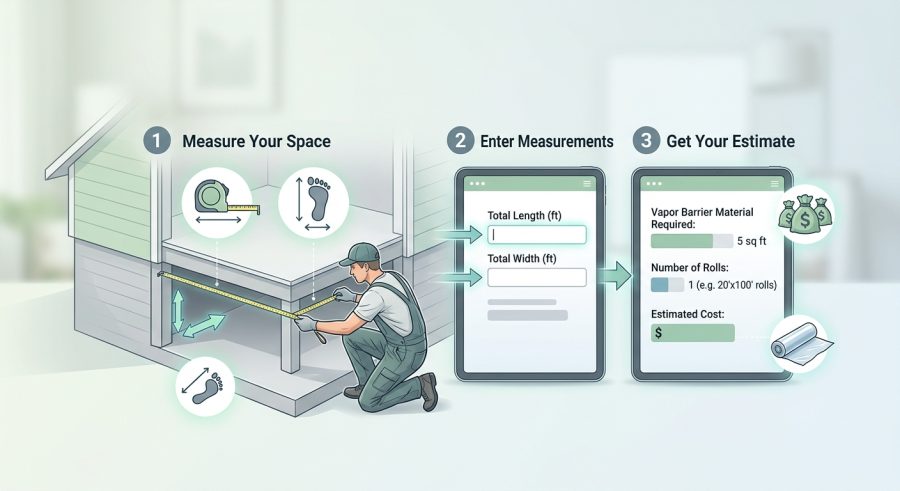
- Measure the length and width of the wall, floor, or crawl space you plan to cover, and enter both in feet.
- Set the waste and overlap allowance based on how complex the space is (10% for simple rectangles, 15-20% for irregular areas).
- Enter the roll width and roll length listed on the product packaging of your chosen vapor barrier.
- Select the vapor barrier material to see its permeance rating and building code class.
- Enter the cost per roll to get an estimated total material cost.
- Review the results for total area, rolls needed, permeance rating, and estimated cost.
Understanding Each Measurement You Enter
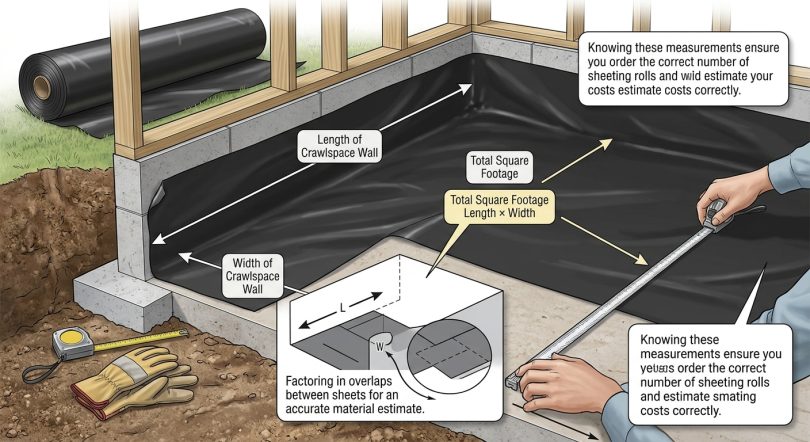
Area Length and Area Width are the dimensions, in feet, of the surface you are covering, such as a wall, subfloor, or crawl space ground area. Multiplying these gives the base square footage.
Waste and Overlap Allowance is a percentage added to the base area to account for seam overlaps, trimming around corners, and cutting mistakes. Simple rectangular rooms typically need less allowance than spaces with many angles or obstructions.
Roll Width and Roll Length, both in feet, describe the size of a single roll of the vapor barrier product, as printed on the packaging. Multiplying these gives the coverage area of one roll.
Vapor Barrier Material lets you select a common product type. Each option carries a permeance value, measured in perms, which reflects how much water vapor can pass through the material.
Cost per Roll, in US dollars, is the price you pay for one roll of material. This is used only to estimate total material cost and does not include labor, tape, or fasteners.
How Area, Rolls, and Cost Are Calculated
Total Area to Cover equals length multiplied by width, both in feet, giving square feet: Area = length * width.
Area Including Waste Allowance adds the chosen percentage: Adjusted Area = length * width * (1 + waste_factor / 100), where waste_factor is entered as a whole number percentage.
Rolls Needed divides the adjusted area by the coverage of one roll and rounds up to a whole roll, since partial rolls cannot be purchased: Rolls = ceil(Adjusted Area / (roll_width * roll_length)).
Material Permeance Rating simply displays the perm value assigned to the selected material option, based on common industry reference figures rather than a specific manufacturer’s lab test.
Estimated Total Material Cost multiplies rolls needed by cost per roll: Cost = Rolls * cost_per_roll. This assumes every roll is purchased at the same listed price.
Sample Projects Calculated Step by Step
Example 1: Small Basement Wall
Given: length = 12 ft, width = 8 ft, waste = 10%, roll = 10 ft x 50 ft, cost = $60/roll.
Formula: Area = length * width; Adjusted = Area * 1.10; Rolls = ceil(Adjusted / 500).
Substitution: Area = 12 * 8 = 96 sq ft; Adjusted = 96 * 1.10 = 105.6 sq ft; Rolls = ceil(105.6 / 500) = 1.
Result: 1 roll needed, cost = $60.
Example 2: Standard Crawl Space Floor
Given: length = 20 ft, width = 15 ft, waste = 10%, roll = 10 ft x 100 ft, cost = $50/roll.
Substitution: Area = 20 * 15 = 300 sq ft; Adjusted = 300 * 1.10 = 330 sq ft; Rolls = ceil(330 / 1000) = 1.
Result: 1 roll needed, cost = $50.
Example 3: Larger Crawl Space with Kraft-Faced Insulation
Given: length = 40 ft, width = 30 ft, waste = 15%, roll = 6 ft x 25 ft, cost = $35/roll.
Substitution: Area = 40 * 30 = 1200 sq ft; Adjusted = 1200 * 1.15 = 1380 sq ft; Rolls = ceil(1380 / 150) = ceil(9.2) = 10.
Result: 10 rolls needed, cost = $350.
Example 4: Large Subfloor with Foil-Faced Kraft Paper
Given: length = 100 ft, width = 50 ft, waste = 20%, roll = 20 ft x 200 ft, cost = $75/roll.
Substitution: Area = 100 * 50 = 5000 sq ft; Adjusted = 5000 * 1.20 = 6000 sq ft; Rolls = ceil(6000 / 4000) = 2.
Result: 2 rolls needed, cost = $150.
Permeance Values and Class by Material
| Material | Permeance (perm) | Class |
|---|---|---|
| Polyethylene Sheeting, 6 mil | 0.06 | I |
| Polyethylene Sheeting, 10 mil | 0.05 | I |
| Foil-Faced Kraft Paper | 0.05 | I |
| Vapor Retarder Paint | 1.00 | II |
| Kraft Facing on Insulation | 1.00 | II |
| Standard Latex Paint | 8.00 | III |
Class I materials have a permeance of 0.1 perm or lower, Class II materials fall between 0.1 and 1.0 perm, and Class III materials range from 1.0 to 10 perms. These figures are general reference values and can vary by manufacturer and product thickness.
Reading Your Coverage and Cost Results
Total Area to Cover is the raw square footage of your surface before any waste is added. Use it to sanity-check your measurements.
Area Including Waste Allowance is the number that actually determines how much material to buy, since it accounts for seams and cutting loss.
Rolls Needed is always rounded up to a whole number because suppliers sell full rolls only. If your adjusted area is close to a roll boundary, consider rounding up further for a safety margin.
Material Permeance Rating tells you the vapor class of your selected product, which matters for meeting local building code requirements in certain climate zones.
Estimated Total Material Cost reflects material only. Actual project cost will be higher once labor, tape, fasteners, and any additional trim material are included.
What Changes Your Material Needs
Surface shape and obstructions: Complex layouts with corners, pipes, or vents need more waste allowance than this calculator’s simple length-times-width model assumes. Increase the waste percentage manually for irregular spaces.
Roll size availability: Actual product roll dimensions vary by brand. The calculator only reflects the roll width and length you enter, so double-check the package label.
Material selection: Choosing a different material changes the permeance rating and class shown, which can affect code compliance, but it does not change the area or roll math.
Waste allowance choice: A higher waste percentage directly increases the adjusted area, rolls needed, and total cost, so this single input has a large effect on your estimate.
Multi-plane installations: Covering a floor and adjoining walls as separate planes requires running this calculator once per plane, since the tool assumes one continuous surface.
Errors That Lead to Under-Buying Material
- Forgetting seam overlap: Installers often overlap seams by 6 inches or more; if you do not add enough waste allowance, you may run short.
- Mixing units: Entering roll dimensions in inches while area is in feet will produce an inaccurate roll count. Keep all measurements in feet.
- Ignoring irregular areas: Treating an L-shaped room as one simple rectangle can under- or over-estimate material. Break complex spaces into sections and calculate separately.
- Choosing the wrong material for the climate: Vapor barrier class requirements vary by climate zone and wall assembly, so material choice should match local code guidance, not just cost.
- Skipping cost for tape and fasteners: The cost result covers rolls only, so budget separately for seam tape, adhesive, and fastening hardware.
- Rounding rolls down: Some users manually reduce the rolls needed to save money, but this calculator always rounds up because partial rolls are not usable.
- Overlooking penetrations: Pipes, outlets, and vents require careful sealing and extra material that a basic area calculation does not capture.
What This Tool Does Not Account For
This calculator provides a planning estimate, not an exact material order. It assumes one continuous, mostly rectangular surface and does not automatically account for windows, doors, pipe penetrations, or complex framing. Permeance values are general reference figures and may differ from a specific manufacturer’s tested product, so always confirm ratings against the product data sheet.
Building code requirements for vapor barriers and vapor retarders vary by region, climate zone, and wall assembly type. This tool does not determine code compliance for your specific project. For structural, moisture control, or code-related decisions, consult a qualified contractor, building inspector, or licensed professional before purchasing materials or beginning installation.
Vapor Barrier vs Vapor Retarder Explained
A vapor barrier is a material with very low permeance, typically 0.1 perm or less, that nearly stops water vapor from passing through. A vapor retarder is a broader term covering materials that slow, but do not fully block, vapor movement, including Class II products like kraft-faced insulation. Both terms are used in building codes, and the right choice depends on your climate zone, wall assembly, and whether the assembly needs to dry inward, outward, or both.
Handling Crawl Spaces and Basement Floors
For crawl space ground covers, measure the full footprint length and width, and increase the waste allowance to 15% or 20% to account for wrapping material up foundation walls and around support piers. For basement floors, treat the floor as one plane and any adjoining walls as separate planes if you plan to cover both, running the calculator once for each surface.
Choosing a Waste Allowance That Fits Your Job
A 10% waste allowance generally works for simple, open rectangular rooms with few obstructions. Rooms with multiple corners, pipes, ductwork, or support columns often need 15% to 20% to cover extra cutting and patching. Very complex or oddly shaped spaces may need even more, and it is safer to round the allowance up than to run short mid-installation.
Vapor Barrier Questions Answered
What is a vapor barrier and why do I need one?
A vapor barrier is a material installed to stop or slow water vapor from moving through walls, floors, or crawl spaces. It helps prevent condensation, mold growth, and moisture damage inside building assemblies, especially in climates with large temperature swings between indoors and outdoors.
How are vapor barrier materials classified into Class I, II, and III?
Classification is based on permeance, measured in perms. Class I materials have a permeance of 0.1 perm or less, Class II materials range from 0.1 to 1.0 perm, and Class III materials range from 1.0 to 10 perms. This calculator shows the permeance and implied class for each material option.
How much waste allowance should I use for my project?
A 10% allowance works well for simple rectangular rooms. For spaces with corners, obstructions, or irregular shapes, use 15% to 20% or more. The waste allowance directly increases the adjusted area, so choosing a realistic percentage helps avoid running short on material.
Can I use this calculator for a crawl space or basement floor?
Yes. Enter the length and width of the crawl space or basement floor footprint, and increase the waste allowance if the material needs to wrap up walls or around piers. For multiple surfaces, such as a floor plus walls, run the calculator separately for each plane.
What is the difference between a vapor barrier and a vapor retarder?
A vapor barrier has very low permeance and nearly blocks vapor movement, while a vapor retarder slows vapor movement without fully stopping it. Class I materials are typically called vapor barriers, while Class II and III materials are usually described as vapor retarders.
How do I pick the right material for my climate zone?
Material choice depends on climate, wall assembly design, and local building code requirements, which vary by region. This calculator shows permeance and class for common materials, but a qualified contractor or building professional should confirm the correct choice for your specific location and construction type.
Does this calculator include seams, tape, or fasteners in the cost?
No. The estimated cost result covers vapor barrier material rolls only. Seam tape, adhesive, staples, and other fasteners are separate expenses that should be budgeted for in addition to the material cost shown here.
How accurate is the roll estimate compared to what I will actually use?
The roll estimate is a planning figure based on the area, waste allowance, and roll size you enter. Actual usage can vary due to irregular room shapes, penetrations, and installation technique, so treat the result as a starting point and consider rounding up for complex jobs.
Planning Your Vapor Barrier Purchase
Use this calculator as a starting point for budgeting and material planning on your vapor barrier project. It gives you a quick estimate of area, rolls, permeance class, and cost, but real-world factors like room shape, penetrations, and local code requirements can change what you actually need, so confirm final material choices with a qualified professional when the project involves structural or moisture control decisions.
