
This calculator estimates how many wallpaper rolls you need by measuring your room’s wall area, subtracting door and window openings, and dividing by the coverage of a single roll plus a waste allowance. Enter your room width, length, and wall height, along with door and window sizes and your roll dimensions, all in the same unit system. The result shows total wall area, rolls needed, and leftover material.
Wallpaper Roll Calculator: Estimate Rolls & Waste Needed
Calculate how many wallpaper rolls you need based on room size, doors, windows, roll dimensions, and waste allowance.
What This Wallpaper Estimator Figures Out
This tool estimates the number of wallpaper rolls needed to cover a rectangular room’s walls. It works by calculating total wall surface area, subtracting the space taken up by doors and windows, and dividing that net area by how much surface a single roll covers. A waste allowance is added to account for pattern matching, trimming, and cutting mistakes that happen during real installation.
Homeowners, DIY renovators, interior designers, and decorating contractors can use it to budget material and cost before buying wallpaper. The result is an estimate, not an exact figure, because real installations involve pattern repeats, wall irregularities, and cutting choices that vary by project.
Steps to Get an Accurate Roll Count

- Measure your room width, length, and wall height in either feet or meters, and enter them into the calculator.
- Count your doors and windows, then enter their average width and height.
- Check the packaging or listing for your chosen wallpaper roll’s width and length, and enter those values in the same unit as your room measurements.
- Set a waste allowance percentage between 0 and 30, using a higher number for large pattern repeats.
- Review the results: total wall area, coverage per roll, rolls needed, total wallpaper purchased, and waste allowance area.
Measuring Your Room, Openings, and Roll Size
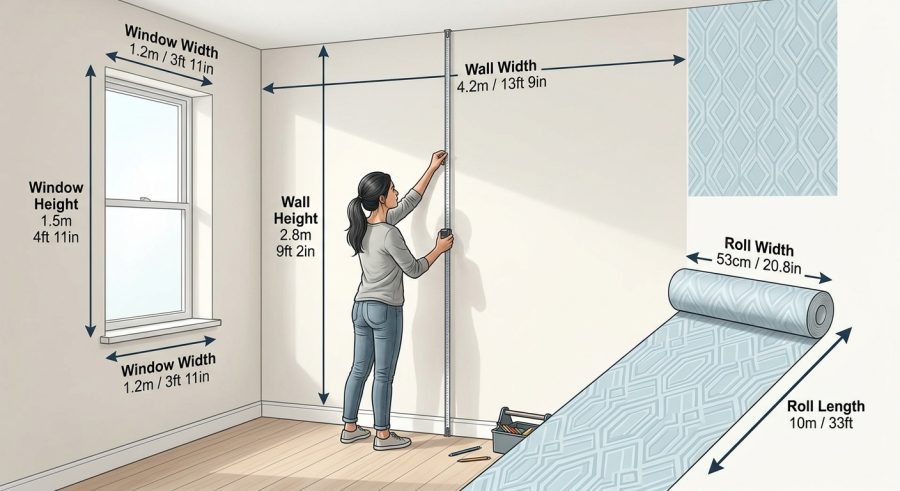
Room Width and Room Length are the floor dimensions of the room, entered in feet or meters. Together with wall height they determine the total wall perimeter area.
Wall Height is the vertical distance from floor to ceiling, in the same unit as room width and length.
Number of Doors and Average Door Width and Height describe the door openings that will not be wallpapered. If doors vary in size, use an average width and height.
Number of Windows and Average Window Width and Height work the same way for window openings.
Roll Width and Roll Length come from the wallpaper product label, entered in the same unit system as your room measurements. Standard rolls vary by manufacturer and region, so check the specific product you plan to buy.
Waste Allowance is a percentage added to the net wall area to cover pattern matching, trimming, and mistakes. Higher percentages suit large pattern repeats or complex rooms.
How Wall Area and Roll Count Are Calculated
The calculator applies five formulas. All linear inputs must share one unit system, either feet or meters, so the resulting area is in square feet or square meters accordingly.
Total Wall Area equals 2 times the sum of room width and room length, times wall height, minus the total door area and total window area:
Total Wall Area = (2 x (Room Width + Room Length) x Wall Height) – (Number of Doors x Door Width x Door Height) – (Number of Windows x Window Width x Window Height)
Coverage per Roll equals Roll Width times Roll Length, giving the usable area one roll provides.
Rolls Needed equals the Total Wall Area multiplied by (1 plus Waste Allowance divided by 100), then divided by Coverage per Roll, rounded up to the next whole number since partial rolls cannot be purchased.
Total Wallpaper Purchased equals Rolls Needed multiplied by Coverage per Roll, showing the actual material area supplied by whole rolls.
Waste Allowance Area equals Total Wall Area multiplied by (Waste Allowance divided by 100), showing how much extra area the waste percentage sets aside.
This model treats the room as a simple rectangle with four uniform walls and does not account for pattern repeat matching across individual strips, which can raise real-world roll needs for heavily patterned wallpaper.
Sample Rooms Calculated Step by Step
Example 1: Standard bedroom, imperial units
Given: room width 12 ft, room length 15 ft, wall height 8 ft, 1 door (3 ft x 6.67 ft), 2 windows (3 ft x 4 ft each), roll width 1.75 ft, roll length 33 ft, waste 10 percent.
Formula: Total Wall Area = (2 x (12+15) x 8) – (1 x 3 x 6.67) – (2 x 3 x 4)
Substitution: (2 x 27 x 8) – 20.01 – 24 = 432 – 20.01 – 24
Calculation: 387.99 sq ft net area. Coverage per roll = 1.75 x 33 = 57.75 sq ft. Rolls needed = ceil(387.99 x 1.10 / 57.75) = ceil(7.39) = 8 rolls.
Final result: 8 rolls, 462 sq ft purchased, 38.80 sq ft waste allowance.
Example 2: Small bedroom, metric units
Given: room width 4 m, room length 5 m, wall height 2.4 m, 1 door (0.9 m x 2.1 m), 2 windows (1.2 m x 1.2 m each), roll width 0.53 m, roll length 10.05 m, waste 15 percent.
Formula: Total Wall Area = (2 x (4+5) x 2.4) – (1 x 0.9 x 2.1) – (2 x 1.2 x 1.2)
Substitution: (2 x 9 x 2.4) – 1.89 – 2.88 = 43.2 – 1.89 – 2.88
Calculation: 38.43 sq m net area. Coverage per roll = 0.53 x 10.05 = 5.33 sq m. Rolls needed = ceil(38.43 x 1.15 / 5.33) = ceil(8.30) = 9 rolls.
Final result: 9 rolls, 47.94 sq m purchased, 5.76 sq m waste allowance.
Example 3: Small room, minimal openings
Given: room width 10 ft, room length 12 ft, wall height 8 ft, 0 doors, 1 window (2 ft x 3 ft), roll width 1.75 ft, roll length 33 ft, waste 5 percent.
Formula: Total Wall Area = (2 x (10+12) x 8) – 0 – (1 x 2 x 3)
Substitution: (2 x 22 x 8) – 6 = 352 – 6
Calculation: 346 sq ft net area. Coverage per roll = 57.75 sq ft. Rolls needed = ceil(346 x 1.05 / 57.75) = ceil(6.29) = 7 rolls.
Final result: 7 rolls, 404.25 sq ft purchased, 17.30 sq ft waste allowance.
Example 4: Large room with double rolls
Given: room width 20 ft, room length 25 ft, wall height 9 ft, 2 doors (3 ft x 6.67 ft each), 3 windows (4 ft x 5 ft each), roll width 1.75 ft, roll length 66 ft (double roll), waste 12 percent.
Formula: Total Wall Area = (2 x (20+25) x 9) – (2 x 3 x 6.67) – (3 x 4 x 5)
Substitution: (2 x 45 x 9) – 40.02 – 60 = 810 – 40.02 – 60
Calculation: 709.98 sq ft net area. Coverage per roll = 1.75 x 66 = 115.5 sq ft. Rolls needed = ceil(709.98 x 1.12 / 115.5) = ceil(6.88) = 7 rolls.
Final result: 7 rolls, 808.5 sq ft purchased, 85.20 sq ft waste allowance.
Common Wallpaper Roll Sizes to Reference
| Roll Type | Typical Width | Typical Length | Approx. Coverage |
|---|---|---|---|
| US single roll | 1.5-1.75 ft (18-21 in) | 27-33 ft | 40-58 sq ft |
| European standard roll | 0.53 m | 10.05 m | about 5.33 sq m |
| Double roll | 1.5-1.75 ft | 54-66 ft | 80-115 sq ft |
| Wide-format roll | 0.7-1 m | 10-15 m | 7-15 sq m |
These figures are general references. Always confirm exact width and length printed on the wallpaper you plan to buy, since sizes vary by manufacturer and product line.
Reading Your Coverage and Roll Results
Total Wall Area to Cover is the net surface area after subtracting doors and windows, shown in square feet or square meters depending on your input units.
Coverage per Roll shows how much area one roll can cover before cutting losses.
Rolls Needed is the primary output, rounded up to a whole number since you must buy complete rolls.
Total Wallpaper Purchased reflects the actual area supplied by the rolls you buy, which is often larger than the net wall area because of rounding up.
Waste Allowance Area shows how much of that purchased material is reserved for cutting, trimming, and pattern matching rather than visible coverage.
These results are estimates. Actual roll usage can shift based on pattern repeat, wall layout, and how carefully strips are cut and matched during installation.
What Changes Your Actual Roll Count
Pattern repeat: Large or complex repeating patterns require more matching and cutting, which this calculator does not model directly. Increase the waste allowance to compensate.
Wall irregularities: Alcoves, closets, sloped ceilings, and jogs in the wall are not included in this rectangular room model and require manual adjustment.
Door and window count accuracy: Using average sizes for multiple openings is accounted for, but very different door or window sizes in the same room will reduce accuracy.
Unit consistency: Mixing feet and meters between room and roll dimensions produces incorrect results. This calculator assumes all inputs share one unit system.
Waste percentage choice: A higher waste allowance directly increases rolls needed and total material purchased, so this setting has a large effect on the final count.
Measurement Errors That Waste Money
- Mixing units: Entering room dimensions in feet and roll dimensions in meters produces a meaningless result; keep every measurement in one unit system.
- Ignoring pattern repeat: Large patterns need more waste allowance than plain or small-print wallpaper; raise the waste percentage accordingly.
- Forgetting openings: Skipping door and window entries overestimates the wallpaper needed, wasting money on unused rolls.
- Using outside wall length: Measure interior wall dimensions, not the outer building footprint, since interior walls are shorter due to wall thickness.
- Rounding down rolls: Never round the roll count down to save money; partial rolls cannot be split between walls once cut.
- Assuming leftover reuse: Cut-offs from one wall may not match cleanly on another wall due to pattern direction, so treat leftovers as a buffer, not guaranteed usable material.
- Overlooking ceiling or accent areas: This calculator covers four standard walls only; ceilings and separate feature walls need their own calculation.
Where This Estimate Falls Short
This calculator provides a planning estimate for a rectangular room with four uniform walls. It does not account for pattern repeat matching, sloped ceilings, alcoves, closets, or irregular wall shapes, all of which can increase actual material needs. Door and window sizes are treated as averages, so rooms with widely varying opening sizes may see reduced accuracy.
Roll sizes vary by manufacturer, country, and product line, so always verify the exact width and length of your chosen wallpaper before finalizing a purchase. For complex layouts, specialty patterns, or large commercial projects, consult a professional decorator or installer to confirm material quantities before buying.
Adjusting Waste Allowance for Pattern Repeat
Plain or textured wallpaper with no visible repeat typically needs a waste allowance of 5 to 10 percent. Patterns with a small repeat, under about 12 inches or 30 centimeters, generally need 10 to 15 percent. Large-scale patterns with repeats over 20 inches or 50 centimeters often require 15 to 25 percent because each strip must be cut to align with the previous one, creating more offcuts. When in doubt, check the manufacturer’s pattern repeat specification and choose a higher waste percentage in this calculator rather than a lower one.
Calculating for Accent Walls or Partial Rooms
This calculator assumes wallpaper covers all four walls of a room. For a single accent wall, you can still use it by treating the room width and length so that the perimeter formula equals just the length of that one wall doubled, or by calculating the accent wall’s area separately as width times height minus any openings, then dividing by coverage per roll and rounding up. This manual approach keeps the roll count accurate for partial coverage projects.
Single Rolls Versus Double Rolls
Wallpaper is sold as single rolls or double rolls, and the difference is length, not width. A double roll typically has the same width as a single roll but twice the length, so it covers roughly twice the area per unit purchased. When entering roll length in this calculator, use the actual length printed on the packaging, whether that reflects a single or double roll, so the coverage per roll calculation stays accurate.
Wallpaper Roll Questions Answered
How do I measure a room for a wallpaper roll calculation?
Measure the width and length of the room's floor and the height from floor to ceiling, using either feet or meters consistently. Then measure the width and height of each door and window opening you plan to leave uncovered. Enter these figures into the calculator along with your roll dimensions and waste allowance.
What is a standard wallpaper roll size?
Standard rolls vary by region and manufacturer. Common US single rolls are about 1.5 to 1.75 feet wide and 27 to 33 feet long. European rolls are often 0.53 meters wide and 10.05 meters long. Always check the specific product label since sizes differ between brands.
How much extra wallpaper should I buy for pattern matching?
For plain or lightly textured wallpaper, a 5 to 10 percent waste allowance is usually enough. Patterns with large or complex repeats often need 15 to 25 percent extra because more material is trimmed to align each strip. Adjust the waste allowance field based on your chosen pattern's repeat size.
Do I need to subtract windows and doors from the wall area?
Yes, this calculator automatically subtracts the area of doors and windows from the total wall area, since those openings are not wallpapered. Enter the number of doors and windows along with their average width and height to get an accurate net coverage area.
How does the waste percentage change the number of rolls I need?
The waste percentage increases the net wall area before it is divided by roll coverage, so a higher percentage raises both the rolls needed and total wallpaper purchased. For example, moving from 10 percent to 20 percent waste on the same room can push the rolls needed result up by one or more rolls.
What happens if my wallpaper has a large pattern repeat?
Large pattern repeats are not factored into this calculator's core formula directly, so you should compensate by choosing a higher waste allowance, often 15 to 25 percent, to account for extra trimming needed to align the pattern between strips.
Can I use this calculator for an accent wall or partial room?
This calculator is built for a full rectangular room with four walls. For a single accent wall, calculate that wall's area manually as width times height minus any openings, then divide by coverage per roll and round up, since the built-in perimeter formula assumes all four walls are covered.
How do double rolls differ from single rolls in coverage?
Double rolls usually share the same width as single rolls but have roughly twice the length, so they cover about twice the area per roll purchased. Enter the actual roll length from the product packaging, whether single or double, so the coverage per roll result stays accurate.
Planning Your Wallpaper Purchase with Confidence
Estimating wallpaper rolls accurately starts with careful measurements of your room, doors, and windows, paired with the correct roll dimensions and a realistic waste allowance. This calculator turns those numbers into a clear estimate of total wall area, rolls needed, and material purchased, helping you budget before you buy. For patterned wallpaper, complex layouts, or large projects, confirming quantities with a decorating professional can help avoid running short mid-installation.
