
Estimate exactly how many concrete bags you need for post holes by entering your hole diameter, depth, post width, and number of holes below. This calculator automatically converts US or metric measurements, subtracts post volume, adds a waste allowance, and calculates total concrete volume, bags required, and estimated cost so you can buy the right amount of concrete mix the first time.
Concrete Bag Calculator for Post Holes – Bags & Cost
Calculate how many bags of concrete you need for fence, deck, or mailbox post holes, plus total volume and estimated material cost.
What This Post Hole Concrete Estimator Does
This calculator figures out how many bags of ready-mix concrete you need to set posts for fences, decks, mailboxes, or pergolas. It works out the hole volume, subtracts the space your post takes up, adds a waste allowance for spillage and crowning, then converts everything into a bag count and material cost. Homeowners planning a weekend fence job and contractors bidding post-setting work can both use it before heading to the store. Results are estimates based on the measurements you enter, not a substitute for checking actual hole dimensions once digging is complete, since real soil conditions and hole shapes vary.
Steps to Estimate Bags for Your Project
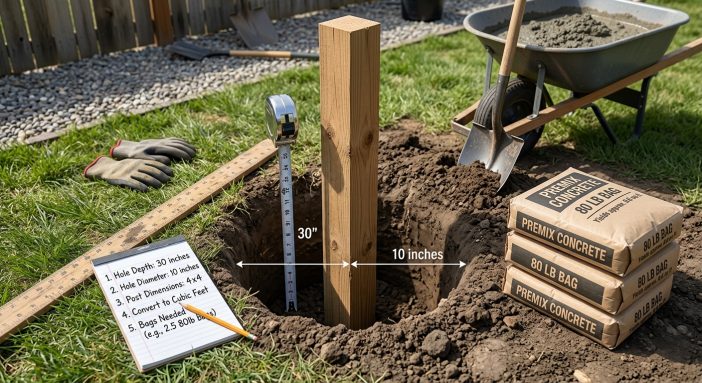
- Select your diameter unit (inches or centimeters) and enter the hole diameter.
- Select your depth unit (feet or meters) and enter the hole depth.
- Choose the hole shape: round for augered holes or square for hand-dug holes.
- Enter the post width or diameter and the total number of post holes.
- Pick your concrete bag size, add a waste percentage, and enter your cost per bag.
- Review the calculated volume, total bags required, and estimated total cost.
Entering Hole Size, Post Width, and Bag Type
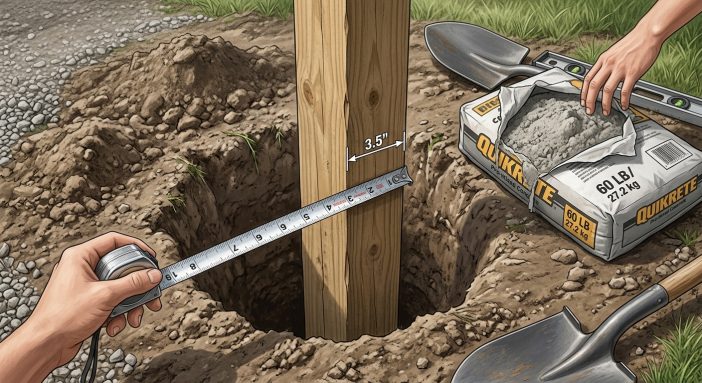
Diameter Measurement Unit lets you switch between inches and centimeters so the hole diameter and post width fields convert correctly. Hole Diameter is the width across the widest point of the dug or augered hole. Depth Measurement Unit switches between feet and meters for the hole depth field. Hole Depth is how far below grade the hole extends. Hole Shape chooses between a round augered hole and a square or rectangular hand-dug hole, which changes the area formula used. Post Width or Diameter is the size of the post itself, used to subtract the volume it displaces. Number of Post Holes scales the result to your whole project. Concrete Bag Size sets how many cubic feet one bag yields once mixed. Waste and Overfill Allowance adds a percentage for spillage and crowning concrete above grade. Cost per Bag is your local price per bag, used to estimate total spending.
How Hole Volume and Bag Count Are Calculated
The calculator first converts diameter and depth into feet using standard conversions: 1 inch equals 0.0833333 feet, 1 centimeter equals 0.0328084 feet, and 1 meter equals 3.28084 feet. Let d be hole diameter in feet, h be hole depth in feet, w be post width in feet, k be the shape factor (0.7853982, which is pi divided by four, for round holes or 1 for square holes), and n be the number of holes.
Volume per hole equals k times d squared times h, minus w squared times h. This subtracts a square cross-section for the post from the hole volume, which is a close approximation even for round posts.
Total volume needed equals volume per hole times n, multiplied by one plus the waste percentage divided by 100.
Total bags required equals total volume divided by the bag’s cubic-foot yield, rounded up to the next whole bag since partial bags cannot be purchased.
Estimated total cost equals total bags multiplied by your entered cost per bag. This assumes consistent bag pricing and does not include delivery fees, tax, or bulk discounts.
Sample Post Hole Concrete Calculations
Example 1: Standard fence post. Given: 10 in round hole, 2 ft deep, 4 in post, 1 hole, 60 lb bags (0.45 cu ft), 10% waste. Formula: volume = 0.7853982 x (10×0.0833333)^2 x 2 minus (4×0.0833333)^2 x 2. Substitution: 0.7853982 x 0.6944 x 2 minus 0.1111 x 2 = 1.0908 minus 0.2222. Calculation: net volume = 0.8686 ft3; with 10% waste, total = 0.9555 ft3; bags = ceil(0.9555/0.45) = 3. Final result: 3 bags, about $15.00 at $5 per bag.
Example 2: Metric deck posts. Given: 30 cm round hole, 0.6 m deep, 10 cm post, 4 holes, 80 lb bags (0.6 cu ft), 15% waste. Calculation: per-hole volume converts to about 1.286 ft3; total volume with waste = 5.916 ft3; bags = ceil(5.916/0.6) = 10. Final result: 10 bags, about $65.00 at $6.50 per bag.
Example 3: Square dug holes. Given: 12 in square hole, 3 ft deep, 6 in post, 2 holes, 50 lb bags (0.375 cu ft), 5% waste. Calculation: per-hole volume = 1.0 x 3 minus 0.25 x 3 = 2.25 ft3; total with waste = 4.725 ft3; bags = ceil(4.725/0.375) = 13. Final result: 13 bags, about $61.75 at $4.75 per bag.
Example 4: Mailbox post. Given: 8 in round hole, 1.5 ft deep, 2 in post, 1 hole, 40 lb bags (0.3 cu ft), 20% waste. Calculation: per-hole volume = 0.5236 minus 0.0417 = 0.4819 ft3; total with waste = 0.5783 ft3; bags = ceil(0.5783/0.3) = 2. Final result: 2 bags, about $8.50 at $4.25 per bag.
Typical Bag Counts by Hole Size
The table below shows approximate bag counts for common post hole sizes, assuming a round augered hole, 60 lb bags (0.45 cu ft yield), and a 10% waste allowance. Actual results will vary based on your exact measurements and bag choice.
| Hole Diameter | Depth | Post Width | Approx. Bags Needed (per hole) |
|---|---|---|---|
| 8 in | 1.5 ft | 4 in | 1 bag |
| 10 in | 2 ft | 4 in | 3 bags |
| 12 in | 3 ft | 4 in | 5 bags |
| 18 in | 3.5 ft | 6 in | 13 bags |
Reading Your Volume, Bag Count, and Cost Results
The primary result is Total Bags Required, always rounded up to the nearest whole bag so you buy enough to finish the job. Concrete Volume per Hole and Total Concrete Volume Needed show the cubic footage behind that bag count, useful if you plan to order bulk mixed concrete instead of bags. Estimated Total Cost multiplies bags by your entered price, giving a quick materials budget before you add tax or delivery. If any volume result shows 0.00, the post width you entered is equal to or larger than the hole diameter, which is not physically possible and means you should re-check your measurements.
What Changes Your Concrete Requirement
Hole shape makes a real difference: augered round holes use a smaller area factor (pi/4) than square hand-dug holes of the same width, so switching shapes can change bag counts by 20 percent or more. Post size matters more on narrow holes, since a thick post in a small hole removes a larger share of the total volume. Waste allowance should increase for uneven ground, rocky soil, or when you plan to crown concrete above grade for drainage. Bag size selection affects both cost per cubic foot and how many bags you physically carry and mix, so match it to your project’s scale. Depth consistency across multiple holes is rarely perfect in real digging, so treat multi-hole totals as an estimate and buy a few extra bags for uneven excavation.
Common Errors When Estimating Post Hole Concrete
A frequent mistake is measuring the auger or post-hole digger size instead of the actual hole after digging, which can be wider due to loose soil sloughing off the sides. Another error is forgetting to subtract post volume entirely, which slightly overestimates concrete needs on small holes but matters more on large piers with thick posts. Some users mix diameter units, entering centimeters while the calculator is set to inches, which produces wildly inaccurate volumes. Skipping the waste allowance is also common; even careful work loses some mix to spillage, bag clumps, and crowning above grade. Finally, rounding down bag counts to save money leads to running short mid-pour, which is far costlier than buying one extra bag.
What This Calculator Does Not Cover
This tool assumes uniform hole diameter and depth for every hole entered; it does not account for holes of varying sizes within the same project. It approximates post cross-section as a square even for round posts, which slightly overestimates the volume subtracted for round posts and is intentional to keep the math conservative. It does not calculate quikrete curing time, rebar or gravel base requirements, or structural load capacity. Prices are a simple multiplication of bag count and unit cost, excluding tax, delivery, and regional pricing variation. Always confirm final hole dimensions on site, since soil type, water table, and digging method can change actual excavated volume.
Post Hole Concrete Questions Answered
How many bags of concrete do I need for one post hole?
It depends on hole diameter, depth, and post width. A typical 10-inch diameter hole, 2 feet deep, with a 4-inch post needs about 3 bags of 60 lb concrete mix with a 10% waste allowance, as shown in the worked examples above.
Should I use round or square in the hole shape setting?
Choose round for holes made with a power or manual auger, which are cylindrical. Choose square for hand-dug holes made with a shovel or clamshell digger, since these are usually closer to a square or irregular rectangular shape.
Why does the calculator subtract the post width from the volume?
The post itself occupies space inside the hole, so the concrete only fills the gap around it. Subtracting post volume prevents overestimating how much concrete mix you actually need to purchase.
How much waste allowance should I add?
10 percent is a reasonable default for most careful pours. Increase it to 15-20 percent for rocky or uneven soil, deep holes, or if you plan to crown concrete above grade for water runoff.
Can I use this calculator for metric measurements?
Yes. Switch the diameter unit to centimeters and the depth unit to meters, and the calculator automatically converts your entries into feet internally before calculating volume and bag count.
What if my result shows zero cubic feet needed?
A zero or negative volume means your entered post width is equal to or larger than the hole diameter, which is not realistic. Double-check that you entered hole diameter and post width in the correct fields.
Does this calculator include gravel base or rebar cost?
No. It only estimates the concrete mix bags and their cost. Gravel drainage base, rebar, post material, and labor are not included and should be budgeted separately.
Is it cheaper to buy bags or order bulk concrete?
For a handful of holes, bagged concrete is usually more convenient and cost-effective. For many deep holes on a large project, bulk delivered concrete often costs less per cubic yard; convert the Total Concrete Volume Needed result to cubic yards to compare.
Planning Your Concrete Purchase With Confidence
Getting post hole concrete right comes down to accurate hole measurements, a sensible waste allowance, and rounding up to full bags. Use this calculator before your next trip to the hardware store to avoid mid-project shortages or excess leftover mix, and adjust your waste percentage based on soil conditions and digging method for the most reliable estimate.

One Response