
Enter your fence height, post width, soil type, local frost depth, and wind exposure to instantly calculate the recommended burial depth, total post length, hole diameter, and concrete volume needed per post and for your whole project. This tool uses standard construction rules of thumb, roughly one-third burial depth, adjusted for soil stability, frost line, and wind load.
Fence Post Depth Calculator – Burial Depth & Concrete
Calculate recommended fence post burial depth, total post length, hole diameter, and concrete volume based on fence height, soil type, frost line, and wind exposure.
Why Fence Post Depth Matters for Stability
This calculator estimates how deep to bury fence posts and how much concrete each hole needs. It helps homeowners, DIY builders, and fencing contractors plan post lengths and order the right amount of concrete before digging. The tool works for wood, metal, or vinyl posts set in round holes.
Results are planning estimates, not exact engineering figures. Actual burial depth may need to change based on local building codes, soil conditions found during digging, and manufacturer instructions for your specific post and bracket system.
Using the Post Depth and Concrete Calculator
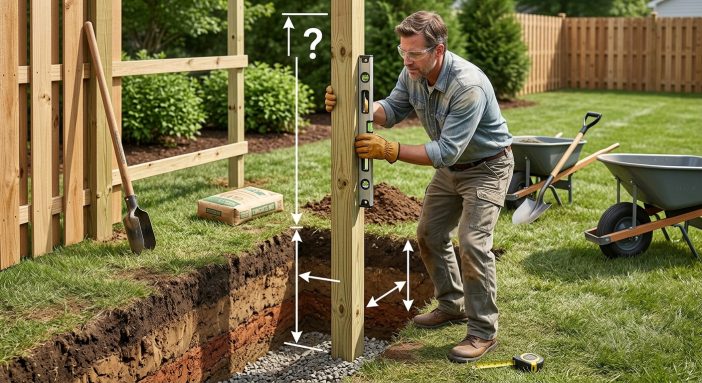
- Enter your fence height above ground in feet.
- Enter your post width or diameter in inches.
- Select the soil type that best matches your yard.
- Enter your local frost line depth in inches, or use 0 if you do not have freezing winters.
- Select your wind exposure level and add an extra footing allowance if you plan to add gravel or extra concrete below the post.
- Enter the total number of posts to see combined concrete volume for the whole project.
What Each Measurement Means for Your Fence
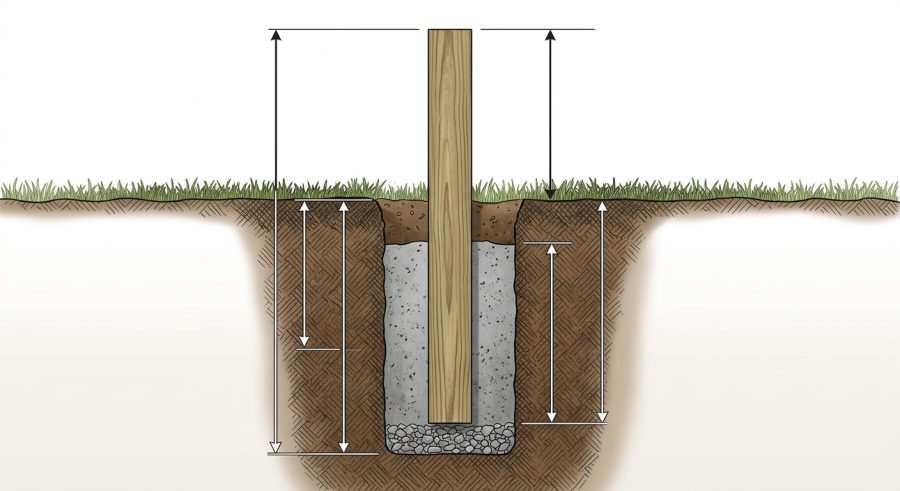
Fence Height Above Ground is the visible height of the fence in feet, measured from ground level to the top of the post or panel. This drives the base one-third burial depth calculation.
Post Width or Diameter is the thickness of your post in inches, whether it is a square 4×4 post, a round post, or a larger 6×6 post. This value sets the recommended hole diameter.
Soil Type adjusts the burial depth. Sandy or loose soil needs extra depth for stability. Dense clay or rocky soil holds posts more firmly and needs slightly less.
Local Frost Line Depth is how far frost penetrates into the ground in your area during winter, measured in inches. Enter 0 if you live somewhere without ground freezing. This number often comes from local building codes.
Wind Exposure Level reflects how exposed your fence line is to wind. Open yards and coastal areas need deeper burial to resist wind load on tall fence panels.
Extra Footing Allowance is additional depth in inches for a gravel base or extra concrete pad below the post, entered in inches.
Number of Posts is the total count of post holes in your project, used to scale the total concrete volume estimate.
How Burial Depth and Concrete Volume Are Calculated
The calculator uses five formulas built on the one-third embedment rule, adjusted for soil, wind, and frost.
Recommended Burial Depth = the greater of (fence height in feet times 12, divided by 3, times soil factor, times wind factor) or the frost line depth, plus the footing allowance. All values are in inches. This ensures the post is deep enough for basic stability or below the frost line, whichever requires more depth.
Total Post Length Needed = fence height in feet plus burial depth in inches divided by 12. This gives the full post length to buy, in feet.
Recommended Hole Diameter = post width in inches times 3. This follows a common guideline that the hole should be about three times wider than the post for adequate concrete surround.
Concrete Volume Per Hole = pi times the hole radius squared times the burial depth, all converted to feet, using the cylinder volume formula. Hole radius is half the hole diameter, and hole diameter divided by 24 converts inches to a radius in feet.
Total Concrete Volume Needed = concrete volume per hole times the number of posts.
These formulas assume a simple cylindrical hole and do not subtract the volume displaced by the post itself, which gives a small safety margin in the concrete estimate.
Sample Calculations for Common Fence Setups
Example 1: Standard 6 ft privacy fence
Given: fence height 6 ft, post width 4 in, average soil, no frost, low wind, 2 in footing.
Formula: max((6*12/3)*1*1, 0) + 2
Substitution: max(24, 0) + 2
Calculation: 24 + 2 = 26 in burial depth. Total post length = 6 + 26/12 = 8.17 ft. Concrete per hole = pi times (12/24)^2 times (26/12) = 1.70 cu ft.
Final result: 26 in burial depth, 8.17 ft post, 12 in hole, 1.70 cu ft concrete per hole.
Example 2: Sandy soil, windy coastal yard
Given: fence height 6 ft, post width 4 in, sandy soil (1.15), high wind (1.25), no frost, 2 in footing.
Formula: max((6*12/3)*1.15*1.25, 0) + 2
Substitution: max(24*1.4375, 0) + 2 = max(34.5, 0) + 2
Calculation: 34.5 + 2 = 36.5 in.
Final result: 36.5 in burial depth, 9.04 ft post length, 12 in hole diameter, 2.39 cu ft concrete per hole.
Example 3: Cold climate with deep frost line
Given: fence height 4 ft, post width 4 in, dense clay soil (0.85), low wind, frost depth 36 in, 2 in footing.
Formula: max((4*12/3)*0.85*1, 36) + 2
Substitution: max(13.6, 36) + 2
Calculation: 36 + 2 = 38 in, since frost depth exceeds the soil-adjusted base depth.
Final result: 38 in burial depth, 7.17 ft post length, 12 in hole diameter, 2.49 cu ft concrete per hole.
Example 4: Larger fence project with 12 posts
Given: fence height 8 ft, post width 6 in, average soil, medium wind (1.1), no frost, 3 in footing, 12 posts.
Formula: max((8*12/3)*1*1.1, 0) + 3
Substitution: max(32*1.1, 0) + 3 = max(35.2, 0) + 3
Calculation: 35.2 + 3 = 38.2 in burial depth. Hole diameter = 6*3 = 18 in. Concrete per hole = pi times (18/24)^2 times (38.2/12) = 5.63 cu ft. Total = 5.63 times 12.
Final result: 38.2 in burial depth, 11.18 ft post length, 18 in hole diameter, 67.50 cu ft total concrete for 12 posts.
Typical Burial Depths by Height and Soil Type
| Fence Height | Soil Type | Wind Exposure | Recommended Burial Depth |
|---|---|---|---|
| 4 ft | Average | Low | 18.0 in |
| 6 ft | Average | Low | 26.0 in |
| 6 ft | Sandy | High | 36.5 in |
| 6 ft | Dense Clay | Low | 22.4 in |
| 8 ft | Average | Medium | 37.2 in |
Table assumes no frost line adjustment and a 2 inch footing allowance. Always compare these figures against your local frost depth requirement.
Reading Your Depth, Length, and Concrete Results
Recommended Burial Depth is the main output, shown in inches. It combines the one-third rule adjusted for soil and wind with your frost line and footing allowance, using whichever value is deeper.
Total Post Length Needed tells you what length of post to buy, in feet, so the post reaches full height above ground plus the calculated burial depth.
Recommended Hole Diameter gives the suggested hole width in inches so there is enough room around the post for concrete.
Concrete Volume Per Hole and Total Concrete Volume Needed are shown in cubic feet. Use the per-hole figure to check a single post and the total figure to order concrete for the entire project. Round up slightly when ordering material to allow for uneven holes or spillage.
Conditions That Change How Deep to Dig
- Fence height: Taller fences need deeper burial and are directly accounted for through the one-third rule.
- Soil type: Loose or sandy soil reduces holding strength, so the calculator increases depth. Dense clay or rocky soil holds posts more firmly, so it slightly reduces the base depth.
- Frost line depth: In freezing climates, posts must sit below the frost line or they can heave upward over winter. The calculator always uses the frost depth if it exceeds the soil-adjusted base depth.
- Wind exposure: Open or coastal areas apply more lateral force to fence panels, so higher wind settings increase the recommended depth.
- Footing allowance: Added gravel or concrete pad thickness is added directly to the final depth.
- Post material: This calculator does not distinguish between wood, metal, or vinyl posts, though heavier or larger posts may benefit from extra depth beyond the estimate.
Digging and Setting Mistakes to Avoid
- Ignoring the frost line: Skipping frost depth in cold climates can cause posts to heave and lean within a year or two.
- Using the same depth for every soil type: Loose sandy soil needs more depth than firm clay for the same fence height.
- Digging a hole too narrow: A hole close to the post width leaves little room for concrete, weakening the bond.
- Forgetting the footing allowance: Skipping a gravel base at the bottom of the hole can trap water against the post and speed up rot or rust.
- Underestimating concrete needs: Ordering concrete for the post length only, without accounting for the wider hole diameter, often leads to running short mid-project.
- Not checking local codes: Some areas require specific minimum burial depths regardless of the one-third rule.
- Assuming one hole size fits all posts: Corner and gate posts often need extra depth and a wider hole than standard line posts.
What This Estimate Does Not Cover
This calculator provides planning estimates based on common construction guidelines, not a certified structural design. It does not account for extreme wind zones, seismic activity, unusual soil conditions like expansive clay, or specific manufacturer bracket requirements. Frost line depth and minimum burial requirements vary by region and local building code, so always confirm exact figures with your local building department.
The concrete volume estimate assumes a simple cylindrical hole and does not subtract the space taken up by the post itself, which gives a small safety margin. For gate posts, corner posts, retaining structures, or any load-bearing application beyond a standard residential fence, consult a qualified contractor or structural engineer before finalizing your design.
The One-Third Rule and When It Changes
The one-third rule is a widely used guideline that says a post should be buried to roughly one-third of its total above-ground height. For a 6 foot fence, that works out to about 24 inches of base burial depth before other adjustments. This calculator starts with that rule, then checks whether soil type, wind exposure, or frost depth requires a deeper hole, and uses whichever number is larger.
Concrete Versus Gravel Footings
Some builders set posts in solid concrete for maximum stability, while others use compacted gravel with a concrete collar near the surface. Gravel allows water to drain away from the post base, which can reduce rot in wood posts. The extra footing allowance field lets you add a few inches of gravel depth below the post without changing the core burial depth calculation. If you are estimating bagged concrete for post holes, a concrete bag calculator for post holes can convert the cubic foot totals here into an actual bag count.
Adjusting for Frost Heave in Cold Climates
In regions with freezing winters, water in the soil expands as it freezes, which can slowly push shallow posts upward over several seasons. Setting the post base below the frost line reduces this risk because the soil at that depth stays at a more stable temperature. If your local frost depth is deeper than the soil-and-wind-adjusted base depth, this calculator automatically uses the frost depth instead, so your posts are set to the safer, deeper measurement.
Fence Post Depth Questions Answered
How deep should a fence post be buried for a 6 foot fence?
For a standard 6 foot fence in average soil with low wind exposure and no frost concerns, this calculator recommends about 26 inches of burial depth, which includes a 2 inch footing allowance. Sandy soil or high wind exposure will increase that number, while dense clay soil slightly reduces it.Always check local codes before finalizing your depth.
Does frost line depth change how deep I need to dig?
Yes. If your local frost line is deeper than the soil-and-wind-adjusted base depth, the calculator uses the frost depth instead. This is important in cold climates because posts set above the frost line can heave upward as the ground freezes and thaws each year.
How much concrete do I need per fence post?
The calculator estimates concrete volume per hole in cubic feet using a cylindrical hole shape based on your calculated hole diameter and burial depth. Multiply that figure by your total post count, shown as the total concrete volume result, to estimate material for your whole project.
What is the one-third rule for fence posts?
The one-third rule is a common guideline stating that roughly one-third of a post's total length should be buried underground for basic stability. This calculator uses that rule as a starting point, then adjusts it for soil type, wind exposure, and frost depth.
How does soil type affect post depth?
Sandy or loose soil holds posts less firmly, so the calculator increases burial depth for stability. Dense clay or rocky soil grips posts more tightly, allowing for a slightly shallower base depth. Average loamy soil uses the standard one-third rule with no adjustment.
Should wind exposure change my burial depth?
Yes. Fences in open yards or windy coastal areas experience more lateral force, especially on tall solid panels. This calculator applies a wind factor that increases burial depth for medium and high exposure settings compared to sheltered, low-wind locations.
Can I use gravel instead of concrete for footing?
Many builders use compacted gravel at the base of the hole for drainage, sometimes topped with a shorter concrete collar near the surface. Use the extra footing allowance field to add this gravel depth, and reduce the concrete volume manually if you plan to fill part of the hole with gravel instead of concrete.
Are these results exact enough to skip checking local codes?
No. These results are planning estimates based on general construction guidelines, not a substitute for local building codes or engineering review. Frost depth requirements and minimum burial rules vary by location, so confirm exact requirements with your local building department before digging.
Planning Your Post Holes with Confidence
Getting fence post depth right protects your fence from leaning, heaving, and premature failure. This calculator combines the one-third rule with soil type, frost line, and wind exposure to give you a practical burial depth, post length, and concrete estimate for your project. Use these figures as a solid starting point, then confirm final depth requirements with your local building code before you dig.
