
This concrete curb and gutter calculator estimates the concrete volume and material cost for a curb-and-gutter run by combining the trapezoidal curb face with the rectangular gutter pan cross-section, then multiplying by length and adding a waste allowance. Enter your curb height, top and base widths, gutter width and thickness, run length, waste percentage, and cost per cubic yard to get instant volume and cost results.
Concrete Curb and Gutter Calculator: Volume & Cost
Estimate concrete volume and material cost for a curb-and-gutter run from curb height, widths, gutter dimensions, length, and waste allowance.
What This Curb and Gutter Calculator Measures
This calculator estimates concrete volume and material cost for a curb-and-gutter run by treating the shape as two combined cross-sections: a trapezoidal curb face and a rectangular gutter pan. It is built for concrete contractors, site estimators, municipal crews, and homeowners planning a curb replacement or new installation.
Use it during early takeoff or bidding to size a ready-mix order, or during final planning to sanity-check a supplier quote. Results are estimates based on the dimensions you enter, not exact field measurements, so actual quantities can vary once forms are set and subgrade is graded.
Steps to Estimate Your Concrete Order
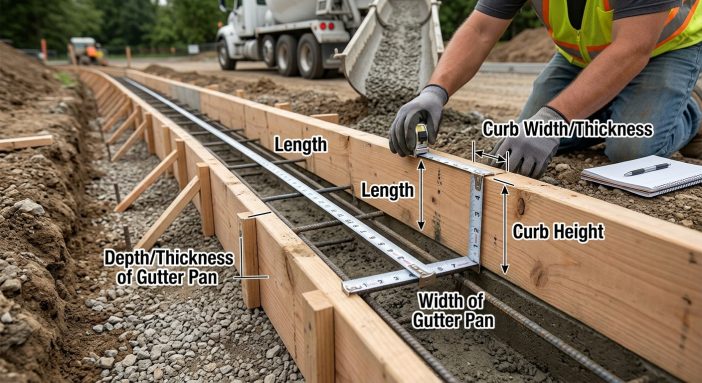
- Measure the total run length of curb and gutter you plan to pour, in feet.
- Measure the curb face height and its top and base widths, in inches, from your project plans or field measurements.
- Measure the gutter pan width and thickness, in inches, next to the curb face.
- Enter a waste percentage to cover subgrade irregularities, spillage, and minor form leakage.
- Enter your ready-mix concrete price per cubic yard from your supplier’s quote.
- Review the cross-sectional area, volume in cubic feet, cubic yards, cubic meters, and estimated cost results.
Understanding Each Measurement You Enter
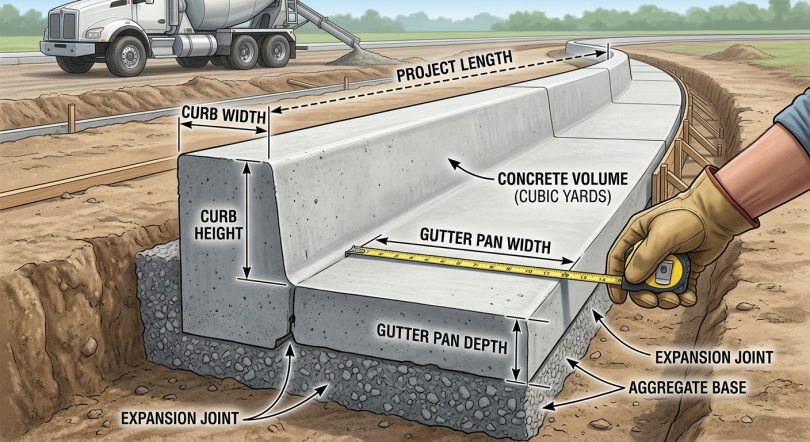
Total Curb & Gutter Run Length (ft): the full straight-line length of the run you are pouring, measured in feet.
Curb Face Height (in): the vertical height of the curb face, from the gutter pan surface to the top of the curb, in inches.
Curb Top Width (in): the width across the top surface of the curb, in inches.
Curb Base Width (in): the width across the bottom of the curb where it meets the gutter pan, in inches.
Gutter Pan Width (in): the width of the flat gutter section next to the curb face, in inches.
Gutter Pan Thickness (in): the slab thickness of the gutter pan, in inches.
Waste / Overage Allowance (%): a percentage added to cover subgrade irregularities, form leakage, and spillage during the pour.
Concrete Cost per Cubic Yard ($/yd3): your supplier’s ready-mix price for the specified mix design.
How Curb and Gutter Volume Is Calculated
The calculator first finds a single cross-sectional area by adding a trapezoid for the curb face to a rectangle for the gutter pan.
Curb area = ((Top Width + Base Width) / 2) x Curb Face Height, in square inches.
Gutter area = Gutter Width x Gutter Thickness, in square inches.
Cross-Sectional Area = Curb area + Gutter area, in square inches.
To get volume, the area is converted from square inches to square feet by dividing by 144, then multiplied by the run length in feet, then increased by the waste percentage:
Volume (cubic feet) = (Cross-Sectional Area / 144) x Length x (1 + Waste% / 100).
Volume (cubic yards) = Volume (cubic feet) / 27, since one cubic yard equals 27 cubic feet.
Volume (cubic meters) = Volume (cubic feet) x 0.0283168, the standard cubic-foot-to-cubic-meter conversion factor.
Estimated Material Cost = Volume (cubic yards) x Cost per Cubic Yard.
This method assumes the cross-section is constant along the entire run, with no curves, transitions, or driveway openings included in the shape.
Sample Curb and Gutter Volume Calculations
Example 1: Standard residential run. Given: length 100 ft, curb height 6 in, top width 6 in, base width 8 in, gutter width 24 in, gutter thickness 6 in, waste 10%, cost $150/yd3. Formula: Area = ((6+8)/2)x6 + (24×6). Substitution: (7×6) + 144 = 42 + 144 = 186 in2. Volume = (186/144) x 100 x 1.10 = 1.2917 x 100 x 1.10 = 142.08 ft3. Cubic yards = 142.08 / 27 = 5.26 yd3. Cost = 5.26 x $150 = $789.35. Final result: about 5.26 yd3 costing roughly $789.
Example 2: Larger municipal section. Given: length 500 ft, curb height 8 in, top width 6 in, base width 10 in, gutter width 36 in, gutter thickness 8 in, waste 15%, cost $160/yd3. Area = ((6+10)/2)x8 + (36×8) = (8×8) + 288 = 64 + 288 = 352 in2. Volume = (352/144) x 500 x 1.15 = 2.4444 x 500 x 1.15 = 1405.56 ft3. Cubic yards = 1405.56 / 27 = 52.06 yd3. Cost = 52.06 x $160 = $8,329.22. Final result: about 52.06 yd3 costing roughly $8,329.
Example 3: Small driveway curb section. Given: length 50 ft, curb height 4 in, top width 4 in, base width 6 in, gutter width 12 in, gutter thickness 4 in, waste 5%, cost $140/yd3. Area = ((4+6)/2)x4 + (12×4) = (5×4) + 48 = 20 + 48 = 68 in2. Volume = (68/144) x 50 x 1.05 = 0.4722 x 50 x 1.05 = 24.79 ft3. Cubic yards = 24.79 / 27 = 0.92 yd3. Cost = 0.92 x $140 = $128.55. Final result: about 0.92 yd3 costing roughly $129.
Example 4: Metric plans converted to inches. Given: length converted to 98.43 ft, curb height 5.91 in, top width 5.91 in, base width 7.87 in, gutter width 23.62 in, gutter thickness 5.91 in, waste 10%, cost $170/yd3. Area = ((5.91+7.87)/2)x5.91 + (23.62×5.91) = (6.89×5.91) + 139.60 = 40.72 + 139.60 = 180.32 in2. Volume = (180.32/144) x 98.43 x 1.10 = 1.2522 x 98.43 x 1.10 = 135.65 ft3. Cubic yards = 135.65 / 27 = 5.02 yd3. Cost = 5.02 x $170 = $853.40. Final result: about 5.02 yd3 costing roughly $853.
Typical Curb and Gutter Dimensions by Project Type
| Project Type | Typical Curb Face Height | Typical Top/Base Width | Typical Gutter Width | Typical Gutter Thickness |
|---|---|---|---|---|
| Residential barrier curb | 6 in | 6 in / 8 in | 18-24 in | 5-6 in |
| Municipal street curb & gutter | 6-8 in | 6 in / 8-10 in | 24-36 in | 6-7 in |
| Highway or arterial curb & gutter | 7-9 in | 6-8 in / 10-12 in | 24-48 in | 7-9 in |
| Mountable/rolled curb | 4-6 in | 4-6 in / 6-8 in | 18-30 in | 5-6 in |
These ranges reflect commonly used dimensions and are not a design standard. Always confirm exact curb and gutter profiles against your approved project plans or the governing local specification before ordering concrete.
Reading Your Volume and Cost Results
The Cross-Sectional Area shows the combined trapezoid-plus-rectangle shape in square inches, useful for checking your dimensions before scaling to a full run.
The three volume results (cubic feet, cubic yards, cubic meters) express the same waste-adjusted quantity in different units. Ready-mix suppliers in the United States typically sell by the cubic yard, so that figure is usually the one used for ordering. The cubic meter figure is provided for reference in metric-based projects.
The Estimated Material Cost multiplies the cubic yard volume by your entered price and reflects material cost only. Because ready-mix trucks often have minimum load charges, many buyers round the cubic yard result up to the nearest quarter or half yard before placing an order.
What Changes Your Concrete Quantity
Curb face height and widths: directly change the trapezoidal curb area; the calculator accounts for these through your entered values.
Gutter width and thickness: directly change the rectangular gutter area; both are included in the area calculation.
Waste percentage: increases total volume to cover spillage and subgrade variation; the calculator applies it as a flat multiplier.
Curves, radii, and driveway cuts: these change the true cross-section or footprint along the run but are not modeled here, since the calculator assumes a constant straight-run shape.
Concrete price fluctuation: local ready-mix pricing changes by region, mix design, and season; the calculator only uses the price you supply and does not estimate market pricing.
Common Errors When Estimating Curb and Gutter Concrete
- Mixing units: entering curb dimensions in feet instead of inches will produce a very small or very large area; keep length in feet and all curb/gutter dimensions in inches.
- Skipping the waste allowance: ordering the exact calculated volume with 0% waste often leads to running short mid-pour; most crews use 5-15%.
- Ignoring curb radii: curved sections at intersections or driveways have different footprints than straight runs and should be measured and calculated separately.
- Confusing gutter width with sidewalk width: gutter pan width should reflect only the flat drainage section next to the curb, not an adjacent sidewalk.
- Using a delivered price as the material price: the cost field only estimates concrete material cost, not delivery, pumping, or fuel surcharges.
- Not rounding for truck minimums: many suppliers charge extra for partial loads, so it helps to round the cubic yard result up to a practical order size.
- Assuming one cross-section fits the whole job: transitions between curb types or thickness changes along a run require separate calculations for each segment.
What This Estimate Does Not Include
This calculator estimates concrete volume and material cost from user-entered cross-sectional dimensions and run length. It does not calculate rebar, dowels, expansion joints, forming materials, subgrade preparation, finishing labor, sawcutting, or delivery and pumping charges.
It assumes a constant cross-section for the entire length entered, so curves, radii, driveway aprons, and thickness transitions are not modeled and must be measured and calculated separately. Curb and gutter design details vary by city, county, state, and project specification, so actual required dimensions should always come from approved plans.
Results are estimates for planning purposes only. Always verify quantities and pricing with a qualified contractor, engineer, or concrete supplier before ordering material or finalizing a project budget.
Trapezoidal Curb Face and Rectangular Gutter Pan
Most curb-and-gutter profiles are not a single simple shape. The curb face commonly tapers slightly from base to top, which is why this calculator treats it as a trapezoid using separate top and base widths. The adjoining gutter pan is generally poured flat, so it is treated as a simple rectangle defined by width and thickness. Adding these two areas together gives a realistic approximation of many common curb profiles, including standard barrier curb and rolled or mountable curb designs, as long as the top and base widths are set to match the actual project detail.
Handling Curves, Radii, and Driveway Openings
This calculator assumes a straight run with a constant cross-section, so it will not automatically account for curved sections at corners, cul-de-sacs, or driveway cuts. For curved sections, measure the curved length separately using the same cross-sectional dimensions and calculate that segment on its own. For driveway openings where curb and gutter is interrupted or replaced with a flared section, subtract that length from your total run or calculate it separately, since the standard trapezoid-plus-rectangle shape usually does not apply at those transitions.
Ordering Ready-Mix Concrete in Practical Quantities
Ready-mix trucks are usually dispatched in fixed capacities, often around 8 to 10 cubic yards per load, and many suppliers charge a short-load fee for partial truck orders. After reviewing the cubic yard result, it is common practice to round up to the nearest quarter or half yard, and to check with your supplier about minimum order sizes and short-load charges before finalizing your order. This helps avoid both running short during the pour and overpaying for unnecessary rounding.
Curb and Gutter Calculator Questions Answered
How is curb and gutter concrete volume calculated?
The calculator adds the trapezoidal area of the curb face to the rectangular area of the gutter pan to get a total cross-sectional area, then multiplies that area by the total run length and applies a waste allowance to estimate total volume.
Why does the calculator include a waste percentage?
Curb and gutter pours often experience minor losses from subgrade irregularities, form leakage, and spillage during placement, so adding a waste allowance helps avoid running short on concrete during the pour.
Does this calculator account for curb radii or driveway openings?
No. The calculator assumes a constant cross-section along a straight run length. Curves, radii, and driveway cuts will change actual volume and should be measured and calculated separately.
What cost per cubic yard should I enter?
Use the ready-mix material price quoted by your concrete supplier for the specific mix design required on your project. This field only reflects material cost, not delivery, pumping, or short-load fees.
Can I use this calculator for metric measurements?
Yes, but you must convert your metric dimensions to feet for length and inches for curb and gutter dimensions before entering them, since the formulas are built around those unit inputs.
How much waste percentage should I use for a typical pour?
Most contractors use somewhere between 5% and 15% depending on subgrade conditions, form quality, and crew experience, with rougher or uneven subgrades usually warranting a higher allowance.
Why are there three different volume results?
Cubic feet, cubic yards, and cubic meters all represent the same waste-adjusted volume in different units. Cubic yards is the standard ordering unit for ready-mix concrete in the United States.
Should I round my final order up to a whole cubic yard?
It often helps to round up to the nearest quarter or half yard because ready-mix trucks may have minimum load charges, and running short mid-pour is usually more costly than a small amount of leftover concrete.
Planning Your Next Curb and Gutter Pour
Estimating concrete for curb and gutter work comes down to combining two simple shapes, scaling by run length, and padding for waste. Use this calculator to size a ready-mix order or check a supplier quote, but always confirm dimensions against approved plans and round your final order to a practical truck-load quantity before you pour.

One Response