
This calculator estimates how much crushed concrete you need by volume, weight, and cost. Enter your project length, width, and fill depth along with the material density, a waste allowance, and price per ton. The calculator converts your measurements into cubic yards, then into tons, and finally multiplies by the price per ton to give an estimated total material cost for ordering.
Crushed Concrete Calculator: Volume, Weight & Cost
Estimate the cubic yards, tons, and material cost of crushed concrete needed for a driveway, base layer, or fill project based on your measured area and depth.
What This Crushed Concrete Estimator Calculates
This tool estimates the amount of crushed concrete needed for a driveway base, patio sub-base, drainage fill, or general landscaping project. It takes a measured rectangular area and a fill depth, then converts that into cubic yards, tons, and an estimated material cost.
It is useful for homeowners planning a small path, contractors bidding a driveway base, and landscapers calculating fill for drainage projects. Because crushed concrete density varies by particle size and compaction, results are estimates rather than exact order quantities. Always confirm final quantities with your material supplier before placing a large order.
Steps to Get an Accurate Material Estimate
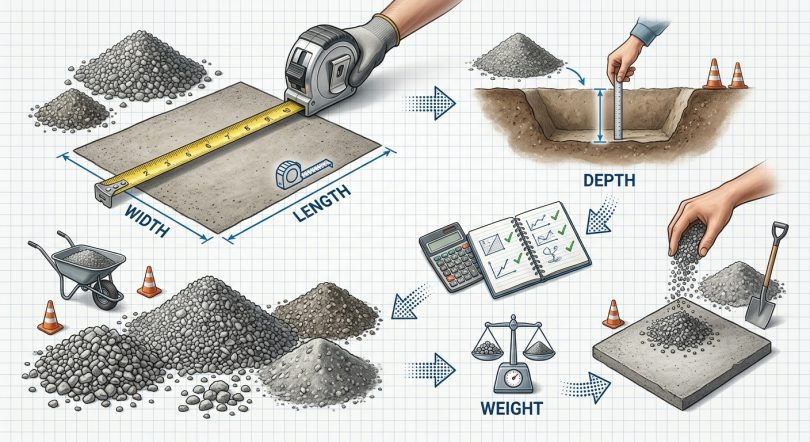
- Measure the length and width of the area in feet.
- Measure or decide on the fill depth in inches.
- Enter the crushed concrete density, or use the default if you are unsure.
- Set a waste and compaction allowance percentage to avoid running short.
- Enter the price per ton quoted by your supplier.
- Review the volume, weight, and cost results before placing an order.
Understanding Each Measurement You Enter
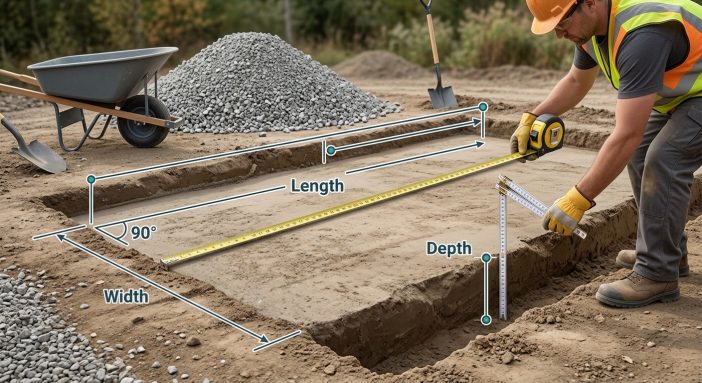
Area Length and Area Width (ft): The two dimensions of the rectangular space you are filling, measured in feet. For irregular shapes, split the area into rectangles and calculate each separately.
Fill Depth (in): The thickness of the crushed concrete layer, measured in inches. Typical base layers range from 3 to 6 inches, while deeper fill applications may need more.
Crushed Concrete Density (lb per cubic yard): The weight of one cubic yard of material. Crushed concrete usually falls between 2,000 and 3,000 pounds per cubic yard depending on gradation and how tightly it is compacted. Ask your supplier for a specific value if you need a precise estimate.
Waste and Compaction Allowance (%): An extra percentage added to cover material lost to spillage, uneven subgrade, and settling after compaction. A 10 percent allowance is a common starting point.
Price per Ton (USD): The delivered price your supplier charges per ton. This figure varies by region, quarry distance, and order size.
How Volume, Weight, and Cost Are Calculated
Base Volume Needed = length * width * (depth / 12) / 27. This converts the depth from inches to feet, multiplies by the area in square feet to get cubic feet, then divides by 27 to convert cubic feet into cubic yards, the standard unit crushed concrete is sold by.
Volume Including Waste Allowance = Base Volume * (1 + waste_percent / 100). This adds your chosen waste and compaction percentage to the base volume.
Estimated Weight Needed = Volume Including Waste Allowance * density / 2000. This multiplies the adjusted volume by the density in pounds per cubic yard, then divides by 2,000 to convert pounds into tons.
Estimated Material Cost = Estimated Weight Needed * price_per_ton. This multiplies the tonnage by your entered price per ton to produce a total material cost estimate.
These formulas assume a rectangular, flat area and a uniform fill depth. They do not account for subgrade excavation, grading, delivery fees, or labor.
Sample Projects With Full Calculations
Example 1: Small backyard path. Given length 10 ft, width 10 ft, depth 4 in, density 2,400 lb per cubic yard, waste 10%, price $45 per ton.
Formula: length * width * (depth/12) / 27, then apply waste and density.
Substitution: 10 * 10 * (4/12) / 27 = 1.23 cubic yards base volume.
Calculation: 1.23 * 1.10 = 1.36 cubic yards with waste; 1.36 * 2400 / 2000 = 1.63 tons; 1.63 * 45 = $73.33.
Final result: about 1.36 cubic yards, 1.63 tons, and $73.33 in material cost.
Example 2: Driveway base. Given length 50 ft, width 12 ft, depth 6 in, density 2,500 lb per cubic yard, waste 15%, price $50 per ton.
Substitution: 50 * 12 * (6/12) / 27 = 11.11 cubic yards base volume.
Calculation: 11.11 * 1.15 = 12.78 cubic yards with waste; 12.78 * 2500 / 2000 = 15.97 tons; 15.97 * 50 = $798.61.
Final result: about 12.78 cubic yards, 15.97 tons, and $798.61 in material cost.
Example 3: Narrow garden path. Given length 20 ft, width 3 ft, depth 3 in, density 2,200 lb per cubic yard, waste 5%, price $40 per ton.
Substitution: 20 * 3 * (3/12) / 27 = 0.56 cubic yards base volume.
Calculation: 0.56 * 1.05 = 0.58 cubic yards with waste; 0.58 * 2200 / 2000 = 0.64 tons; 0.64 * 40 = $25.67.
Final result: about 0.58 cubic yards, 0.64 tons, and $25.67 in material cost.
Example 4: Large fill area. Given length 100 ft, width 40 ft, depth 12 in, density 2,800 lb per cubic yard, waste 10%, price $35 per ton.
Substitution: 100 * 40 * (12/12) / 27 = 148.15 cubic yards base volume.
Calculation: 148.15 * 1.10 = 162.96 cubic yards with waste; 162.96 * 2800 / 2000 = 228.15 tons; 228.15 * 35 = $7,985.19.
Final result: about 162.96 cubic yards, 228.15 tons, and $7,985.19 in material cost.
Typical Depth and Density Reference Chart
| Application | Typical Depth | Typical Density Range |
|---|---|---|
| Garden path or stepping area | 2 to 3 inches | 2,000 to 2,300 lb per cubic yard |
| Driveway base layer | 4 to 6 inches | 2,300 to 2,600 lb per cubic yard |
| Parking area or heavy traffic base | 6 to 8 inches | 2,500 to 2,800 lb per cubic yard |
| Drainage fill or low-area backfill | 8 to 12 inches | 2,400 to 3,000 lb per cubic yard |
These are general planning ranges. Actual depth requirements depend on soil conditions, expected load, and local building practices, so confirm specifications with a qualified contractor for structural applications.
Reading Your Volume, Weight, and Cost Results
Base Volume Needed is the raw cubic yardage based only on your measured dimensions, before any extra material is added.
Volume Including Waste Allowance is the amount you should actually plan to order, since it accounts for spillage, uneven subgrade, and compaction settling.
Estimated Weight Needed converts that adjusted volume into tons, which is how most suppliers price and deliver crushed concrete.
Estimated Material Cost is the tonnage multiplied by your entered price per ton. This figure covers material only and excludes delivery charges, taxes, labor, or equipment rental unless your price per ton already includes them.
All results are estimates. Actual quantities can vary based on real-world compaction, base preparation, and supplier rounding practices.
What Changes Your Crushed Concrete Estimate
Density variation: Crushed concrete density changes with particle size and how tightly it is compacted. The calculator lets you adjust this value, but an inaccurate density input will shift the weight and cost results.
Waste allowance: Higher waste percentages increase ordered volume and cost. This is accounted for directly through the waste and compaction allowance field.
Depth accuracy: Even small depth errors multiply across a large area. The calculator uses your entered depth exactly as given, so double-check this measurement.
Irregular shapes: This calculator assumes a single rectangular area. It does not automatically handle L-shaped or curved layouts; those must be split into sections and added together.
Price fluctuations: Delivered price per ton varies by region, quarry distance, and order size. The calculator only reflects the price you enter, not live market rates.
Ordering Errors That Lead to Shortages or Waste
- Entering depth in feet instead of inches: The depth field expects inches; entering feet will produce a hugely oversized estimate.
- Skipping the waste allowance: Ordering only the base volume often leads to running short once compaction and spillage are factored in.
- Using a generic density for all projects: Loose versus compacted crushed concrete can differ significantly in weight per cubic yard.
- Forgetting to divide irregular areas: Treating an L-shaped yard as one rectangle will misstate the true area.
- Ignoring delivery and taxes: The cost result covers material only, not hauling fees or applicable taxes.
- Rounding measurements too early: Rounding length or width before entering them can compound small errors across a large area.
What This Estimate Does Not Cover
This calculator provides a planning estimate for material volume, weight, and cost. It does not calculate structural adequacy, subgrade preparation, drainage design, or compaction requirements. Density and price inputs vary by supplier and region, and actual delivered material may be rounded up to the nearest available load size.
The tool assumes a single rectangular area and a uniform fill depth. It does not include excavation, geotextile fabric, labor, equipment, or delivery costs. For driveway bases, retaining structures, or any load-bearing application, consult a qualified contractor or engineer before finalizing your project.
Choosing a Realistic Waste Allowance
A waste and compaction allowance covers material that is lost to spillage during placement, uneven subgrade that absorbs extra fill, and settling after compaction. Small, simple projects with a flat, prepared subgrade can often use a lower allowance, around 5 to 8 percent. Larger driveway or parking base projects, or sites with uneven ground, typically benefit from 10 to 15 percent. If you are unsure, starting near the calculator’s 10 percent default is a reasonable middle ground for most residential projects.
Crushed Concrete Compared to Gravel or Crushed Stone
Crushed concrete is made by breaking up old concrete and screening it into graded sizes, while gravel and crushed stone come from natural rock deposits or quarries. Crushed concrete is often less expensive and compacts well for base layers, though its exact density can vary more than quarried stone because it contains a mix of aggregate and old cement paste. When comparing materials, always check the specific density and gradation your supplier offers, since this calculator’s default values are general planning figures rather than a fixed industry standard.
Handling L-Shaped or Multi-Section Areas
This calculator is built for a single rectangular area. For an L-shaped driveway, a yard with multiple sections, or any irregular footprint, divide the space into two or more rectangles. Run the calculator separately for each rectangle using its own length, width, and depth, then add the resulting cubic yards, tons, and costs together for a combined total.
Crushed Concrete Calculator Questions Answered
How many tons of crushed concrete are in a cubic yard?
It depends on density, but crushed concrete typically weighs between 2,000 and 3,000 pounds per cubic yard, which equals roughly 1 to 1.5 tons per cubic yard. This calculator uses your entered density value to convert volume into tons for a more specific estimate.
How much crushed concrete do I need for a driveway base?
Most residential driveway base layers use a depth between 4 and 6 inches. Enter your driveway’s length and width along with that depth, and the calculator will estimate the cubic yards, tons, and cost, including your chosen waste allowance.
What waste or compaction allowance should I use?
A 10 percent allowance is a common default for typical projects. Simple, flat areas may need less, around 5 percent, while larger or uneven sites often benefit from 10 to 15 percent to avoid running short on material.
Why does changing the density value change my results so much?
Density directly determines how many pounds are in each cubic yard of material. A higher density means more weight for the same volume, which increases both the tons needed and the total estimated cost, even though the volume in cubic yards stays the same.
Is crushed concrete the same as crushed stone or gravel?
No. Crushed concrete is recycled from old concrete, while crushed stone and gravel come from quarried or natural rock. They can serve similar base and fill purposes, but their density and price per ton often differ, so use the correct material’s specifications when estimating.
How thick should my crushed concrete layer be?
Thickness depends on the application. Garden paths often use 2 to 3 inches, driveway bases commonly use 4 to 6 inches, and heavier-use areas or drainage fill may require 6 inches or more. Check local guidelines or a contractor for load-bearing projects.
How do I calculate crushed concrete for an irregularly shaped yard?
Split the irregular area into two or more rectangles, run the calculator separately for each section using its own length, width, and depth, then add up the resulting cubic yards, tons, and costs for a combined total estimate.
Does the price per ton include delivery and taxes?
No. The estimated material cost result only reflects the tonnage multiplied by the price per ton you enter. It does not automatically include delivery fees, taxes, labor, or equipment rental unless those costs are already built into your entered price.
Getting Ready to Order Crushed Concrete
Use this crushed concrete calculator as a starting point for ordering material, not as a final engineering specification. Confirm your measured dimensions, choose a realistic density and waste allowance, and check current pricing with your supplier before placing an order. For projects that also include curb work, you can estimate that separately with a concrete curb and gutter volume calculator.

2 Responses