
Enter your wall length, height, backfill width, base width, and base depth to instantly calculate the gravel volume, weight, bag count, and cost needed for retaining wall drainage backfill and base preparation. This retaining wall gravel calculator applies a waste factor so you order enough material the first time.
Retaining Wall Gravel Calculator: Volume, Weight & Bags
Calculate the gravel volume, weight, bag count, and cost needed for retaining wall backfill drainage and base leveling pads.
What This Retaining Wall Gravel Calculator Solves
This calculator estimates how much gravel you need for two parts of a retaining wall project: the drainage backfill placed behind the wall and the leveling base pad placed underneath it. It converts your measurements into loose cubic yards, total weight in tons, the number of bags to buy, and an approximate material cost.
It helps homeowners planning a small garden wall as well as contractors ordering bulk gravel for a longer commercial retaining wall. Results are planning estimates, not exact quantities, because compaction rates, trench irregularities, and soil conditions vary from site to site.
Steps to Estimate Your Gravel Order
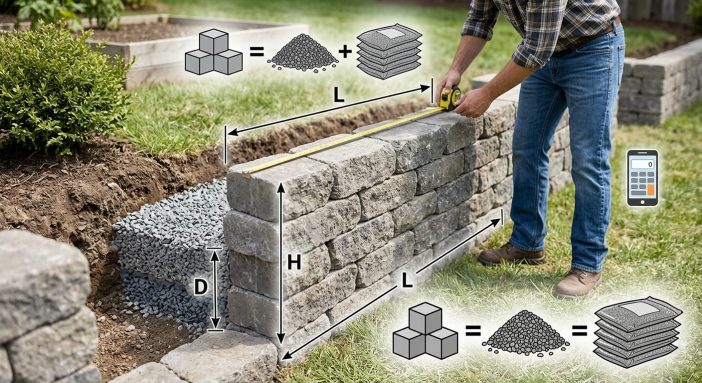
- Measure the total length of the wall run in feet.
- Measure the wall height, including the buried portion below grade.
- Set the backfill zone width, usually 12 to 24 inches behind the wall.
- Set the base trench width and base gravel depth for the leveling pad.
- Choose a gravel type, waste percentage, bag size, and cost per ton.
- Review the volume, weight, bag count, and cost results below.
Understanding Each Measurement You Enter
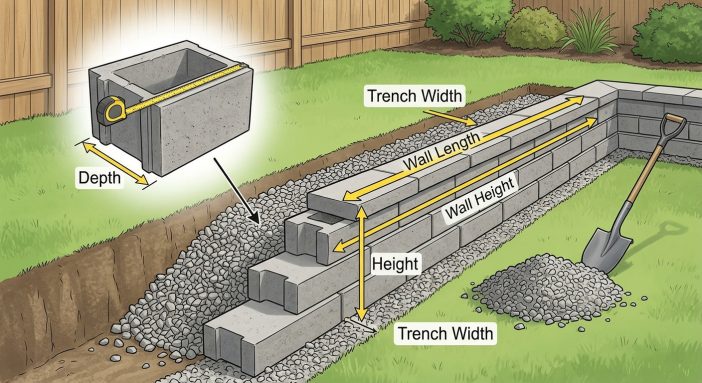
Wall Length is the total linear footage of the wall run, measured in feet. Wall Height should include any portion buried below grade, since the drainage gravel typically runs the full height of the wall behind it. Backfill Zone Width is the horizontal thickness of the gravel column placed directly behind the wall, commonly 12 to 24 inches. Base Trench Width is the width of the gravel pad under the wall footing, usually the wall thickness plus a small margin on each side.
Base Gravel Depth is entered in inches and represents the compacted thickness of the leveling pad. Gravel Type sets the material density in pounds per cubic foot, which affects weight and cost. Waste and Compaction Allowance is a percentage added to cover settling, spillage, and uneven trench shape. Bag Size converts loose volume into a bag count for bagged gravel purchases, and Gravel Cost is the price per ton used to estimate total spending.
How Volume, Weight, and Cost Are Calculated
The calculator treats the backfill zone and base pad as separate rectangular volumes, then combines them.
Backfill volume (cu yd) = (wall length x wall height x backfill width) / 27 x (1 + waste percent / 100)
Base volume (cu yd) = (wall length x base width x (base depth in inches / 12)) / 27 x (1 + waste percent / 100)
Total volume is the sum of both raw cubic-foot volumes, converted to cubic yards using the standard 27 cubic feet per cubic yard, then increased by the waste allowance.
Total weight (tons) = total raw cubic feet x (1 + waste percent / 100) x gravel density (lb per cu ft) / 2000, since one ton equals 2000 pounds.
Bag count = total raw cubic feet x (1 + waste percent / 100) / bag volume in cubic feet, rounded to a whole number.
Estimated cost = total weight in tons x cost per ton. These formulas assume rectangular trench and backfill geometry and a consistent gravel density throughout the fill zone.
Sample Gravel Calculations for Different Wall Sizes
Example 1: Standard backyard wall. Given: length 20 ft, height 3 ft, backfill width 1 ft, base width 1.5 ft, base depth 6 in, crushed stone (105 lb/cu ft), 10% waste, 0.5 cu ft bags, $45 per ton. Backfill raw volume = 20 x 3 x 1 = 60 cu ft. Base raw volume = 20 x 1.5 x 0.5 = 15 cu ft. Total raw = 75 cu ft. Total volume = 75 / 27 x 1.10 = 3.06 cu yd. Weight = 75 x 1.10 x 105 / 2000 = 4.33 tons. Bags = 75 x 1.10 / 0.5 = 165 bags. Cost = 4.33 x 45 = $194.91.
Example 2: Longer wall with washed drainage rock. Given: length 40 ft, height 4 ft, backfill width 1.5 ft, base width 2 ft, base depth 8 in, washed drainage rock (100 lb/cu ft), 15% waste, 0.75 cu ft bags, $50 per ton. Backfill raw = 40 x 4 x 1.5 = 240 cu ft. Base raw = 40 x 2 x 0.667 = 53.33 cu ft. Total raw = 293.33 cu ft. Total volume = 293.33 / 27 x 1.15 = 12.49 cu yd. Weight = 293.33 x 1.15 x 100 / 2000 = 16.87 tons. Bags = 293.33 x 1.15 / 0.75 = 450 bags. Cost = 16.87 x 50 = $843.33.
Example 3: Small garden wall with pea gravel. Given: length 10 ft, height 2 ft, backfill width 0.75 ft, base width 1 ft, base depth 4 in, pea gravel (95 lb/cu ft), 5% waste, 0.5 cu ft bags, $40 per ton. Backfill raw = 10 x 2 x 0.75 = 15 cu ft. Base raw = 10 x 1 x 0.333 = 3.33 cu ft. Total raw = 18.33 cu ft. Total volume = 18.33 / 27 x 1.05 = 0.71 cu yd. Weight = 18.33 x 1.05 x 95 / 2000 = 0.91 tons. Bags = 18.33 x 1.05 / 0.5 = 39 bags. Cost = 0.91 x 40 = $36.58.
Example 4: Large commercial wall with recycled concrete aggregate. Given: length 100 ft, height 6 ft, backfill width 2 ft, base width 3 ft, base depth 12 in, recycled concrete aggregate (110 lb/cu ft), 20% waste, $35 per ton. Backfill raw = 100 x 6 x 2 = 1200 cu ft. Base raw = 100 x 3 x 1 = 300 cu ft. Total raw = 1500 cu ft. Total volume = 1500 / 27 x 1.20 = 66.67 cu yd. Weight = 1500 x 1.20 x 110 / 2000 = 99 tons. Cost = 99 x 35 = $3,465.00.
Typical Gravel Depth and Width Guidelines
| Wall Height | Typical Backfill Width | Typical Base Depth | Notes |
|---|---|---|---|
| Under 2 ft | 6 to 12 in | 4 in | Small garden or edging walls, minimal drainage load |
| 2 to 4 ft | 12 in | 4 to 6 in | Common residential retaining walls |
| 4 to 6 ft | 12 to 18 in | 6 to 8 in | Taller walls need wider drainage columns |
| Over 6 ft | 18 to 24 in | 8 in or more | Engineered design usually required |
These figures are general planning ranges, not fixed standards. Local soil conditions, drainage requirements, and building codes can call for different widths and depths, so check with a local contractor or engineer for taller or load-bearing walls.
Reading Your Volume, Weight, and Bag Results
The calculator returns six results. Backfill Gravel Volume and Base Gravel Volume show the loose cubic yards needed for each zone separately, which helps if you order the two materials on different days or from different suppliers. Total Gravel Volume combines both figures.
Total Gravel Weight converts that volume to tons using your selected gravel density, which is useful for bulk delivery orders priced by weight. Number of Bags Needed rounds the total volume into whole bags based on your chosen bag size, useful for smaller projects buying bagged gravel from a hardware store. Estimated Material Cost multiplies the weight by your entered price per ton to give an approximate budget figure. All results scale directly with wall length, so doubling the length roughly doubles every output.
What Changes Your Gravel Quantity
Wall length and height directly scale the backfill volume and are fully accounted for in the formulas. Backfill and base widths control how thick each gravel zone is and are entered directly, so wider zones increase results proportionally. Gravel density changes weight and cost but not volume, since the calculator uses volume as the base unit and applies density only for weight conversion.
Waste and compaction allowance is a single adjustable percentage; it does not distinguish between spillage losses and compaction settling, so you may need a higher value on uneven or rocky sites. Soil type, drainage pipe placement, and geotextile fabric are not part of this calculator and can affect the actual gravel needed on site, so treat those as separate planning items.
Gravel Ordering Mistakes to Avoid
- Forgetting the buried portion of the wall. Wall height should include the section below grade, not just the visible face.
- Using compacted depth instead of loose volume for ordering. Gravel settles after placement, so the waste allowance helps but does not fully replace it.
- Mixing up backfill width and base width. These are different zones with different typical dimensions; check both before entering values.
- Choosing the wrong gravel type for density. Crushed stone, pea gravel, washed rock, and recycled concrete all weigh differently per cubic foot, which changes weight and cost.
- Setting waste percentage too low for rough terrain. Sloped or rocky sites often need a higher allowance than flat, prepared trenches.
- Ignoring bag size when comparing suppliers. A 0.5 cubic foot bag and a 1.5 cubic foot bag produce very different bag counts for the same volume.
- Assuming the cost result includes delivery or labor. The cost figure only reflects material price per ton, not hauling or installation charges.
What This Estimate Does Not Cover
This calculator provides a planning-level estimate based on simple rectangular geometry for the backfill and base zones. It does not model drainage pipe placement, geotextile fabric, wall batter or setback, curved wall sections, or soil bearing capacity. Gravel needs for structural walls, especially those over 4 feet tall or supporting a slope or structure above, depend on engineering factors this tool cannot evaluate.
Local building codes and soil conditions vary widely by region, and actual delivered gravel volumes can differ from calculated loose volume due to supplier measurement methods. This tool does not replace a site evaluation or engineering review. Consult a structural engineer or local contractor before finalizing retaining wall construction plans, particularly for taller or load-bearing walls.
Choosing Between Bagged and Bulk Gravel
Small projects under a few cubic yards are often cheaper to buy in bags from a hardware store, while larger orders are usually more economical delivered in bulk by the ton. Use the bag count result for small walls and the weight result when requesting a bulk delivery quote. If you are also comparing bulk stone options for a broader landscaping area, a landscape rock calculator by square footage can help estimate material for surrounding beds or paths.
Backfill Gravel vs Base Pad Gravel
The backfill zone behind a retaining wall is meant to let water drain away from the wall face and reduce hydrostatic pressure. The base pad underneath the wall is meant to provide a stable, level surface for the first course of blocks or footing. These two zones often use similar gravel but serve different structural purposes, which is why this calculator reports their volumes separately before combining them into a total.
Adjusting for Recycled or Alternative Aggregate
Recycled concrete aggregate is a common substitute for virgin crushed stone in backfill and base applications, and it typically has a higher density than natural gravel. If you are deciding between materials, comparing weight and cost side by side using the gravel type selector can help. For a closer look at recycled material sizing on its own, a crushed concrete volume and cost calculator covers that material in more detail.
Retaining Wall Gravel Questions Answered
How much gravel do I need behind a retaining wall?
Typically a drainage backfill zone of 12 to 24 inches wide is placed behind the wall from the base to near the top. Enter your wall length, height, and desired backfill width to calculate the loose volume required.
How deep should the gravel base be under a retaining wall?
Base gravel pads are commonly 4 to 8 inches deep depending on soil conditions and wall height. Check local building guidance or an engineer’s recommendation for your specific wall.
Why does the calculator add a waste percentage?
Gravel compacts after placement and some material is lost to spillage or uneven trench shapes, so a waste and compaction allowance helps ensure you order enough material the first time.
How do I convert gravel volume to bags or tons?
The calculator divides the total loose cubic footage by your selected bag size to estimate bag count, and multiplies volume by the gravel density to estimate weight in tons for bulk orders.
Does gravel type change how much volume I need?
No. Volume depends only on the dimensions you enter. Gravel type changes the weight and estimated cost because different materials have different densities, measured in pounds per cubic foot.
Can I use this calculator for a curved retaining wall?
This calculator assumes a straight rectangular wall run. For curved walls, measure the average length along the curve as your wall length, understanding that the result will be an approximation rather than an exact figure.
Is the cost result exact?
No. The cost result multiplies estimated weight by your entered price per ton, so it reflects material cost only. Delivery fees, taxes, and labor are not included and should be added separately.
What if my base width and backfill width are the same?
You can enter the same value for both if your project uses one continuous gravel zone. The calculator will still report backfill and base volumes separately based on the height and depth you specify for each.
Planning Your Next Gravel Delivery
Ordering the right amount of gravel starts with accurate measurements of wall length, height, backfill width, and base depth. This calculator turns those numbers into loose volume, weight, bag count, and estimated cost, giving you a practical starting point for a material order. Because soil conditions, drainage needs, and local codes vary, confirm final quantities with a contractor or engineer before your project begins.
