
This calculator estimates how much landscape rock, gravel, or stone you need based on the square footage of your area and your chosen depth. Enter length, width, depth, and rock type, and it converts those numbers into cubic feet, cubic yards, weight in tons, and estimated cost. Results are practical estimates meant to guide purchasing decisions, since actual bulk density and coverage can vary by supplier and material batch.
Landscape Rock Calculator by Square Feet: Tons & Cost
Estimate how much landscape rock, gravel, or stone you need based on square footage, depth, and rock type, including weight in tons and material cost.
What This Rock Coverage Tool Estimates
This tool helps homeowners, landscapers, and contractors figure out how much rock, gravel, or decorative stone to buy for a project. You give it the size of the area and how deep you want the rock layer, and it works out volume, weight, and cost. It works for pathways, garden beds, drainage areas, and larger yard installations.
Results are estimates based on typical bulk density values for common rock types. Actual material weight and coverage can shift slightly depending on moisture, compaction, and the specific quarry supplying your stone, so treat the output as a strong planning figure rather than an exact order quantity.
Steps to Estimate Your Rock Needs
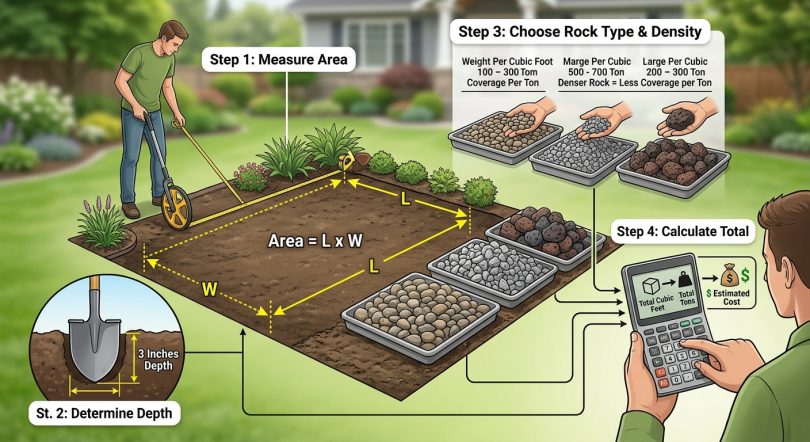
- Measure the length and width of the area in feet and enter them into the calculator.
- Enter your desired rock depth in inches; most decorative beds use 2 to 3 inches, while drainage layers may need more.
- Select the rock type that matches what you plan to buy, since density affects total weight.
- Adjust the waste and overage buffer slider to account for uneven ground or irregular edges.
- Enter the price per ton quoted by your supplier to see an estimated total material cost.
- Review the volume, weight, and cost results, then confirm final quantities with your supplier before ordering.
Understanding Each Measurement Field

Area Length and Area Width are the outer dimensions of the space you plan to cover, measured in feet. Multiplying these gives the total square footage.
Desired Rock Depth is how thick the finished rock layer should be, measured in inches. Thin decorative layers often use 2 inches, while functional or drainage layers may need 3 to 4 inches or more.
Rock Type sets the bulk density in pounds per cubic foot. Lighter materials like lava rock weigh far less than dense options like rip rap, so this choice changes your weight and cost results significantly.
Waste and Overage Buffer adds a percentage on top of the base weight to cover spillage, uneven ground, and irregular edges. A 10 percent buffer is a common starting point.
Price per Ton is the cost your supplier charges for the rock, used to calculate total estimated material cost.
How Area, Volume, and Weight Are Calculated
Total Area equals length multiplied by width, giving square feet.
Volume Needed converts depth from inches to feet by dividing by 12, then multiplies by area: volume = length times width times (depth_in divided by 12), giving cubic feet.
Volume in Cubic Yards divides cubic feet by 27, since one cubic yard equals 27 cubic feet. Most bulk suppliers price and deliver rock by the cubic yard or by the ton.
Estimated Weight multiplies volume in cubic feet by the selected rock density in pounds per cubic foot, then divides by 2000 to convert pounds to tons.
Weight With Waste Buffer multiplies the base weight by one plus the waste percentage divided by 100, adding a safety margin.
Estimated Material Cost multiplies the buffered weight in tons by the price per ton you entered.
These formulas assume a roughly rectangular, flat area and a uniform, compacted finished depth. Irregular shapes should be split into smaller rectangles, calculated separately, and added together.
Sample Rock Quantity Calculations
Example 1: Small Backyard Bed
Given: length 10 ft, width 10 ft, depth 2 in, river rock (100 lb/cubic ft), waste 10 percent, price $45 per ton.
Formula: weight = length times width times (depth_in / 12) times density / 2000.
Substitution: 10 times 10 times (2/12) times 100 / 2000 = 0.8333 tons.
Calculation: 0.8333 times 1.10 = 0.9167 tons; cost = 0.9167 times 45.
Final result: about 0.92 tons and $41.25.
Example 2: Pea Gravel Walkway Border
Given: length 20 ft, width 15 ft, depth 3 in, pea gravel (96 lb/cubic ft), waste 15 percent, price $60 per ton.
Substitution: 20 times 15 times (3/12) times 96 / 2000 = 3.6 tons.
Calculation: 3.6 times 1.15 = 4.14 tons; cost = 4.14 times 60.
Final result: 4.14 tons and $248.40.
Example 3: Rip Rap Drainage Channel
Given: length 50 ft, width 8 ft, depth 4 in, rip rap (110 lb/cubic ft), waste 20 percent, price $55 per ton.
Substitution: 50 times 8 times (4/12) times 110 / 2000 = 7.3333 tons.
Calculation: 7.3333 times 1.20 = 8.8 tons; cost = 8.8 times 55.
Final result: 8.8 tons and $484.00.
Example 4: Small Lava Rock Planting Bed
Given: length 6 ft, width 4 ft, depth 2 in, decorative lava rock (50 lb/cubic ft), waste 10 percent, price $80 per ton.
Substitution: 6 times 4 times (2/12) times 50 / 2000 = 0.1 tons.
Calculation: 0.1 times 1.10 = 0.11 tons; cost = 0.11 times 80.
Final result: 0.11 tons and $8.80.
Approximate Coverage by Rock Type
| Rock Type | Density (lb/cubic ft) | Approx. Coverage per Ton at 2 in Depth |
|---|---|---|
| Pea Gravel | 96 | about 125 sq ft |
| River Rock | 100 | about 120 sq ft |
| Crushed Stone | 105 | about 114 sq ft |
| Decorative Lava Rock | 50 | about 240 sq ft |
| Rip Rap (Large Stone) | 110 | about 109 sq ft |
Coverage figures assume a 2 inch finished depth and typical bulk density; actual coverage changes with depth and material source, so use the calculator for your exact depth and area.
Reading Your Volume, Weight, and Cost Results
Total Area shows the square footage you are covering, useful for double-checking your measurements.
Volume Needed and Volume in Cubic Yards tell you how much rock to order in the units most suppliers use, since bulk yards typically sell and deliver by the cubic yard.
Estimated Weight shows the raw tonnage based on your area and depth, while Weight With Waste Buffer adds your chosen overage percentage, which is the number most people should use when placing an order.
Estimated Material Cost multiplies that buffered weight by your price per ton, giving a planning-level budget figure. Results round to two decimal places, and small rounding differences between manual math and the calculator are normal.
Changing depth, rock type, or the waste buffer will shift every downstream result, since each calculation builds on the previous one.
What Changes How Much Rock You Need
Depth has a direct, linear effect on volume and weight; doubling depth doubles the material needed. The calculator accounts for this through the depth input.
Rock density varies by material type and even by quarry source. The calculator uses fixed typical values per rock type selected, but real-world density can shift with moisture content or compaction, similar to how material density affects total weight in other building material calculations.
Area shape matters because the formula assumes a rectangle. Curved beds or irregular borders should be broken into smaller rectangular sections and totaled separately for accuracy.
Waste percentage accounts for spillage, subgrade unevenness, and settling, and the calculator lets you adjust this directly rather than assuming a fixed buffer.
Price per ton varies by region, supplier, and delivery distance, so the cost result only reflects the price you enter, not a market average.
Common Rock Ordering Errors to Avoid
- Forgetting to convert depth to feet: The calculator handles this automatically, but manual estimates often mix inches and feet incorrectly.
- Measuring only one dimension: Always measure both length and width, since square footage requires both.
- Ignoring irregular shapes: Treating a curved bed as one simple rectangle can overstate or understate the true area.
- Skipping the waste buffer: Ordering the exact calculated amount often leaves you short due to spillage or uneven ground.
- Using the wrong rock density: Selecting a rock type that does not match what you are actually buying will throw off weight and cost.
- Assuming all suppliers price the same way: Some sell by the ton, others by the cubic yard, so confirm units before ordering.
- Overlooking settling over time: Rock layers compact somewhat after installation, so slightly deeper initial placement can help maintain the desired finished depth.
Assumptions and Estimate Boundaries
This calculator provides planning estimates, not guaranteed order quantities. It assumes a rectangular area, a uniform compacted depth, and fixed density values for each rock type, which are typical industry approximations rather than exact figures for every quarry or region.
It does not account for base materials like landscape fabric or edging, delivery fees, sales tax, or minimum order quantities that suppliers often require. Regional pricing and material availability can vary widely, so always confirm final quantities and costs with your supplier before purchasing. For structural applications like retaining wall backfill or drainage systems tied to foundations, consult a qualified landscaping or engineering professional.
Handling Irregular or Curved Bed Shapes
Most yards are not perfect rectangles. To handle curved beds, borders, or L-shaped areas, break the space into two or more simple rectangles or squares. Measure and calculate each section separately using the calculator, then add the volume, weight, and cost results together for a combined total. This approach keeps the math manageable while still giving a reasonably accurate estimate for odd-shaped spaces.
Choosing Depth Based on Project Type
Depth requirements depend heavily on what the rock is doing. Decorative ground cover in planting beds often works well at 2 to 3 inches. Walkways and high-traffic paths typically need 3 to 4 inches for stability. Drainage applications, such as French drains or areas prone to pooling water, may require 4 inches or more, sometimes layered over larger base stone. Always check local guidance or a landscaping professional for drainage-critical projects.
Converting Cubic Yards to Bagged Material
If you are buying bagged rock instead of bulk delivery, you will need to convert cubic yards to the number of bags. Bag sizes vary, but a common bagged volume is 0.5 cubic feet per bag. Since one cubic yard equals 27 cubic feet, dividing your Volume Needed result in cubic feet by the bag’s stated cubic foot capacity tells you roughly how many bags to buy. Bulk delivery is usually more cost-effective for larger areas.
Landscape Rock Coverage Questions Answered
How do I calculate square footage for an irregularly shaped landscape bed?
Split the bed into smaller rectangular or square sections, measure each one’s length and width, and calculate the area of each separately. Add the individual areas together for the total square footage, then use that combined figure or calculate each section through the tool and sum the results.
What rock depth should I use for walkways versus decorative beds?
Decorative beds typically use 2 to 3 inches of rock for ground cover. Walkways and paths generally need 3 to 4 inches for stability underfoot. Drainage-focused installations often require 4 inches or more. Depth needs can vary by project, so adjust based on your specific use case.
How much area does a ton of landscape rock typically cover?
Coverage depends on depth and rock density. At a 2 inch depth, a ton of standard river rock covers roughly 120 square feet, while lighter lava rock covers closer to 240 square feet at the same depth. Use the calculator with your exact depth and rock type for a precise figure.
Why does the same volume of different rock types weigh different amounts?
Weight depends on bulk density, which varies by material composition, shape, and how tightly the pieces pack together. Dense materials like rip rap weigh more per cubic foot than lighter, more porous materials like lava rock, even when the volume is identical.
Should I order more rock than the calculator suggests?
It is generally wise to include a waste buffer, which this calculator lets you set between 0 and 50 percent. A 10 to 15 percent buffer covers common issues like spillage, uneven subgrade, and irregular edges without significantly increasing cost.
How do I convert the cubic yard result into a number of bags?
Multiply your cubic yard result by 27 to get cubic feet, then divide by the cubic foot capacity listed on your chosen bag size, often around 0.5 cubic feet per bag. This gives an approximate bag count, though bulk delivery is usually cheaper for larger areas.
Does this calculator account for base material or landscape fabric?
No, this calculator only estimates the rock, gravel, or stone layer itself. It does not include base gravel, landscape fabric, edging, or labor costs, so factor those into your overall project budget separately.
How accurate is the cost estimate from this calculator?
The cost estimate is a planning figure based on the price per ton you enter and typical density values for each rock type. Actual supplier pricing, delivery fees, taxes, and minimum order requirements can change your final cost, so confirm details directly with your supplier.
Getting Your Rock Order Right
Estimating landscape rock accurately starts with measuring your area correctly and choosing a realistic depth and rock type. This calculator turns those inputs into volume, weight, and cost figures you can use when placing an order. Always add a reasonable waste buffer and confirm final quantities and pricing with your supplier before committing to a purchase.

2 Responses