
This calculator estimates how much river rock you need in cubic yards, tons, bags, and total cost using your area’s length, width, and rock depth. Enter measurements in feet or meters, choose inches or centimeters for depth, select a rock type, and the tool converts everything into a coverage volume, an estimated weight based on material density, and a total material cost so you can order the right amount.
River Rock Calculator: Estimate Volume, Weight & Cost
Calculate how much river rock you need for your project in cubic yards, tons, bags, and total cost based on your area size and depth.
What This River Rock Estimator Tells You
This tool calculates how much river rock you need to cover a rectangular area at a chosen depth. It converts your measurements into cubic feet, cubic yards, and tons, then estimates how many bags you would need and what the material might cost. It is useful for homeowners covering a garden bed, landscapers quoting a project, or contractors ordering bulk delivery. Results are estimates based on the density and dimensions you enter, not exact figures, since real-world stone settling, sub-grade unevenness, and supplier measurement methods vary.
Steps to Get an Accurate Estimate
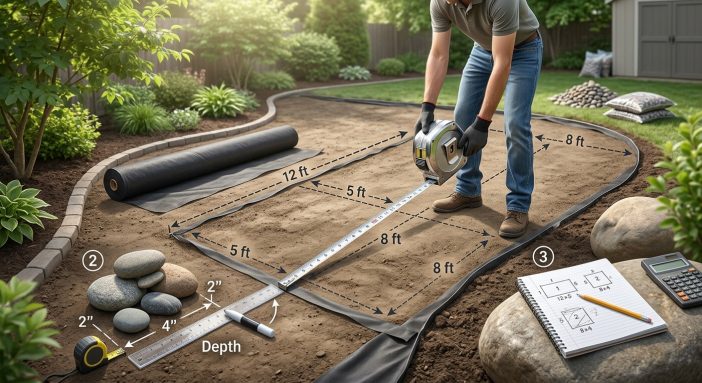
- Measure the length and width of the area you plan to cover and enter them, selecting feet or meters.
- Enter your desired rock depth and choose whether it is in inches or centimeters.
- Select the river rock type that matches your project to apply the correct density.
- Enter the coverage size of your bagged rock product if you plan to buy bags instead of bulk.
- Enter the price per ton quoted by your supplier and adjust the waste buffer if the ground is uneven.
- Review the volume, weight, bag count, and cost results to plan your order.
Entering Your Measurements Correctly
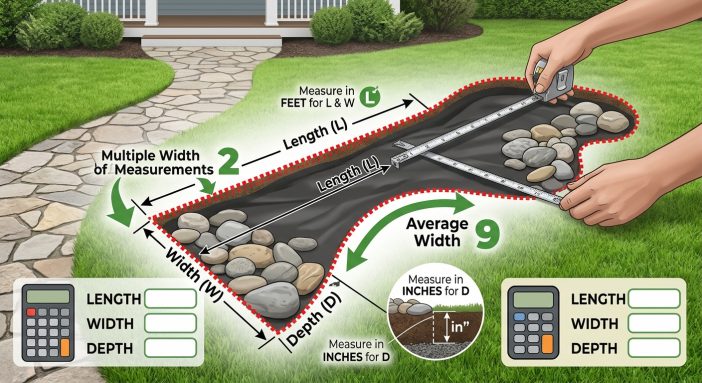
Area Length and Area Width define the footprint of the space you are covering, entered in feet or meters depending on your selected unit. Rock Depth sets how thick the layer of rock will be, entered in inches or centimeters. A typical decorative bed uses 2 to 3 inches, while a drainage or erosion-control layer may need more.
River Rock Type lets you choose a material with a preset density in pounds per cubic foot, since heavier stone weighs more per bag or per truckload. Bag Coverage Size is the volume, in cubic feet, that one bag of your chosen product covers, since bagged products vary by brand and size. Price per Ton is your supplier’s quoted rate, used to estimate total material cost. Waste/Compaction Buffer adds extra material as a percentage to cover settling, uneven ground, and handling loss during installation.
How Volume, Weight, and Cost Are Calculated
The calculator first finds the coverage area, then multiplies by depth to get volume, then applies density to estimate weight. All internal math uses feet and inches, with meters and centimeters converted using standard factors of 3.28084 feet per meter and 0.393701 inches per centimeter.
Volume (cubic feet) = length x width x (depth in inches / 12) x (1 + waste factor / 100). This converts depth from inches to feet before multiplying by the footprint area, then adds the waste buffer as extra volume.
Volume (cubic yards) = volume in cubic feet / 27, since one cubic yard equals 27 cubic feet.
Estimated Weight (tons) = (volume in cubic feet x density in pounds per cubic foot) / 2000, since one ton equals 2000 pounds.
Bags Needed = the volume in cubic feet divided by the bag coverage size, rounded up to the next whole bag, since partial bags cannot be purchased.
Estimated Material Cost = estimated weight in tons x price per ton. This assumes pricing is quoted per ton rather than per cubic yard or per bag; if your supplier prices differently, convert their rate to a per-ton figure first.
Sample Projects Calculated Step by Step
Example 1: Small garden border. Given: length 10 ft, width 5 ft, depth 2 in, waste 10 percent, river rock density 100 lb per cubic foot, price $50 per ton. Formula: volume = 10 x 5 x (2/12) x 1.10. Calculation: 9.17 cubic feet, or 0.34 cubic yards. Weight = 9.17 x 100 / 2000 = 0.46 tons. Bags at 0.5 cubic feet each = 19 bags. Cost = 0.46 x 50 = $22.92.
Example 2: Pea gravel path in metric units. Given: length 4 m, width 3 m, depth 5 cm, waste 15 percent, pea gravel density 95 lb per cubic foot, price $60 per ton. After converting to feet and inches, the area is about 129.17 square feet and depth is about 0.164 feet. Volume = 129.17 x 0.164 x 1.15 = 24.37 cubic feet, or 0.90 cubic yards. Weight = 24.37 x 95 / 2000 = 1.16 tons. Bags = 49. Cost = 1.16 x 60 = $69.45.
Example 3: Small planter bed. Given: length 6 ft, width 2 ft, depth 3 in, waste 5 percent, decorative cobble density 110 lb per cubic foot, price $75 per ton. Volume = 6 x 2 x 0.25 x 1.05 = 3.15 cubic feet, or 0.12 cubic yards. Weight = 3.15 x 110 / 2000 = 0.17 tons. Bags = 7. Cost = 0.17 x 75 = $13.00.
Example 4: Large driveway edge. Given: length 50 ft, width 10 ft, depth 4 in, waste 10 percent, crushed granite density 105 lb per cubic foot, price $45 per ton. Volume = 50 x 10 x 0.3333 x 1.10 = 183.33 cubic feet, or 6.79 cubic yards. Weight = 183.33 x 10⁵ / 2000 = 9.63 tons. Bags = 367. Cost = 9.63 x 45 = $433.13.
Typical River Rock Weights by Type
| Rock Type | Density (lb per cu ft) | Approx. Weight per Cubic Yard | Approx. Tons per Cubic Yard |
|---|---|---|---|
| River Rock (3/4 in – 2 in) | 100 | 2,700 lb | 1.35 tons |
| Pea Gravel | 95 | 2,565 lb | 1.28 tons |
| Crushed Granite | 105 | 2,835 lb | 1.42 tons |
| Decorative Cobble | 110 | 2,970 lb | 1.49 tons |
| Lava Rock | 50 | 1,350 lb | 0.68 tons |
These figures are general industry averages. Actual density varies by moisture content, stone size, and supplier, so treat this table as a planning reference rather than an exact spec.
Reading Your Volume, Weight, and Cost Results
Volume Needed and Volume in Cubic Yards show the same amount of material in two common units, since bulk suppliers usually sell by the cubic yard while smaller projects are easier to picture in cubic feet. Estimated Weight in tons is the figure most bulk delivery suppliers use for pricing and truck load planning. Bags Needed rounds up to the next whole bag, since you cannot buy a partial bag, so the true volume purchased may slightly exceed what you need. Estimated Material Cost reflects only the rock itself, not delivery, labor, edging, or landscape fabric. All results already include your chosen waste buffer, so no further adjustment is needed unless conditions change.
What Changes How Much Rock You Need
Depth accuracy has the biggest effect on volume, since doubling depth doubles the material needed; this calculator applies your entered depth directly. Rock density changes weight and cost but not volume, since heavier stone types cost more per cubic yard even at the same depth; this is handled through the rock type selection. Waste and compaction account for settling and uneven sub-grade and are added as a percentage buffer you control. Irregular shapes are not directly supported, since the calculator assumes a rectangle; split irregular areas into smaller rectangular sections and run each one separately, then add the results together. Bag size variation between brands is accounted for only if you enter the correct coverage size for your specific product.
Errors That Lead to Ordering the Wrong Amount
- Entering depth in the wrong unit: confirm whether your depth field is set to inches or centimeters before calculating.
- Ignoring the waste buffer: skipping this can leave you short on delivery day, especially on uneven ground.
- Using the wrong bag coverage size: check your specific product label, since bag volume varies by brand and stone size.
- Mixing units within one calculation: keep length, width, and depth consistent with the unit selectors provided.
- Assuming price per ton equals price per cubic yard: convert supplier pricing to a per-ton rate before entering it.
- Treating irregular areas as one rectangle: break curved or L-shaped beds into smaller rectangles and total the volumes.
- Forgetting that deeper does not always mean better: excessive depth wastes material and money without added drainage or visual benefit for most decorative uses.
What This Estimate Does Not Account For
This calculator provides a planning estimate only, not an exact material order. It assumes a uniform, rectangular area and a consistent depth throughout, which may not match sloped, curved, or layered installations. Density values are general averages and can vary by supplier, moisture content, and exact stone size, so always confirm actual product weight with your supplier before ordering large quantities. Pricing inputs are user-supplied and do not reflect real-time market rates, delivery fees, or regional cost differences. For structural applications such as drainage systems, retaining wall backfill, or slope stabilization, consult a qualified landscape or civil professional, since those uses involve safety and engineering considerations beyond simple coverage estimates.
Choosing the Right Depth for Your Project Type
Decorative beds around plants or walkways typically use 2 to 3 inches of river rock, which is deep enough to suppress weeds and look full without wasting material. Drainage swales or areas prone to erosion often use 3 to 4 inches for better water flow protection. Driveways or areas with vehicle or foot traffic may need 4 inches or more for stability. Always check your specific application’s requirements, since deeper is not automatically better and adds unnecessary cost.
Splitting an Irregular Yard Into Sections
Since this calculator assumes a rectangular area, an L-shaped bed, curved border, or yard with multiple sections should be divided into two or more rectangles. Measure and calculate each section separately, then add the cubic yard, weight, and cost results together for a combined total. This approach keeps the math accurate even for complex layouts. If you are estimating coverage purely by square footage without breaking out length and width separately, a landscape rock calculator by square feet may offer a simpler starting point for a quick area-based estimate.
Bulk Delivery Versus Bagged Rock
Bulk delivery, priced and measured in cubic yards or tons, is usually more cost-effective for larger areas, often above 1 to 2 cubic yards. Bagged rock is easier to transport and store for small projects but typically costs more per cubic foot. Use the cubic yard and ton results for bulk supplier quotes, and use the bag count result when planning a bagged-product purchase from a retail store.
River Rock Coverage Questions Answered
How much river rock do I need for my yard or garden bed?
Enter your area's length and width along with your desired depth, and the calculator returns the volume in cubic feet and cubic yards, plus the estimated weight in tons. This total already includes your chosen waste buffer, so it reflects a practical amount to order rather than a bare minimum.
What is the ideal depth for a river rock landscaping layer?
Most decorative garden beds use 2 to 3 inches of river rock. Drainage areas or erosion-prone zones often need 3 to 4 inches. Depth needs vary by application, so adjust the depth input based on your specific project goals.
How do I convert cubic yards of river rock to tons?
Multiply the cubic yard volume by the material's density, then divide by 2000 to get tons. This calculator does that automatically using the density value tied to your selected rock type, so the Estimated Weight result already reflects this conversion.
How many bags of river rock equal one cubic yard?
One cubic yard equals 27 cubic feet. If a bag covers 0.5 cubic feet, you would need 54 bags to equal one cubic yard. Since bag sizes vary by brand, always confirm the coverage size printed on your specific product and enter it into the Bag Coverage Size field.
What factors affect the price of river rock per ton?
Price per ton varies by rock type, region, supplier, and delivery distance. Decorative or larger stone sizes generally cost more than basic gravel. This calculator uses the price you enter, so check current local supplier quotes for the most accurate cost estimate.
How does rock size or type change density and weight calculations?
Denser materials, like crushed granite or decorative cobble, weigh more per cubic foot than lighter options like lava rock. This affects the Estimated Weight and Estimated Material Cost results even when the volume needed stays the same, since heavier stone requires more tons for the same coverage.
Should I add extra material for waste or settling?
Yes, a waste buffer of about 5 to 15 percent is common to account for compaction, uneven sub-grade, and handling loss. The default buffer is 10 percent, but you can adjust it higher for rougher terrain or lower for a flat, prepared base.
Can this calculator handle metric measurements?
Yes, you can switch the length and width unit to meters and the depth unit to centimeters. The calculator converts these values internally to feet and inches before calculating volume, weight, bags, and cost, so results stay consistent regardless of the unit system you choose.
Planning Your River Rock Order With Confidence
Getting river rock coverage right comes down to accurate measurements, a realistic depth, and the correct density for your chosen stone. This calculator turns those inputs into volume, weight, bag count, and cost estimates you can bring to a supplier. Since real conditions like ground unevenness and supplier-specific density vary, treat the results as a solid planning estimate and confirm final quantities with your material supplier before placing a large order.
