
This pea gravel calculator instantly estimates how much pea gravel you need for driveways, walkways, or landscaping projects. Enter your area’s length, width, and desired depth in feet or meters, and the tool calculates total volume, weight in tons, number of bags, and estimated material cost—accounting for a waste allowance—so you can order the right amount and budget accurately.
Pea Gravel Calculator: Estimate Volume, Weight & Cost
Calculate how much pea gravel you need for driveways, walkways, and garden beds, including volume, weight, bag count, and estimated cost.
What This Pea Gravel Calculator Figures Out
This calculator estimates how much pea gravel is needed to cover a defined area at a chosen depth. It converts your project’s length, width, and depth into a required volume, then translates that volume into weight, bag count, and estimated cost.
It works for driveways, walkways, patios, drainage beds, and garden borders. Homeowners, landscapers, and contractors can use it to plan purchases before visiting a supplier. Results are estimates based on standard density assumptions, not exact figures, since real gravel settles and compacts differently depending on site conditions.
Steps to Estimate Your Pea Gravel Needs

- Measure the length and width of the area you plan to cover, then enter each value and select feet or meters.
- Enter your desired depth for the pea gravel layer and choose inches or centimeters.
- Adjust the waste allowance percentage if your site has slopes, uneven ground, or irregular edges.
- Select a bag size if you plan to buy packaged gravel, or skip this if buying in bulk.
- Enter the local price per ton to see an estimated total material cost.
- Review the coverage area, volume, weight, bag count, and cost results before ordering.
Understanding Each Measurement Field
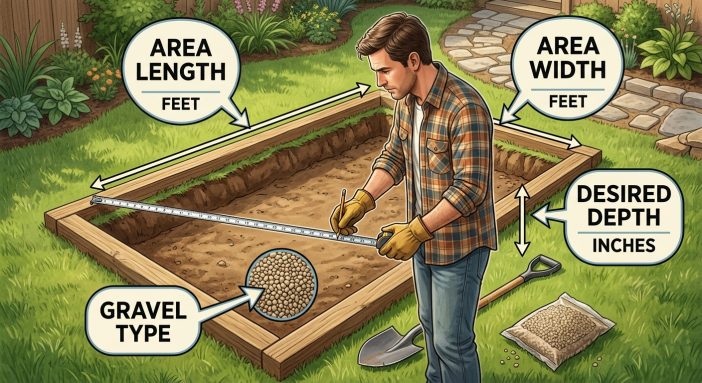
Length and Width: the outer dimensions of the area to cover, entered in feet or meters using the matching unit selector next to each field.
Length Unit and Width Unit: choose feet or meters so the calculator converts your measurements correctly before finding the area.
Depth: the thickness of the gravel layer, entered in inches or centimeters. Most walkways and beds use a shallow layer, while driveways often need more.
Depth Unit: select inches or centimeters to match how you measured depth.
Waste Allowance: a percentage added to cover spillage, uneven ground, and compaction. Ten percent is a reasonable starting point for most flat sites.
Bag Size: the volume of a single packaged bag in cubic feet, used to calculate how many bags to buy if you are not ordering bulk material.
Price per Ton: your local bulk price for pea gravel, used to estimate total material cost.
How Volume, Weight, and Cost Are Calculated
All calculations start by converting length, width, and depth into feet, since the internal formulas use cubic feet as the base unit.
Coverage Area (sq ft) = length × length_unit × width × width_unit. This gives the flat surface area of your project in square feet.
Volume Needed (cu ft) = length × length_unit × width × width_unit × depth × depth_unit × (1 + waste_percent / 100). This is the area multiplied by depth, with the waste allowance added on top.
Volume in Cubic Yards = Volume Needed / 27, since one cubic yard equals 27 cubic feet. Many bulk suppliers price gravel by the cubic yard.
Estimated Weight (tons) = Volume Needed × 0.05. This uses a typical pea gravel density of about 100 pounds per cubic foot, which equals roughly 0.05 tons per cubic foot. Actual density varies by moisture content and stone type.
Bags Required = ceil(Volume Needed / bag_size), rounded up to the next whole bag since partial bags cannot be purchased.
Estimated Material Cost = Estimated Weight × price_per_ton. This assumes you are buying by weight; if your supplier prices by the yard, multiply the cubic yard result by their per-yard rate instead.
Sample Projects With Full Calculations
Example 1: Small walkway. Given: length 10 ft, width 10 ft, depth 2 in, waste 10%, price $45/ton, bag size 0.5 cu ft. Formula: Volume = 10 × 1 × 10 × 1 × 2 × 0.08333333 × 1.10. Substitution: 100 × 0.16667 × 1.10. Calculation: 100 × 2 × 0.08333333 = 16.67, then × 1.10 = 18.33 cu ft. Final result: 18.33 cu ft (0.68 cu yd), about 0.92 tons, 37 bags, and roughly $41.25.
Example 2: Backyard patio base. Given: length 20 ft, width 15 ft, depth 3 in, waste 15%, price $50/ton, bag size 1 cu ft. Calculation: area = 300 sq ft; volume = 300 × 3 × 0.08333333 × 1.15 = 86.25 cu ft. Final result: 86.25 cu ft (3.19 cu yd), about 4.31 tons, 87 bags, and roughly $215.63.
Example 3: Metric driveway edge. Given: length 5 m, width 4 m, depth 5 cm, waste 10%, price $60/ton, bag size 2 cu ft. Calculation: area converts to about 215.28 sq ft; volume = 215.28 × 5 × 0.0328084 × 1.10 = 38.85 cu ft. Final result: 38.85 cu ft (1.44 cu yd), about 1.94 tons, 20 bags, and roughly $116.54.
Example 4: Garden bed. Given: length 6 ft, width 4 ft, depth 2 in, waste 5%, price $40/ton, bag size 0.5 cu ft. Calculation: area = 24 sq ft; volume = 24 × 2 × 0.08333333 × 1.05 = 4.2 cu ft. Final result: 4.2 cu ft (0.16 cu yd), about 0.21 tons, 9 bags, and roughly $8.40.
Typical Depth and Coverage Reference
| Project Type | Typical Depth | Notes |
|---|---|---|
| Walkway or path | 2 to 3 inches | Assumes light foot traffic and a compacted sub-base |
| Garden bed or border | 2 to 3 inches | Decorative use; less depth needed than driveways |
| Patio base layer | 3 to 4 inches | Often combined with a sub-base of larger aggregate |
| Driveway surface | 4 to 6 inches | Heavier vehicle loads require greater depth and a solid base |
| Drainage or French drain | Varies by design | Depth depends on pipe size and drainage plan; confirm with a professional |
These depths are common starting points, not fixed rules. Confirm the right depth for your specific project and soil conditions before ordering.
Making Sense of Your Results
The Coverage Area shows the flat square footage of your project, useful for comparing against supplier coverage charts.
The Volume Needed and Volume in Cubic Yards are the core figures for ordering bulk gravel, since most suppliers sell and price by the cubic yard.
The Estimated Weight in tons helps when a supplier prices gravel by weight rather than volume, or when you need to plan delivery truck capacity.
The Bags Required result rounds up to the next whole bag, since suppliers do not sell partial bags.
The Estimated Material Cost reflects only the gravel itself, based on the weight result and your entered price per ton. It does not include delivery fees, sub-base material, labor, or edging.
All results already include your chosen waste allowance, so no additional buffer is needed unless your site has unusual conditions.
What Changes Your Pea Gravel Estimate
Depth accuracy: even small depth errors change volume significantly, since depth is multiplied across the entire area. The calculator uses the exact depth you enter.
Waste allowance: sloped or irregular sites need a higher percentage. The calculator applies whatever percentage you choose to the full volume.
Gravel density: this calculator assumes about 100 pounds per cubic foot, a common average for pea gravel. Actual density varies with stone type and moisture, which the calculator cannot detect.
Compaction: pea gravel settles slightly over time and under foot or vehicle traffic. The calculator does not model long-term settling.
Bag size selection: choosing the wrong bag size changes the bag count result. Confirm the actual volume printed on your bag before buying.
Local pricing: price per ton varies by region and supplier. The calculator only uses the price you enter, so update it to match your local quote.
Ordering Errors to Avoid
- Skipping the waste allowance: ordering exact volume often leaves you short once spillage and uneven ground are accounted for.
- Mixing units accidentally: entering meters but leaving the unit selector on feet will produce an incorrect area and volume.
- Guessing at depth: a shallow layer under driveways can shift and rut quickly; confirm depth for your specific use case.
- Ignoring the sub-base: pea gravel over soft or unprepared soil may sink faster than expected, requiring more material over time.
- Assuming bag volume equals weight: bags are sold by cubic feet, not pounds, so mixing up these units leads to under- or over-ordering.
- Using an outdated price: gravel prices vary by region and season, so an old price per ton can throw off the cost estimate.
- Forgetting delivery and sub-base costs: the cost result covers only pea gravel material, not delivery fees or additional aggregate layers.
Assumptions and Accuracy Notes
This calculator provides a planning estimate based on standard density and geometric assumptions. It does not account for irregular or curved project shapes, existing slopes, drainage requirements, or soil stability. Actual pea gravel density can vary by supplier, moisture level, and stone size, which shifts weight and cost results slightly from the estimate shown.
Pricing and depth recommendations vary by region and supplier, so figures here should be treated as a starting point rather than a final quote. For structural applications such as driveway bases, retaining walls, or drainage systems, consult a qualified landscaping or construction professional before finalizing your order.
Choosing Between Bulk Delivery and Bagged Gravel
Bulk delivery is usually more cost-effective for larger areas, since bagged gravel carries a higher price per cubic foot. As a rough guide, projects needing more than about 1 cubic yard often save money by ordering bulk rather than buying dozens of bags. Use the cubic yard result to request a bulk quote, or the bag count result if a smaller project makes bagged material more convenient.
Comparing Pea Gravel to Other Aggregate Materials
Pea gravel is a smooth, rounded stone popular for walkways, drainage, and decorative beds because it does not compact as tightly as angular aggregate. If your project instead calls for a denser base material, such as for a driveway sub-base, a related option is a crushed concrete volume and cost calculator, which follows similar area and depth logic but uses a different material density.
Adjusting the Waste Allowance for Your Site
A flat, rectangular area with firm soil generally needs only a 5 to 10 percent waste allowance. Sloped yards, curved borders, or sites with loose or sandy soil often need 15 to 20 percent to account for extra spillage and settling during installation. Increase the waste percentage field if your project has any of these conditions.
Pea Gravel Questions Answered
How much pea gravel do I need for my project?
Enter the length, width, and desired depth of your area into the calculator, along with a waste allowance. It will estimate the total volume in cubic feet and cubic yards, the approximate weight in tons, and the number of bags needed.
What depth of pea gravel should I use?
Typical depths range from 2 to 3 inches for walkways and garden beds, and 4 to 6 inches for driveways. Confirm the recommended depth for your specific project type before entering it into the calculator.
Why does the calculator include a waste allowance?
A waste allowance accounts for spillage, uneven ground, and natural compaction during installation. Without it, you may order just enough material on paper but come up short once the gravel is actually spread and settled.
How is the weight of pea gravel calculated?
The calculator multiplies the total volume in cubic feet by an average density of about 100 pounds per cubic foot, which equals roughly 0.05 tons per cubic foot. Actual weight can vary slightly based on stone size and moisture content.
Can I use metric units instead of feet and inches?
Yes. Select meters for length and width, and centimeters for depth, using the unit selectors next to each field. The calculator automatically converts these values into feet internally before calculating results.
How accurate is the cost estimate?
The cost result is an estimate based on the weight calculated and the price per ton you enter. It does not include delivery charges, taxes, or labor, so treat it as a starting budget figure rather than a final price.
Why does the bag count round up to a whole number?
Suppliers sell pea gravel in full bags, so the calculator rounds the bag count up to the next whole bag to make sure you order enough material to cover the calculated volume completely.
Does this calculator work for driveways as well as garden beds?
Yes, it works for any flat, rectangular area, including driveways, walkways, patios, and garden beds. Just adjust the depth and waste allowance to match your specific project type.
Planning Your Pea Gravel Purchase
Estimating pea gravel accurately starts with careful measurements of length, width, and depth, plus a reasonable waste allowance for your site conditions. This calculator turns those numbers into volume, weight, bag count, and cost so you can order confidently. Always confirm final quantities and pricing with your supplier before purchase, especially for larger or structural projects.
