
Enter your pier shape, dimensions, depth, and quantity below to instantly calculate the concrete volume needed in cubic feet and cubic yards, the number of pre-mixed bags required, and an estimated material cost for your project. This calculator supports both round and square piers with an adjustable waste allowance, giving you numbers you can take straight to the concrete supplier.
Concrete Pier Calculator: Volume, Bags & Cost Estimator
Calculate concrete volume, bag count, and material cost for round or square piers with adjustable depth, quantity, and waste allowance.
What This Pier Concrete Calculator Figures Out
This tool calculates how much concrete you need to fill round or square pier holes, such as those used for deck footings, fence posts, or shed foundations. It converts your pier dimensions into a volume, then translates that volume into bags of pre-mixed concrete or cubic yards of ready-mix, along with an estimated material cost.
It is useful for homeowners planning a single post footing, deck builders estimating a full row of piers, and contractors comparing bagged versus truck-delivered concrete. Results are estimates based on the dimensions and prices you enter, not exact figures, since real pours vary with soil conditions, excavation accuracy, and local pricing.
Steps to Get Your Volume, Bags, and Cost
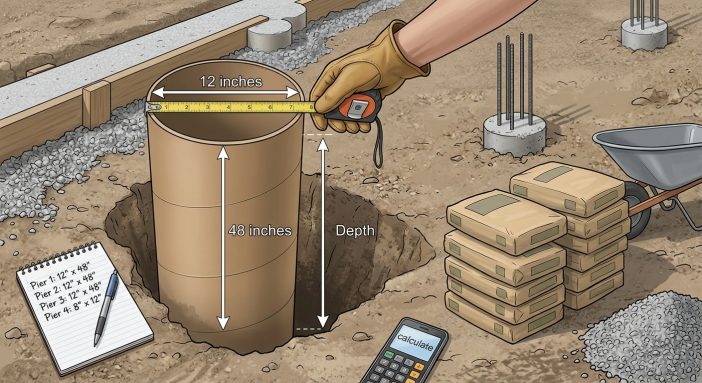
- Select Round or Square as your pier shape.
- Enter the diameter (round) or width/side (square) in inches.
- Enter the pier depth in feet and the number of piers you need.
- Adjust the waste allowance percentage to match your site conditions.
- Choose a bag size and enter your price per bag and price per cubic yard for ready-mix.
- Review the volume, bag count, and cost results shown below the form.
Understanding Each Input Field
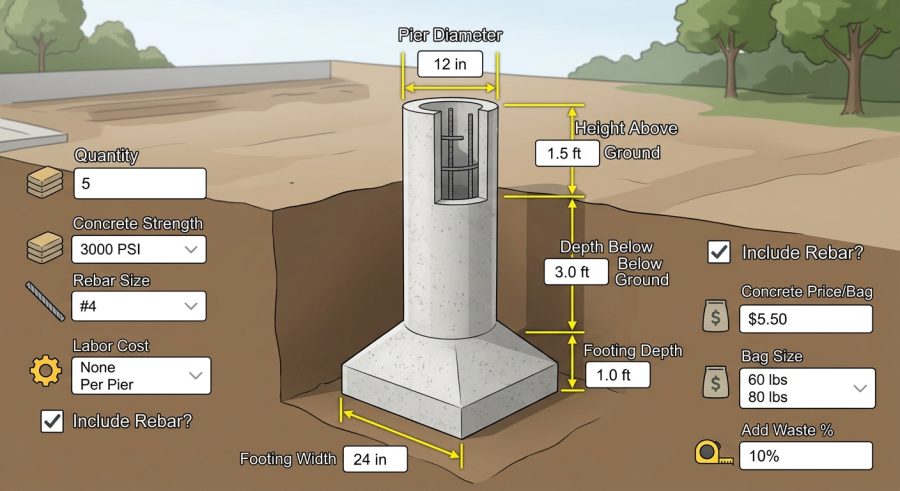
Pier Shape: choose Round for cylindrical holes (common with sonotubes) or Square for rectangular forms.
Pier Diameter (round piers): the width across a round pier, in inches. Only used when Round is selected.
Pier Width/Side (square piers): the length of one side of a square pier, in inches. Only used when Square is selected.
Pier Depth/Height: the full fill depth of the pier hole, in feet, including any below-grade portion.
Number of Piers: how many piers of this exact size you are pouring in one calculation.
Waste/Overfill Allowance: a percentage added to cover spillage, uneven excavation, and overfill. Ten percent is a common starting point.
Concrete Bag Size: select 40, 60, or 80 pound bags; each has a different yield in cubic feet.
Price per Bag: your local cost for one bag of the selected size, in dollars.
Ready-Mix Price per Cubic Yard: your local delivered cost per cubic yard, in dollars, used for the truck-delivery cost estimate.
How Pier Volume and Bag Count Are Calculated
For a round pier, the calculator finds the circular cross-sectional area using the pier diameter, then multiplies by depth. The radius in feet equals diameter in inches divided by 24 (since 24 converts inches to feet and halves the diameter at once). Area equals 3.14159265 times radius squared. Volume per pier equals area times depth in feet, giving cubic feet.
For a square pier, the side length in inches is divided by 12 to get feet, then squared to get area, and multiplied by depth to get volume per pier in cubic feet.
Total Volume Needed multiplies volume per pier by the number of piers, then by (1 plus waste percent divided by 100) to add the waste allowance. Total Volume in Cubic Yards divides that figure by 27, since one cubic yard equals 27 cubic feet.
Bags Needed divides total cubic feet by the selected bag yield and rounds up, since partial bags cannot be purchased. Estimated Cost (Bags) multiplies the rounded bag count by price per bag. Estimated Cost (Ready-Mix) multiplies total cubic yards by price per cubic yard.
Sample Pier Calculations Checked Step by Step
Example 1 — Round deck footing: Given: diameter 12 in, depth 3 ft, quantity 1, waste 10%, 60 lb bags.
Formula: volume = 3.14159265 x (12/24)^2 x 3.
Substitution: 3.14159265 x 0.25 x 3 = 2.36 cu ft per pier.
Calculation: total volume = 2.36 x 1 x 1.10 = 2.59 cu ft = 0.096 cu yd.
Final result: 6 bags needed, about $39.00 in bags, about $14.40 in ready-mix.
Example 2 — Square fence posts: Given: width 12 in, depth 4 ft, quantity 4, waste 10%, 80 lb bags.
Formula: volume = (12/12)^2 x 4 per pier.
Substitution: 1 x 4 = 4 cu ft per pier.
Calculation: total volume = 4 x 4 x 1.10 = 17.6 cu ft = 0.652 cu yd.
Final result: 30 bags needed, about $195.00 in bags, about $97.78 in ready-mix.
Example 3 — Large round shed piers: Given: diameter 18 in, depth 5 ft, quantity 6, waste 15%, 60 lb bags.
Formula: volume = 3.14159265 x (18/24)^2 x 5 per pier.
Substitution: 3.14159265 x 0.5625 x 5 = 8.84 cu ft per pier.
Calculation: total volume = 8.84 x 6 x 1.15 = 60.97 cu ft = 2.258 cu yd.
Final result: 136 bags needed, about $884.00 in bags, about $338.70 in ready-mix.
Example 4 — Small square pier run: Given: width 10 in, depth 2.5 ft, quantity 20, waste 5%, 40 lb bags.
Formula: volume = (10/12)^2 x 2.5 per pier.
Substitution: 0.694 x 2.5 = 1.74 cu ft per pier.
Calculation: total volume = 1.74 x 20 x 1.05 = 36.46 cu ft = 1.350 cu yd.
Final result: 122 bags needed, about $793.00 in bags, about $202.55 in ready-mix.
Quick-Reference Volumes for Common Round Piers
| Diameter (in) | Depth (ft) | Volume per Pier (cu ft) |
|---|---|---|
| 8 | 3 | 1.05 |
| 10 | 3 | 1.64 |
| 12 | 3 | 2.36 |
| 12 | 4 | 3.14 |
| 16 | 4 | 5.59 |
| 18 | 5 | 8.84 |
| 24 | 5 | 15.71 |
These figures assume a round pier with no waste allowance added. Use the calculator above for square piers, custom sizes, or to include waste, bag count, and cost.
Reading Your Volume, Bag, and Cost Results
Volume per Pier shows the concrete needed to fill one hole, useful for checking a single footing before scaling up.
Total Volume Needed and Total Volume in Cubic Yards show the full project amount, already including your waste allowance, in cubic feet and cubic yards.
Bags Needed is always rounded up to the next whole bag, since you cannot buy a partial bag, so the true concrete purchased may be slightly more than the calculated volume.
Estimated Cost (Bags) and Estimated Cost (Ready-Mix) give two purchasing paths so you can compare bagged concrete against a ready-mix delivery for the same job. Neither includes delivery fees, taxes, or labor.
What Changes Your Concrete Quantity and Cost
Pier shape: round piers use a circular area formula while square piers use a squared side length; the calculator applies the correct one automatically based on your selection.
Diameter or width: even a small increase in size has a large effect on volume because area grows with the square of the dimension. The calculator accounts for this directly.
Depth: volume increases in direct proportion to depth. Entering the full fill depth, not just the visible above-ground height, is essential and is fully handled by the depth field.
Quantity and waste allowance: both scale the total volume linearly and are included in every total, bag, and cost result.
Bag yield and pricing: different bag sizes and local prices change bag count and cost outputs, both of which the calculator applies as entered, but it cannot know your actual local price unless you enter it.
Pier Pour Mistakes That Waste Concrete or Money
- Entering above-ground height instead of full depth: pier depth should include the buried portion, not just what shows after backfill.
- Mixing diameter and radius: the diameter field expects the full width across the pier, not half of it.
- Skipping the waste allowance: real pours almost always use more concrete than the exact geometric volume due to uneven holes and spillage.
- Using the wrong bag yield: 40, 60, and 80 pound bags all yield different cubic footage; selecting the wrong one skews the bag count.
- Assuming ready-mix and bag costs will match: small orders are usually cheaper in bags, while large orders often favor ready-mix, so compare both results.
- Forgetting to change quantity: leaving quantity at 1 while planning multiple piers will understate total materials significantly.
- Ignoring frost depth or code minimums: the calculator only computes volume for the depth you enter, not the depth required by local building codes.
What This Calculator Does Not Cover
This calculator computes geometric concrete volume, bag count, and material cost for simple solid round or square piers. It does not model rebar displacement, sonotube wall thickness, or irregular hole shapes, and it assumes consistent dimensions across all piers entered in one calculation.
It does not determine required pier depth, diameter, or spacing for structural adequacy. Frost line depth, soil bearing capacity, and footing size minimums vary by region and local building code, and must be confirmed separately. Bag yield figures are standard industry approximations that can vary slightly by manufacturer, and entered prices do not include delivery, tax, or labor.
For any structural footing supporting a deck, building, or fence subject to inspection, consult local building codes and, where required, a qualified engineer or building official before finalizing depth, diameter, or spacing.
Round vs. Square Pier Volume Differences
A round pier and a square pier with the same width in inches do not use the same amount of concrete. A round pier’s area is based on a circle, which is smaller than a square with the same overall width. For example, a 12 inch round pier uses about 0.79 square feet of cross-sectional area, while a 12 inch square pier uses a full 1 square foot. That means a square pier of the same nominal size typically needs roughly 27 percent more concrete than a round one of matching width.
Choosing Between Bagged and Ready-Mix Concrete
Bagged concrete is usually more practical for small jobs, single posts, or sites without truck access, since you buy only what you need and mix on site. Ready-mix delivery becomes more cost-effective as total volume grows, often once a project needs a half cubic yard or more, because per-yard truck pricing is typically lower than the equivalent cost in bags. Compare the Estimated Cost (Bags) and Estimated Cost (Ready-Mix) results side by side to see which option fits your project size and budget.
Handling Projects With Mixed Pier Sizes
This calculator assumes every pier in a single calculation shares the same shape, dimension, and depth. If your project has piers of different sizes, such as larger corner footings and smaller mid-span footings, run the calculator once for each size group, note the volume, bags, and cost for each, then add the totals together for your full material order.
Concrete Pier Questions Homeowners Ask Most
How much concrete does a typical deck pier require?
A common 12 inch diameter round pier poured 3 feet deep needs about 2.36 cubic feet of concrete per pier before waste. Adding a 10 percent waste allowance brings that to about 2.59 cubic feet. Actual needs vary with your specific diameter, depth, and local building requirements.
How many 60 lb or 80 lb bags fill one pier hole?
It depends on the pier volume and bag yield. A 60 lb bag yields about 0.45 cubic feet, so a 2.59 cubic foot pier needs about 6 bags. An 80 lb bag yields 0.60 cubic feet, needing fewer bags for the same volume. Enter your dimensions above for an exact count.
What is the difference between round and square pier concrete volume?
A square pier uses more concrete than a round pier of the same nominal width, because a square cross-section has a larger area than a circle inscribed within it. For a 12 inch size, a square pier needs roughly 27 percent more volume than a round one of equal width.
How much waste allowance should I add for pier pours?
A 10 percent waste allowance is a reasonable default for most pier pours, covering minor spillage and slightly uneven hole shapes. Rocky or loose soil that requires oversized excavation may call for 15 to 20 percent or more. Adjust the waste field to match your site conditions.
When should I order ready-mix instead of bagged concrete?
Ready-mix delivery tends to be more economical once total volume reaches roughly half a cubic yard or more, since truck pricing per yard is usually lower than the equivalent bagged cost. For a handful of small piers, bagged concrete is often simpler and avoids minimum delivery charges.
How deep should a concrete pier be for a deck or fence post?
Required pier depth depends on local frost line depth, soil conditions, and building code minimums, which vary by region. This calculator computes volume for whatever depth you enter, but it does not determine the correct depth for your location; check local code requirements or consult a professional.
Does this calculator account for local frost line or code depth requirements?
No. This calculator only converts the depth, dimensions, and quantity you enter into volume, bags, and cost. It does not know or apply frost line depth, minimum footing size, or other building code requirements, which vary by city and region and must be confirmed separately.
How do I calculate concrete for multiple piers of different sizes?
Run the calculator separately for each distinct pier size or depth, recording the volume, bags, and cost for each group. Then add the totals from each calculation together to get your combined material needs for the full project.
Planning Your Pier Pour With Confidence
Calculating concrete for piers comes down to getting an accurate volume, then converting that volume into bags or ready-mix quantities you can actually order. Use this calculator to test different diameters, depths, and waste allowances before you dig, and always confirm depth and sizing requirements against your local building code or a qualified professional for any structural footing.

One Response