
This concrete block fill calculator estimates the number of CMU blocks, the grout volume needed to fill hollow cores, and how many premixed grout bags to order for a masonry wall. Enter your wall dimensions, block size, core dimensions, and fill pattern below to get an instant materials and cost estimate for your concrete block project.
Concrete Block Fill Calculator: Grout Volume & Bags
Estimate CMU block count, grout fill volume, bags needed, and material cost for filling concrete block cores in a wall.
Estimating Grout, Blocks, and Cost for CMU Walls
This tool helps masons, contractors, and DIY builders figure out how many concrete blocks a wall needs and how much grout or concrete fill is required for the hollow cores inside those blocks. It is useful when planning reinforced masonry walls, foundation walls, or retaining walls where cores must be filled for strength or code compliance.
The calculator produces an estimate, not an exact order quantity. Real-world block layout, cutting waste, and mortar joint variation will shift the true count slightly. Always round up and buy a small surplus of blocks and grout bags.
Steps to Calculate Your Block Fill Materials
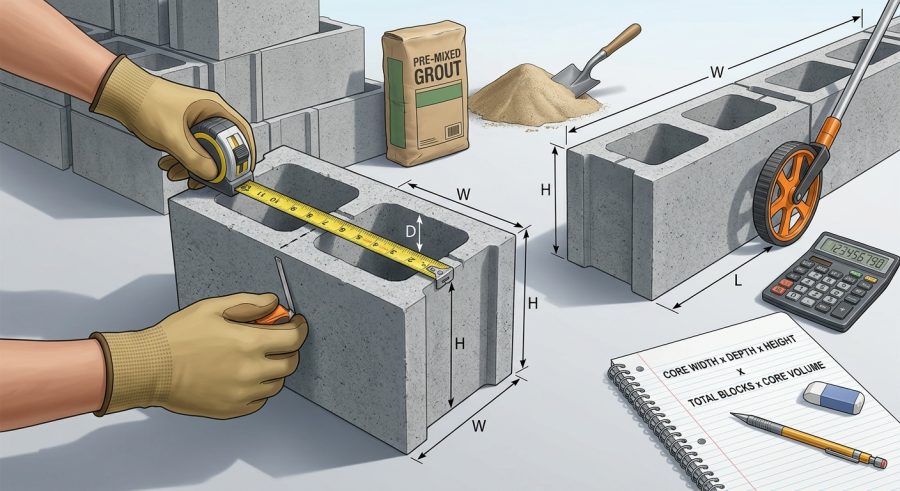
- Enter the wall length and height in feet.
- Enter the actual block length and height in inches, subtracting the mortar joint if you know it.
- Enter the core opening width and length in inches, plus the number of cores per block.
- Choose a fill pattern: full fill, every other course, or partial fill.
- Enter your waste percentage, grout yield per bag, and cost per bag.
- Review the block count, fill volume, bags needed, and estimated cost.
Measuring Wall, Block, and Core Dimensions
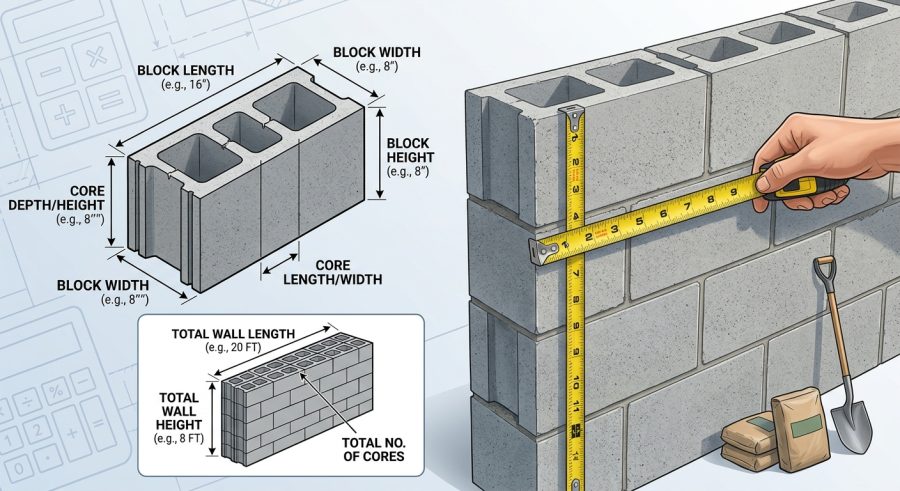
Wall Length and Wall Height are entered in feet and describe the overall rectangular wall area you plan to build.
Block Nominal Length and Block Nominal Height are the actual face dimensions of one block in inches, after subtracting a standard mortar joint. A common 8-inch nominal block measures about 15.625 by 7.625 inches in reality.
Core Opening Width and Core Opening Length describe the hollow void inside the block, in inches. These vary by block manufacturer and block width, so measure a sample block or check the supplier spec sheet.
Cores per Block is usually 2 for standard two-core CMU, but some narrow or specialty blocks have only 1.
Fill Pattern lets you choose full fill, every-other-course fill, or a 33 percent partial fill, matching your structural design.
Waste Factor is a percentage added to cover spillage and bridging during placement.
Grout Yield per Bag is the cubic feet of mixed grout one bag produces, and Cost per Bag is your local price per bag.
How Block Count and Grout Volume Are Calculated
The calculator works through five steps.
Blocks per wall: Number of Blocks = ceil((wall length in inches divided by block length) multiplied by (wall height in inches divided by block height)). This assumes a running-bond or stacked layout filling the full rectangle with no openings deducted.
Core volume per block: Core Volume = (core width times core length times block height) divided by 1728, then multiplied by cores per block. Dividing by 1728 converts cubic inches to cubic feet, since 1 cubic foot equals 1728 cubic inches.
Total fill volume: Total Volume = Number of Blocks times Core Volume per Block times the fill fraction times (1 plus waste percent divided by 100). This scales the raw void volume down for partial fill patterns and up for expected waste.
Bags needed: Bags = ceil(Total Volume divided by Grout Yield per Bag), rounded up because bags cannot be purchased in fractions.
Material cost: Cost = Bags times Cost per Bag.
All formulas assume a solid rectangular wall with no window or door cutouts and uniform core geometry across every block.
Sample Wall Fill Calculations
Example 1 — Standard 8-inch wall, full fill. Given: wall 20 ft by 8 ft, block 15.625 by 7.625 in, core 4.5 by 5.5 in, 2 cores, full fill, 10% waste, yield 0.6 cu ft/bag, cost $5/bag. Blocks = ceil((240/15.625)*(96/7.625)) = ceil(15.36*12.59) = ceil(193.39) = 194 blocks. Core volume = (4.5*5.5*7.625)/1728*2 = 0.2184 cu ft. Fill volume = 194*0.2184*1*1.10 = 46.61 cu ft. Bags = ceil(46.61/0.6) = 78 bags. Cost = 78*5 = $390.00.
Example 2 — Small wall, full fill, lower waste. Given: wall 10 ft by 4 ft, same block and core, waste 5%, cost $6/bag. Blocks = ceil((120/15.625)*(48/7.625)) = ceil(7.68*6.30) = ceil(48.35) = 49 blocks. Fill volume = 49*0.2184*1*1.05 = 11.24 cu ft. Bags = ceil(11.24/0.6) = 19 bags. Cost = 19*6 = $114.00.
Example 3 — Large wall, 33% partial fill. Given: wall 40 ft by 10 ft, same block and core, fill 0.33, waste 10%, yield 0.5, cost $4.50/bag. Blocks = ceil((480/15.625)*(120/7.625)) = ceil(30.72*15.74) = ceil(483.45) = 484 blocks. Fill volume = 484*0.2184*0.33*1.10 = 38.38 cu ft. Bags = ceil(38.38/0.5) = 77 bags. Cost = 77*4.5 = $346.50.
Example 4 — Single-core block, alternating fill. Given: wall 24 ft by 6 ft, block 15.625 by 7.625 in, core 2.5 by 5.5 in, 1 core, fill 0.5, waste 15%, yield 0.45, cost $5.50/bag. Blocks = ceil((288/15.625)*(72/7.625)) = ceil(18.43*9.44) = ceil(174.04) = 175 blocks. Core volume = (2.5*5.5*7.625)/1728*1 = 0.0607 cu ft. Fill volume = 175*0.0607*0.5*1.15 = 6.11 cu ft. Bags = ceil(6.11/0.45) = 14 bags. Cost = 14*5.5 = $77.00.
Typical CMU Core Sizes by Block Width
| Nominal Block Size | Typical Actual Size (L x H) | Approximate Core Opening | Typical Cores |
|---|---|---|---|
| 4 in wide CMU | 15.625 x 7.625 in | 2.5 x 5.5 in | 1 or 2 |
| 6 in wide CMU | 15.625 x 7.625 in | 4.0 x 5.5 in | 2 |
| 8 in wide CMU | 15.625 x 7.625 in | 4.5 x 5.5 in | 2 |
| 12 in wide CMU | 15.625 x 7.625 in | 9.5 x 5.5 in | 2 |
Core openings vary by manufacturer, block design, and web thickness. Always confirm the exact core size with your supplier before ordering large quantities of grout.
Reading Your Block and Grout Estimate
Number of Blocks Needed tells you how many CMU units to order for the wall face area, rounded up to a whole block.
Core Volume per Block shows the void space inside a single block, which is useful for checking your inputs before scaling up.
Total Grout Fill Volume is the cubic footage of grout or concrete you need after applying the fill pattern and waste factor.
Bags Needed rounds the volume up to whole bags since partial bags cannot be purchased.
Estimated Material Cost multiplies bags by your entered price per bag. This covers grout material only, not labor, delivery, mortar, rebar, or block cost.
All results are planning estimates. Site conditions, block breakage, and mix variance can change the final quantities needed.
What Changes Your Grout Quantity
Block and core dimensions: Different manufacturers produce different core sizes even for the same nominal block width. The calculator accounts for whatever values you enter, so accurate measurements matter most.
Fill pattern: Full fill uses far more grout than alternating or partial fill. This is directly accounted for through the fill fraction selection.
Waste factor: Spillage, bridging inside cores, and pump losses all increase real material use. The waste percentage input adjusts for this.
Bag yield: Grout and concrete mix products vary in cubic foot yield per bag. Always check the actual bag label rather than relying on a generic default.
Wall openings: Doors, windows, and other cutouts are not automatically subtracted. You must reduce the wall length or height manually to reflect net wall area.
Frequent Errors When Ordering Grout
- Using nominal block size instead of actual size: An 8-inch nominal block is actually about 7.625 inches; using 8 inches understates the true course count.
- Guessing core dimensions: Core openings differ by manufacturer, so measure a sample block instead of assuming a standard size.
- Forgetting door and window openings: This calculator assumes a solid rectangular wall, so subtract opening area from your wall dimensions first.
- Ignoring waste losses: Skipping the waste factor often leads to running short on grout mid-pour.
- Using the wrong bag yield: Bag yield varies by product; using a generic value can overstate or understate bags needed.
- Rounding down bag counts: Bags must be purchased whole, so always round up rather than truncating.
- Applying full fill when only reinforced cells need grout: Many walls only require partial or alternating fill at reinforced cells, not every core.
What This Tool Does Not Cover
This calculator provides a planning estimate for CMU block count, grout fill volume, and material cost. It assumes a rectangular wall with uniform block and core dimensions throughout, and it does not automatically deduct door, window, or utility openings. Core sizes, mortar joint thickness, and bag yields vary by manufacturer and region, so figures should be verified against your specific product specifications. It does not account for block breakage, rebar placement, mortar quantity, labor, or delivery costs. For structural fill requirements, engineered wall design, or building code compliance, consult a qualified structural engineer or masonry contractor before finalizing material orders.
Full Fill Versus Partial Fill Grouting
Full fill grouting fills every core in every course and is common in load-bearing or high-wind walls. Partial fill, such as every other course or roughly a third of the cell volume, is often used where only reinforced cells or specific structural cells need fill. Choosing the correct fill pattern is a structural design decision, not a calculator setting, so confirm the required pattern with your project drawings or a qualified engineer before selecting an option.
Adjusting for Door and Window Openings
Since this calculator assumes a solid rectangular wall, any door, window, or utility penetration should be subtracted before entering your dimensions. One common method is to calculate the gross wall area separately, subtract the opening area, then convert the net area back into an equivalent length at your wall height to enter here. This keeps the block count and grout volume closer to what the actual wall will require.
Related Concrete and Masonry Material Estimates
If your project also involves footings, piers, or surrounding hardscape, related planning tools can help. A concrete pier calculator for volume and bags is useful for footing supports beneath a block wall, while a crushed concrete volume and cost calculator can help plan base material or backfill around the wall. For paved areas near the wall, a polymeric sand calculator for paver joints may also be useful.
Concrete Block Fill Questions Answered
How do I measure the core opening size on a concrete block?
Turn the block on its end and measure the width and length of the hollow opening with a tape measure or calipers, in inches. Measure a few sample blocks since manufacturing tolerances and product lines can vary the opening slightly.
What is the difference between full grout fill and partial fill?
Full fill means every hollow core in every course is filled with grout, typically for load-bearing or high-wind walls. Partial fill, such as every other course or about a third of the cell volume, is used when only specific reinforced cells need fill, based on structural design requirements.
How many bags of grout do I need per concrete block wall?
It depends on wall size, block and core dimensions, fill pattern, and bag yield. This calculator multiplies the total fill volume by your waste factor, then divides by the cubic foot yield per bag, rounding up to a whole number of bags.
Does this calculator account for door and window openings?
No. The formulas assume a solid rectangular wall. If your wall has openings, reduce the wall length or height manually to reflect the net wall area before entering your dimensions.
What is the standard core size for an 8x8x16 CMU block?
Core openings vary by manufacturer, but a common approximate range for an 8-inch wide block is around 4.5 by 5.5 inches per core, with two cores per block. Always confirm exact dimensions with your block supplier before ordering large quantities.
How does the waste factor affect my total grout order?
The waste factor is added as a percentage on top of the calculated fill volume to cover spillage, bridging inside cores, and placement losses. A higher waste percentage increases both the total volume and the number of bags needed.
Can I use this calculator for metric block sizes?
Yes, if you convert your wall, block, and core measurements to feet and inches first, since the formulas are built around those units. If your blocks are specified in millimeters or centimeters, convert them to inches before entering the values.
Are the results from this calculator exact enough to place a final material order?
No. Results are planning estimates based on the dimensions you enter. Actual material needs can shift due to block breakage, mortar joint variation, and site conditions, so always add a reasonable buffer and confirm quantities with your supplier.
Planning Your Grout Order With Confidence
Filling concrete block cores correctly depends on accurate wall, block, and core measurements along with the right fill pattern for your structural design. This calculator turns those inputs into a clear estimate of blocks, grout volume, bags, and cost, helping you plan a more efficient material order. For structural fill requirements or code-specific grouting patterns, confirm final specifications with a qualified masonry professional or structural engineer.
