
This sonotube concrete calculator estimates how much concrete you need to fill round cardboard forms for footings, piers, or deck posts. Enter the tube diameter, height, and quantity, along with a waste allowance and bag size, to get the total volume in cubic feet and cubic yards, the number of bags to buy, and an estimated ready-mix cost for your pour.
Sonotube Concrete Calculator: Volume, Bags & Cost Estimator
Estimate cubic feet, cubic yards, bag count, and ready-mix cost needed to fill round sonotube forms for footings, piers, and deck posts.
What This Sonotube Volume and Bag Estimator Does
This calculator finds the volume of concrete needed to fill one or more round sonotube forms, then converts that volume into practical ordering numbers: bags of pre-mixed concrete or cubic yards of ready-mix. It helps DIY homeowners setting deck posts, contractors pouring pier footings, and estimators pricing a job before delivery day.
Results are estimates based on the form acting as a perfect cylinder. Real pours can vary slightly due to soil conditions, form bulging, or uneven excavation, which is why a waste allowance is built into the math.
Steps to Estimate Your Concrete Pour
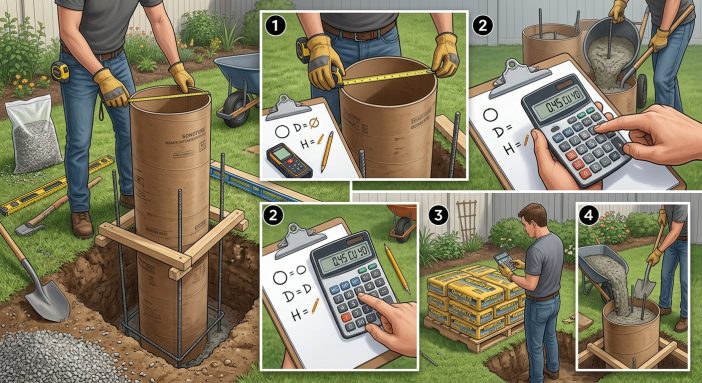
- Measure the inside diameter of your sonotube form in inches and enter it in the Tube Diameter field.
- Measure the total fill height in feet, including any portion that sits below grade.
- Enter how many tubes you are pouring in the Number of Tubes field.
- Set a waste allowance to cover spillage, over-excavation, and settling, typically 10 to 15 percent.
- Pick your bag size if you plan to use pre-mixed bags, or leave the default to compare against ready-mix.
- Enter your local ready-mix cost per cubic yard to see an estimated delivered cost.
Understanding Each Measurement You Enter
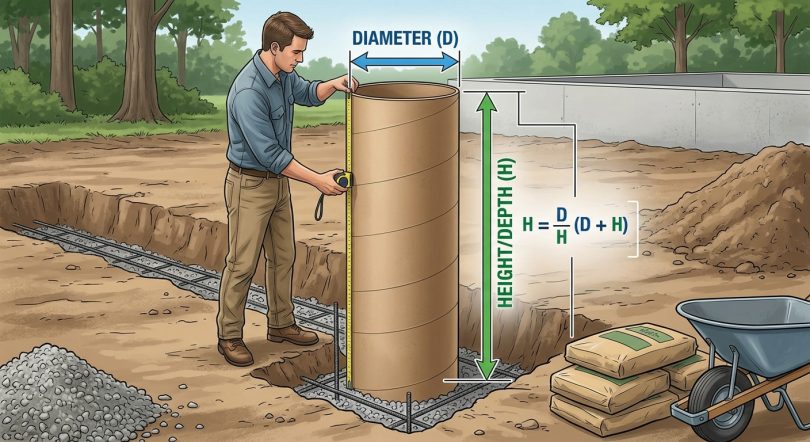
Tube Diameter (inches) is the inside width of the sonotube, matching standard sizes like 8, 10, 12, or 16 inches. Use the manufacturer size printed on the tube, since that reflects the inside pour diameter.
Tube Height (feet) is the total length of concrete you will pour into the tube, measured from the bottom of the hole to the top of the form, including any portion buried below grade.
Number of Tubes lets you calculate multiple identical footings or piers at once instead of running the calculator repeatedly.
Waste / Overage Allowance (percent) adds extra volume to cover spillage, form expansion, and minor excavation variance. Most small pours use 10 to 15 percent.
Bag Size / Yield selects how many cubic feet one bag of pre-mixed concrete produces once mixed with water, based on common 40, 60, and 80 pound bag sizes.
Ready-Mix Cost per Cubic Yard is your local supplier’s delivered price, used only to estimate cost if you order bulk ready-mix instead of bags.
How Cylinder Volume Becomes Bags and Cost
The calculator treats each sonotube as a right circular cylinder. Volume equals pi multiplied by radius squared, multiplied by height.
Volume per Tube = 3.14159265 * (diameter_in / 24)^2 * height_ft. Dividing diameter in inches by 24 converts it to a radius in feet, since dividing by 12 converts inches to feet and dividing by 2 converts diameter to radius.
Total Concrete Volume (with Waste) = Volume per Tube * quantity * (1 + waste_percent / 100). This multiplies single-tube volume by the number of tubes, then adds the chosen waste percentage.
Total Volume in Cubic Yards = Total Concrete Volume (with Waste) / 27, since one cubic yard equals 27 cubic feet.
Bags of Concrete Needed = Total Concrete Volume (with Waste) / bag_yield_cubic_feet, where bag yield is the cubic feet one bag produces.
Estimated Ready-Mix Cost = Total Volume in Cubic Yards * concrete_cost_per_yard.
These formulas assume a straight-sided cylinder with no taper, so actual concrete used can differ slightly if the tube bulges under wet concrete pressure.
Four Real Pour Scenarios Calculated Step by Step
Example 1: Standard deck post footing. Given: diameter 12 in, height 4 ft, quantity 1, waste 10%, 60 lb bags (0.45 cu ft), $150 per cu yd. Formula: 3.14159265 * (12/24)^2 * 4. Substitution: 3.14159265 * 0.25 * 4. Calculation: 3.14 cu ft per tube; with 10% waste, 3.46 cu ft total. Final result: 0.13 cu yd, about 8 bags, roughly $19.20 in ready-mix.
Example 2: Six small deck posts. Given: diameter 8 in, height 3 ft, quantity 6, waste 15%, 60 lb bags, $140 per cu yd. Formula: 3.14159265 * (8/24)^2 * 3 = 1.05 cu ft per tube. Substitution: 1.05 * 6 * 1.15. Calculation: 7.23 cu ft total. Final result: 0.27 cu yd, about 16 bags, roughly $37.47.
Example 3: Four larger piers. Given: diameter 16 in, height 6 ft, quantity 4, waste 10%, 80 lb bags (0.60 cu ft), $160 per cu yd. Formula: 3.14159265 * (16/24)^2 * 6 = 8.38 cu ft per tube. Substitution: 8.38 * 4 * 1.10. Calculation: 36.86 cu ft total. Final result: 1.37 cu yd, about 61 bags, roughly $218.44.
Example 4: Single large column footing. Given: diameter 24 in, height 8 ft, quantity 1, waste 5%, 60 lb bags, $175 per cu yd. Formula: 3.14159265 * (24/24)^2 * 8 = 25.13 cu ft per tube. Substitution: 25.13 * 1 * 1.05. Calculation: 26.39 cu ft total. Final result: 0.98 cu yd, about 59 bags, roughly $171.04.
Concrete Volume per Foot by Tube Diameter
| Tube Diameter | Volume per Foot of Height | 60 lb Bags per Foot |
|---|---|---|
| 6 in | 0.20 cu ft | 0.44 bags |
| 8 in | 0.35 cu ft | 0.78 bags |
| 10 in | 0.55 cu ft | 1.21 bags |
| 12 in | 0.79 cu ft | 1.75 bags |
| 16 in | 1.40 cu ft | 3.10 bags |
| 18 in | 1.77 cu ft | 3.93 bags |
| 20 in | 2.18 cu ft | 4.85 bags |
| 24 in | 3.14 cu ft | 6.98 bags |
Values assume no waste allowance and standard 60 lb bags yielding 0.45 cubic feet each. Multiply by your actual height and add your waste percentage for a full estimate.
Reading Your Volume, Bag, and Cost Results
Volume per Tube shows the raw cylinder volume for one form before waste or quantity are applied, useful for checking your math against known references.
Total Concrete Volume (with Waste) and its Cubic Yards counterpart are the numbers to give a ready-mix supplier or use for large bulk orders.
Bags of Concrete Needed rounds to a whole number and reflects your selected bag size, so switching bag size changes this count even though total volume stays the same.
Estimated Ready-Mix Cost is a rough budgeting figure based on the price you enter; actual delivered cost depends on minimum order fees, short-load surcharges, and regional pricing.
What Changes How Much Concrete You Need
Tube diameter has the largest effect on volume because area scales with the radius squared. This calculator accounts for it directly through the entered diameter.
Fill height scales volume linearly, and the calculator assumes the full entered height is filled with concrete, including any buried portion.
Waste allowance is user-adjustable and covers real-world losses like spillage or slight over-excavation; it is not automatically estimated from soil type.
Form bulging under wet concrete pressure can slightly increase actual volume beyond a perfect cylinder, especially on taller pours. This calculator does not model bulging and assumes rigid cylindrical dimensions.
Bag mixing water content and compaction affect real yield slightly, but the calculator uses standard manufacturer yield figures rather than measuring your specific mix.
Mistakes That Lead to Ordering Too Little
- Measuring outside diameter instead of inside diameter: Use the inside pour diameter, which is what the tube is labeled and sold as.
- Forgetting the below-grade portion of height: Include the full depth from the bottom of the hole to the top of the tube, not just the visible above-ground portion.
- Skipping the waste allowance: Ordering exact volume with zero waste often leaves you short on pour day due to spillage or uneven holes.
- Mixing up bag sizes: A 40 lb bag yields less concrete than a 60 or 80 lb bag, so selecting the wrong size skews the bag count.
- Rounding down the bag count: Always round up to the next whole bag, since partial bags cannot be purchased.
- Assuming ready-mix cost includes delivery fees: Many suppliers add short-load or delivery charges not reflected in the base price per yard.
- Treating multiple different tube sizes as one entry: If your project mixes diameters, calculate each size separately and add the results together.
What This Estimate Does Not Cover
This calculator assumes each sonotube is a perfectly straight cylinder with no taper, crushing, or bulging. It does not account for rebar or embedded hardware displacing volume, soil type, frost depth requirements, or local building code minimums for footing depth and diameter. Ready-mix pricing is a placeholder you supply and will vary by region, supplier, and order size. For structural footings supporting decks, additions, or load-bearing posts, confirm sizing, depth, and reinforcement requirements with a qualified engineer, contractor, or your local building department before pouring.
Bagged Concrete or Ready-Mix: Choosing an Order Method
Small jobs with only one or two tubes are usually cheaper and easier with pre-mixed bags, since you avoid ready-mix delivery minimums. Larger projects, such as several piers or a run of deep footings, often become more cost-effective with a ready-mix truck once total volume approaches half a cubic yard or more. Compare the Bags of Concrete Needed result against the Estimated Ready-Mix Cost to see which option fits your budget and labor capacity.
Standard Sonotube Sizes and Typical Uses
Common sonotube diameters range from 6 to 24 inches, though larger sizes exist for heavy commercial columns. Smaller 8 and 10 inch tubes are typical for deck post footings, while 12 and 16 inch tubes suit structural piers and porch supports. If you are also planning a broader concrete pier layout with different shapes or depths, a dedicated concrete pier volume calculator can help compare options side by side.
Above-Grade vs Below-Grade Height Planning
Frost depth requirements in many regions mean footings must extend well below ground level, so the height you enter should include both the visible above-grade portion and the buried section down to the bottom of the hole. Skipping the below-grade portion is one of the most common reasons DIYers underestimate total concrete volume.
sonotube concrete calculator Questions and Answers
How is sonotube diameter measured for concrete calculations?
Use the inside diameter of the tube, which matches the size printed on the product, such as 8, 10, or 12 inches. This is the diameter that determines the actual poured concrete cross-section.
How much concrete does a 12 inch sonotube need per foot of height?
A 12 inch diameter tube holds about 0.79 cubic feet of concrete per foot of height, based on the cylinder volume formula. Multiply this by your total fill height to estimate volume for one tube before adding waste.
How many 60 lb or 80 lb bags fill one sonotube?
Bag count depends on total volume and bag yield. A 60 lb bag yields about 0.45 cubic feet, while an 80 lb bag yields about 0.60 cubic feet, so fewer 80 lb bags are needed for the same volume.
When should I order ready-mix instead of bagged concrete?
Ready-mix delivery often becomes more practical once total volume reaches roughly half a cubic yard or more, or when pouring many tubes at once, since mixing dozens of bags by hand is labor intensive.
How much waste allowance should I add for footings and piers?
Most small pours use a 10 to 15 percent waste allowance to cover spillage, form bulging, and uneven excavation. Larger or more controlled commercial pours sometimes use a smaller percentage.
Does tube height include the portion buried below grade?
Yes, the height you enter should include the full depth of concrete from the bottom of the hole to the top of the form, since that entire length gets filled with concrete.
How do I convert cubic feet of concrete to cubic yards?
Divide the total cubic feet by 27, since one cubic yard equals 27 cubic feet. This calculator performs that conversion automatically in the Cubic Yards result.
Is this calculator accurate enough for ordering exact materials?
It provides a close estimate based on standard cylinder math and typical bag yields, but real pours can vary due to form bulging or excavation differences. Always round up and consider a professional check for structural footings.
Planning Your Pour with Confidence
Filling sonotube forms accurately comes down to three numbers: diameter, height, and quantity, adjusted with a reasonable waste allowance. This calculator turns those measurements into usable cubic feet, cubic yards, bag counts, and a rough cost estimate so you can order the right amount of concrete before your pour begins.
