
Enter your fence run length, picket width, and desired gap to instantly see how many pickets fit, the exact spacing to keep them even, and total materials needed including waste. This calculator converts your inputs and applies standard even-spacing math used by fence builders to avoid uneven gaps at the end of a run.
Fence Picket Spacing Calculator: Gaps & Picket Count
Calculate the exact number of fence pickets, the true gap between them, and total materials needed for an even, professional-looking fence.
Planning an Even Picket Fence Before You Buy Lumber
This calculator figures out how many fence pickets fit across a section of fence and what gap to actually use so the boards land evenly, with no awkward sliver of space at either end. It is built for homeowners planning a DIY picket fence, contractors pricing out material lists, and fence supply staff helping customers figure out order quantities.
You enter the fence section length, the picket width, and your preferred gap. The calculator then works out the true adjusted gap that fits your exact section perfectly, along with total picket counts and board footage across your whole project. Results are estimates based on the numbers you enter. Actual material needs can shift with lumber variation, post placement, and cutting technique, so always allow room for adjustment on site.
Steps to Find Your Picket Count and Spacing
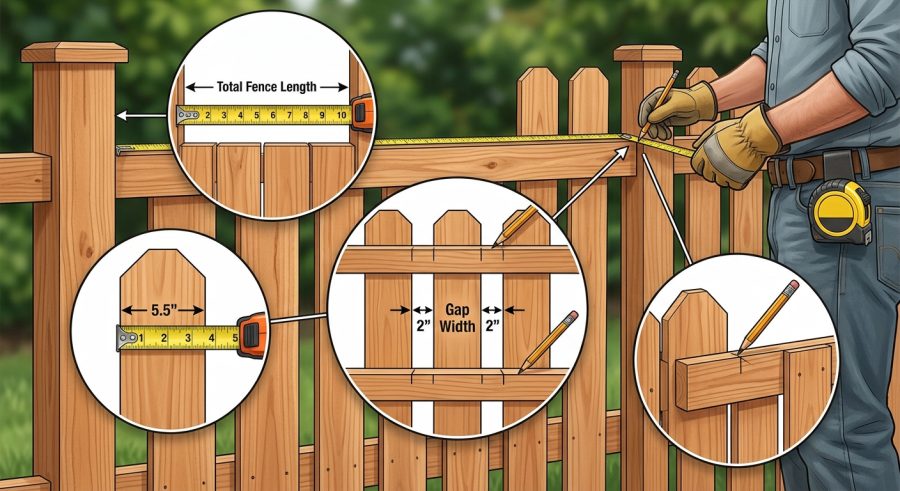
- Measure the clear span of your fence section between posts and enter it in feet as Fence Section Length.
- Measure the actual finished width of one picket board in inches and enter it as Picket Width.
- Enter the gap you would like between pickets in inches as Desired Gap Between Pickets. This is a starting target, not the final result.
- If you are building more than one identical section, enter the total count under Number of Identical Fence Sections.
- Enter a Waste and Cutting Allowance percentage to cover cut errors and damaged boards.
- Review the results for pickets per section, the true adjusted gap, and total materials needed.
What Each Measurement Means and How to Get It
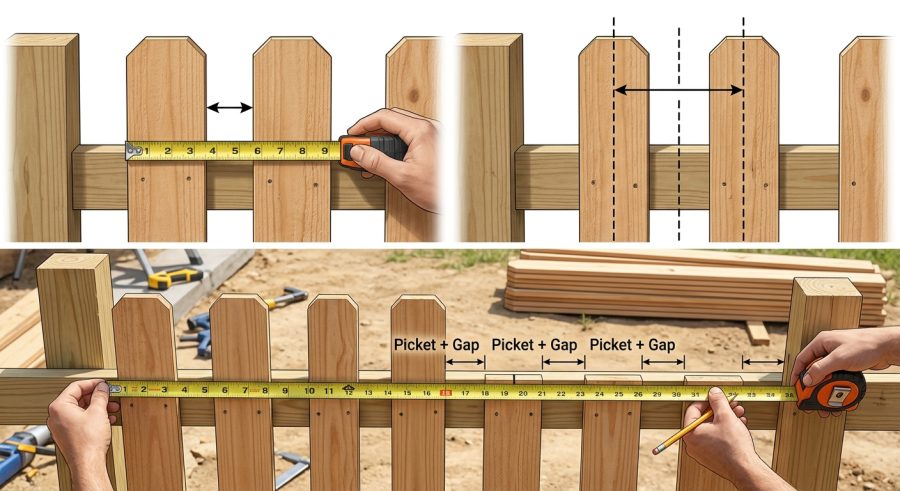
Fence Section Length (ft): the clear span between posts that the pickets must cover, not including the thickness of the posts themselves. Measure this at the picket line, since some fences taper slightly with terrain.
Picket Width (in): the actual finished width of one picket board, measured with a tape measure rather than assumed from the nominal lumber size. A board sold as a 1×6 often measures closer to 5.5 inches.
Desired Gap Between Pickets (in): the spacing you would like to see between boards. This is only a starting target. The calculator adjusts it slightly so the final layout comes out even.
Number of Identical Fence Sections: how many repeated spans of this exact length and picket pattern you are building, so material totals scale across the whole fence line.
Waste and Cutting Allowance (%): extra material percentage added to the picket count to cover miscuts, damaged boards, and trimming at the ends of runs.
The Math Behind Even Picket Spacing
The calculator treats each section as a row of pickets separated by gaps, with no gap counted at the very outer edges beyond the first and last board. For a section of length L (converted from feet to inches), picket width W, and target gap G, the number of pickets n is estimated first, then the gap is recalculated to fit exactly.
Pickets per Section: n = floor((L times 12 + G) / (W + G)), where L is fence length in feet, W is picket width in inches, and G is the desired gap in inches. This finds the largest whole number of pickets that will fit using the target gap as a guide.
Actual Gap Between Pickets: once n is known, the true gap is recalculated as (L times 12 minus n times W) divided by (n minus 1). This spreads any leftover space evenly across all the gaps between pickets so the section comes out exact, rather than leaving a mismatched gap at one end.
Total Pickets Needed: n multiplied by the number of sections, then increased by the waste percentage and rounded up to the next whole picket.
Total Fence Run Length: fence length multiplied by the number of sections, giving the combined length of the whole fence line.
Total Picket Board Footage: total pickets needed multiplied by picket width, converted from inches back to feet by dividing by 12. This gives the linear footage of picket material to purchase.
Four Fence Layout Scenarios Solved Step by Step
Example 1: Standard 8-foot section. Given: fence length 8 ft, picket width 5.5 in, target gap 2 in, 1 section, 5% waste. Formula: n = floor((96 + 2)/(5.5 + 2)). Substitution: floor(98/7.5) = floor(13.07). Calculation: n = 13 pickets. Actual gap = (96 minus 13 times 5.5) divided by 12 = (96 minus 71.5)/12 = 2.042 in. Total pickets needed = ceil(13 times 1.05) = 14. Final result: 13 pickets per section, 2.042 in actual gap, 14 pickets total.
Example 2: Ten narrow sections. Given: fence length 6 ft, picket width 3.5 in, target gap 1.5 in, 10 sections, 10% waste. Substitution: floor((72 + 1.5)/(3.5 + 1.5)) = floor(73.5/5) = floor(14.7). Calculation: n = 14 pickets. Actual gap = (72 minus 49)/13 = 1.769 in. Total pickets needed = ceil(14 times 10 times 1.10) = ceil(154) = 154. Final result: 14 pickets per section, 1.769 in gap, 154 pickets total, 60 ft of total run.
Example 3: Wide pickets, tight gap. Given: fence length 10 ft, picket width 7.25 in, target gap 1 in, 1 section, 0% waste. Substitution: floor((120 + 1)/(7.25 + 1)) = floor(121/8.25) = floor(14.67). Calculation: n = 14 pickets. Actual gap = (120 minus 101.5)/13 = 1.423 in. Total pickets needed = 14. Final result: 14 pickets, 1.423 in actual gap, 8.46 ft of board footage.
Example 4: Narrow pickets, multiple sections. Given: fence length 4 ft, picket width 1.5 in, target gap 0.5 in, 3 sections, 8% waste. Substitution: floor((48 + 0.5)/(1.5 + 0.5)) = floor(48.5/2) = floor(24.25). Calculation: n = 24 pickets. Actual gap = (48 minus 36)/23 = 0.522 in. Total pickets needed = ceil(24 times 3 times 1.08) = ceil(77.76) = 78. Final result: 24 pickets per section, 0.522 in gap, 78 pickets total, 9.75 ft of board footage.
Typical Picket Counts for an 8-Foot Section
The table below assumes a single 8-foot fence section and a 2-inch target gap, showing how picket width alone changes the count and true spacing. Use it as a quick sanity check, not a substitute for entering your own numbers.
| Picket Width (in) | Target Gap (in) | Pickets per 8 ft Section | Actual Adjusted Gap (in) |
|---|---|---|---|
| 3.5 | 2.0 | 17 | 2.281 |
| 5.5 | 2.0 | 13 | 2.042 |
| 6.0 | 2.0 | 12 | 2.182 |
| 7.25 | 2.0 | 10 | 2.611 |
| 8.0 | 2.0 | 9 | 3.000 |
Reading Your Picket Count and Gap Results
Pickets per Section is the whole number of boards that fit using your target gap as a guide. It is always rounded down, since a fence cannot use a fraction of a picket.
Actual Gap Between Pickets is the true, evenly distributed spacing that makes the picket count fit your exact section length. It usually differs slightly from your target gap, and this is the number to use when marking layout on site.
Total Pickets Needed scales the per-section count across all sections and adds your waste allowance, rounded up to the next whole picket since partial boards cannot be ordered.
Total Fence Run Length and Total Picket Board Footage give you the combined length of your fence and the linear footage of picket material to purchase, useful for pricing and lumber orders.
What Changes Your Picket Layout Numbers
Picket width accuracy: even a small measuring error changes the picket count meaningfully across a long run. The calculator uses exactly the width you enter, so measure the real board, not the nominal size.
Target gap size: a larger desired gap reduces the picket count and increases the actual gap needed to fill the section evenly. A smaller target gap does the opposite.
Number of sections: this scales total materials linearly but does not change the per-section picket count or gap, since each section is assumed identical.
Waste allowance: higher waste percentages increase total pickets and board footage but do not affect the per-section layout math.
Post thickness: this calculator does not add or subtract for post width. You must measure the clear span between posts as your fence length input.
Picket Spacing Errors That Lead to Uneven Fences
- Using nominal lumber size instead of actual width: a 1×6 board is rarely 6 inches wide. Measure the picket directly.
- Measuring from outside edge of posts: this overstates the usable span. Measure the clear distance between where pickets actually start and end.
- Ignoring the actual gap result: the target gap is only a planning number. Always build to the actual adjusted gap shown in the results.
- Forgetting waste allowance on large orders: skipping this can leave you short if boards are damaged or miscut.
- Mixing units: entering picket width in feet instead of inches will produce a meaningless picket count.
- Assuming all sections are identical: if your fence has sections of different lengths, calculate each one separately rather than using an average.
- Rounding the gap yourself: rounding the actual gap to a whole number before marking layout can throw off the final picket alignment.
What This Tool Does Not Account For
This calculator assumes vertical pickets installed with uniform gaps and no decorative pattern, such as alternating heights or dog-ear cutouts that change effective spacing. It does not account for post thickness, rail placement, or fasteners, and it does not calculate framing lumber, concrete, or hardware quantities.
Results are planning estimates based on the numbers entered. Actual lumber often varies slightly in width from board to board, and on-site adjustments are common. Local fencing codes or homeowner association rules may set minimum or maximum gap requirements that this tool does not check. For structural fence design, load-bearing gates, or projects near property lines, consult a qualified contractor or check local building requirements before finalizing your plan.
Choosing a Gap Width for Privacy, Airflow, or Style
A smaller gap, often under 1 inch, gives more privacy and blocks wind but uses more pickets. A wider gap, commonly 2 to 4 inches, reduces material cost and improves airflow but shows more of what is on the other side. There is no single correct gap; it depends on your privacy needs, local wind exposure, and the look you want. Enter a few different target gaps into the calculator to compare picket counts and material totals before deciding.
Accounting for Posts and Corner Sections
This calculator only covers the clear span between posts, so measure from the inside face of one post to the inside face of the next, not from center to center of the posts. Corner sections and gate openings often have different lengths than typical fence bays, so calculate each unique section separately rather than assuming they match your standard run. For projects involving deck framing or post layout planning alongside fencing, a deck post spacing calculator can help plan the support structure.
Using This Tool for Horizontal Boards or Battens
The same even-spacing math applies to horizontal fence boards, though you would enter the total wall or fence height in place of length, and board height in place of picket width. If you are laying out horizontal siding, wall battens, or similar evenly spaced boards rather than a vertical picket fence, a board and batten spacing calculator is built specifically for that layout style.
Fence Spacing Questions Homeowners Ask Most
How do you calculate even fence picket spacing?
Even spacing is found by dividing the total fence length by the combined width of one picket plus your target gap, then rounding down to a whole picket count. The gap is then recalculated so it distributes evenly across the exact section length, which this calculator does automatically.
What is a standard gap between fence pickets?
There is no single required standard. Common gaps range from about 0.25 inch for near-total privacy up to 3 or 4 inches for a more open, decorative look. Local codes or homeowner association rules sometimes set minimum or maximum spacing, so check before finalizing your gap.
How does picket width affect total picket count?
Wider pickets cover more distance per board, so fewer are needed to fill the same fence length. Narrower pickets require more boards and typically produce a tighter, more detailed spacing pattern across the same run.
Why does the actual gap differ from my desired gap?
Your desired gap is only a starting target used to estimate how many whole pickets fit. Since a fence section rarely divides evenly, the calculator adjusts the gap slightly larger or smaller so the pickets fit the exact section length with no leftover space.
How much extra material should I buy for waste?
A common range is 5 to 10 percent for straightforward runs, though rougher lumber or complex cuts around corners and gates may justify a higher allowance, up to 15 or 20 percent. Enter the percentage that matches your project's cutting complexity.
Can this calculator work for horizontal fence boards?
Yes, the same even-spacing formula works for horizontal boards if you enter the vertical height of the fence section in place of length and the board height in place of picket width. The math for splitting leftover space evenly stays the same.
Does this calculator include post spacing or post count?
No, this tool only calculates picket layout within a section you already know the length of. It does not calculate how many posts you need or how far apart they should be placed along a longer fence line.
Why do my results change when I add more sections?
The per-section picket count and actual gap stay the same, since each section is assumed identical. Only the total pickets, total run length, and total board footage scale up, because those figures multiply the per-section results by your section count.
Building a Fence Section That Fits Perfectly
Getting picket spacing right before you cut a single board saves both material and frustration. By entering your fence length, picket width, and target gap, you get a picket count and true adjusted gap that fit your exact run, plus total material needs including waste. Use these results as a solid planning baseline, then confirm final measurements on site before cutting.
