
A pipe fall calculator finds how much a drainage or waste pipe must drop over its length to meet a chosen gradient, such as 1 in 40 or 1 in 100. Enter the pipe run length, pick a fall ratio, and add a starting invert level. The tool then returns the total fall, the slope as a percentage, and the finished invert level so you can set the correct pipe gradient before digging or laying pipework.
Pipe Fall Calculator: Drainage Slope & Invert Level Tool
Calculate the total fall, slope percentage, and finished invert level for a drainage or waste pipe run using a chosen 1-in-X gradient ratio.
What This Drainage Fall Tool Works Out
This calculator works out the vertical drop, or ‘fall,’ a gravity drainage or waste pipe needs over its length to reach a chosen gradient. It also converts that gradient into a slope percentage and shows the finished invert level at the downstream end. Plumbers, drainage installers, apprentices, and homeowners planning a soil, waste, or stormwater line use it before excavation to confirm depths and check that the pipe will actually drain.
Results are mathematically exact for the numbers entered, but they are planning estimates, not a substitute for checking your local plumbing or drainage code, which sets minimum fall requirements by pipe diameter and use.
Steps to Get Your Pipe Fall Result
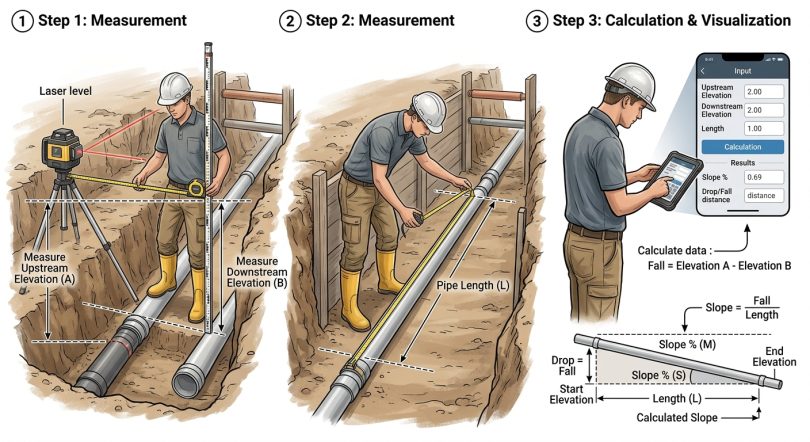
- Enter the Pipe Run Length in the same units you plan to use throughout (feet or meters).
- Select the Desired Fall Ratio from the dropdown, based on your pipe size and local plumbing code requirements.
- Enter the Starting Invert Level, which is the elevation at the upstream end of the pipe.
- Review the four results: total fall required, slope percentage, finished invert level, and fall per 10 units of length.
- Use the fall-per-10-units figure to check the drop on site with a spirit level or laser level over a measured section.
Understanding Each Input Field
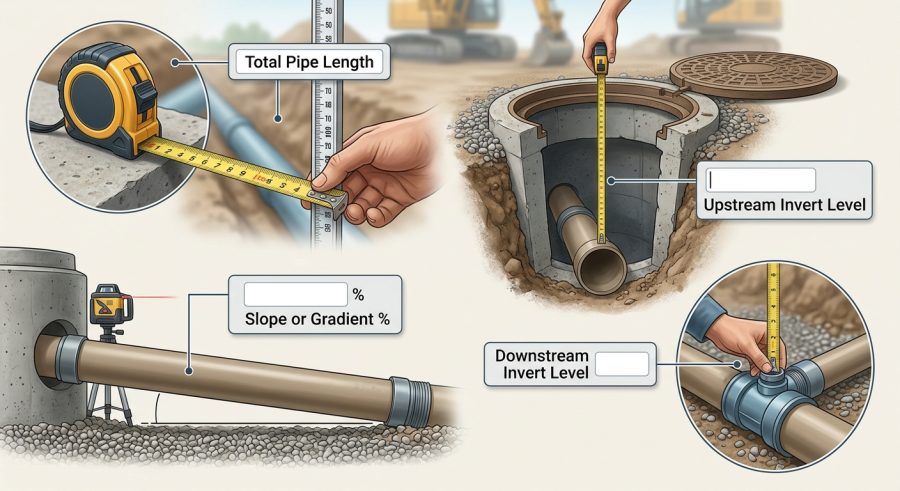
Pipe Run Length is the horizontal distance the pipe travels from the upstream to the downstream end, entered in feet or meters. Use the same unit system for every field.
Desired Fall Ratio (1 in X) is the gradient written in the standard drainage format, where a smaller X means a steeper slope. A 1 in 40 fall is steeper than a 1 in 150 fall. Choose the ratio that matches your pipe diameter and the minimum fall your local code requires.
Starting Invert Level is the elevation of the inside bottom of the pipe at the upstream end. It can be a site survey value, a benchmark elevation, or an arbitrary reference number, as long as it uses the same length unit as the pipe run.
How Fall, Slope, and Invert Level Are Calculated
The calculator uses four straightforward formulas built around the gradient ratio.
Total Fall Required equals pipe length divided by the gradient ratio: fall = length / X. If a 10-unit-long pipe uses a 1 in 40 fall, the total drop is 10 / 40 = 0.25 units.
Slope Percentage converts the ratio to a percentage: slope% = (1 / X) * 100. A 1 in 40 fall equals 2.5% slope, since 1 divided by 40 is 0.025, times 100.
Finished Invert Level subtracts the total fall from the starting invert: finished invert = starting invert − (length / X). This gives the downstream invert elevation after the drop is applied.
Fall per 10 Units of Length equals 10 / X, a quick reference number you can use to check gradient over any 10-foot or 10-meter section using a level.
All formulas assume a single straight pipe section with one constant gradient. They do not account for bends, step changes, or multiple connected runs at different slopes.
Five Verified Fall Calculations
Example 1 — Small waste pipe. Given: length = 10 ft, ratio = 1 in 40, starting invert = 100 ft. Formula: fall = length / X. Substitution: 10 / 40. Calculation: 0.250 ft. Final result: total fall 0.250 ft, slope 2.50%, finished invert 99.750 ft, fall per 10 units 0.250 ft.
Example 2 — Longer waste run. Given: length = 15 ft, ratio = 1 in 60, starting invert = 50 ft. Substitution: 15 / 60 = 0.250 ft fall. Slope = (1/60)*100 = 1.67%. Finished invert = 50 − 0.250 = 49.750 ft. Fall per 10 units = 10/60 = 0.167 ft.
Example 3 — Metric branch drain. Given: length = 8 m, ratio = 1 in 80, starting invert = 12.5 m. Substitution: 8 / 80 = 0.100 m fall. Slope = (1/80)*100 = 1.25%. Finished invert = 12.5 − 0.100 = 12.400 m. Fall per 10 units = 10/80 = 0.125 m.
Example 4 — Stormwater lateral. Given: length = 25 ft, ratio = 1 in 100, starting invert = 200 ft. Substitution: 25 / 100 = 0.250 ft fall. Slope = 1.00%. Finished invert = 200 − 0.250 = 199.750 ft. Fall per 10 units = 10/100 = 0.100 ft.
Example 5 — Shallow large-diameter drain. Given: length = 5 m, ratio = 1 in 150, starting invert = 3 m. Substitution: 5 / 150 = 0.033 m fall. Slope = (1/150)*100 = 0.67%. Finished invert = 3 − 0.033 = 2.967 m. Fall per 10 units = 10/150 = 0.067 m.
Common Fall Ratios and Their Slope Equivalents
| Fall Ratio (1 in X) | Slope Percentage | Fall per 10 Units of Length | Typical Use (check local code) |
|---|---|---|---|
| 1 in 40 | 2.50% | 0.250 | Small-bore waste pipes, short runs |
| 1 in 60 | 1.67% | 0.167 | Standard waste and soil branches |
| 1 in 80 | 1.25% | 0.125 | Mid-size drainage lines |
| 1 in 100 | 1.00% | 0.100 | General stormwater and sewer runs |
| 1 in 120 | 0.83% | 0.083 | Larger-diameter gravity drains |
| 1 in 150 | 0.67% | 0.067 | Large-diameter, low-velocity drains |
Reading Your Fall and Invert Results
Total Fall Required is the main output, showing the exact vertical drop needed over the full pipe length. Use it to set trench depth at the downstream end during excavation.
Slope Percentage restates the same gradient in percent form, which many codes and inspectors reference alongside the 1-in-X ratio.
Finished Invert Level gives the actual elevation at the downstream end once the fall is applied, useful for coordinating with existing sewer connections or manhole inverts.
Fall per 10 Units of Length is a practical checking tool: measure any 10-foot or 10-meter section on site and confirm the level drop matches this figure. All results round to three decimal places for length values and two for percentages, which is precise enough for planning but should be re-verified with a survey instrument before final installation.
What Changes the Required Fall
Pipe run length directly scales the total fall; doubling the length doubles the required drop for the same ratio. This calculator accounts for it fully.
Chosen gradient ratio is the biggest driver of slope. Steeper ratios (lower X) need more fall over the same distance. The calculator applies whichever ratio you select.
Pipe diameter affects the minimum fall allowed by code, since larger pipes can often use shallower gradients while still maintaining adequate flow velocity. This calculator does not select a gradient automatically based on diameter; you must choose the ratio yourself based on applicable standards.
Bends, junctions, and elevation changes along a real pipe run are not modeled. The tool assumes one straight, uniform-gradient section.
Unit consistency matters: mixing feet and meters between the length and invert fields will produce a meaningless result.
Errors That Throw Off a Fall Calculation
- Mixing units: entering pipe length in meters but the invert level in feet gives an incorrect finished invert. Keep every field in one unit system.
- Choosing the wrong ratio for pipe size: a small-bore waste pipe needs a steeper fall than a large stormwater drain; check your local code before selecting.
- Forgetting bends add length: the calculator uses straight-line pipe length only, so measure the actual routed distance, not the direct point-to-point span.
- Treating the result as exact on site: always confirm fall with a level or laser once the trench is dug, since ground conditions vary.
- Ignoring minimum velocity needs: too shallow a fall can cause solids to settle in the pipe, even if it technically drains.
- Using an arbitrary starting invert without a real reference: for site work, tie the starting invert to a surveyed benchmark, not a guessed number.
- Overlooking that fall accumulates on long runs: a shallow ratio over a long pipe can still require a large total fall and deep excavation.
What This Calculator Does Not Cover
This calculator computes fall, slope percentage, and invert level for a single straight pipe section with one constant gradient. It does not model bends, multiple connected pipe segments, changes in pipe diameter, or vertical offsets at fittings. It does not determine minimum legal fall requirements, which vary by pipe diameter, pipe material, flow type, and local jurisdiction.
Always confirm gradient requirements and invert depths against the plumbing or drainage code that applies in your area, and have final layouts checked by a licensed plumber, drainage engineer, or building inspector before installation. This tool is for planning and estimation only and is not a substitute for professional design or site inspection.
Converting Between Fall Ratio and Percentage
Drainage codes sometimes list minimum fall as a ratio, like 1 in 60, and other times as a percentage, like 1.67%. To convert a ratio to a percentage, divide 1 by X and multiply by 100. To go the other way, divide 100 by the percentage to get X. This calculator handles the ratio-to-percentage conversion automatically in the Slope Percentage result, so you can compare against either format your local code uses.
Checking Fall on Site With a Level
The Fall per 10 Units of Length result is designed for field checks. Set up a spirit level or laser level over a measured 10-foot or 10-meter section of the trench or pipe run, and confirm the drop matches this figure. If your actual measured section is shorter or longer than 10 units, scale the number proportionally, for example halving it for a 5-unit check.
Planning Pipe Weight and Material Alongside Fall
Once the fall and invert levels are set, many installers also need to know how heavy the pipe will be for handling, bedding, and support spacing. If material weight is part of your planning, the pipe weight per foot calculator can help estimate that figure based on pipe diameter, wall thickness, and material.
Pipe Fall Questions Plumbers Ask Most
What does pipe fall mean in plumbing and drainage?
Pipe fall is the vertical drop a drainage or waste pipe has over its length so gravity can move water or waste along it. It is usually expressed as a ratio, such as 1 in 40, meaning the pipe drops 1 unit of height for every 40 units of horizontal length.
How is a 1 in 40 or 1 in 60 fall ratio calculated?
Divide the pipe run length by the ratio number. For a 1 in 40 fall over a 10-foot pipe, the total fall is 10 divided by 40, which equals 0.25 feet. The same method applies to any ratio, including 1 in 60, 1 in 80, or 1 in 150.
What is the minimum recommended fall for soil and waste pipes?
Minimum fall depends on pipe diameter, pipe material, and local plumbing code, and it typically ranges from about 1 in 40 for small waste pipes to 1 in 150 or shallower for large-diameter drains. Always confirm the exact minimum with the code that applies in your area before finalizing a design.
How do I find the finished invert level of a drain run?
Subtract the total fall from the starting invert level. If the starting invert is 100 feet and the total fall is 0.25 feet, the finished invert at the downstream end is 99.75 feet. This calculator performs that subtraction automatically once you enter your values.
Can this calculator be used for stormwater or sewer pipe design?
Yes, the same fall, slope, and invert math applies to stormwater, sewer, and waste pipe runs, since all rely on the same 1-in-X gradient convention. However, minimum fall and pipe sizing rules differ by application, so check the specific code requirements for your project type.
Why does pipe diameter affect the required minimum fall?
Larger-diameter pipes can maintain adequate flow velocity at shallower gradients than small pipes, because they carry more volume per unit of slope. This calculator lets you choose any ratio, but it does not automatically adjust the minimum fall based on diameter, so you must select a ratio appropriate for your pipe size.
Do I need to use the same units for every input?
Yes. Pipe run length and starting invert level must both be entered in the same length unit, either feet or meters. Mixing units will produce an incorrect total fall and finished invert level, since the calculator treats all number inputs as the same unit system.
How accurate are the results from this calculator?
The math is exact for the numbers you enter, since it uses simple division and subtraction based on your chosen gradient. However, real pipe runs involve site conditions, bends, and code requirements this calculator does not model, so treat results as a planning estimate to verify on site.
Setting Your Pipe Run With Confidence
Getting pipe fall right keeps a gravity drainage or waste system flowing properly and helps you plan trench depths before digging. By entering the pipe length, a fall ratio suited to your pipe size, and a starting invert level, you get the total fall, slope percentage, and finished invert level needed to set out the run accurately. Always confirm final gradients against local plumbing or drainage code before installation.

One Response