
This calculator finds the average fluid velocity inside a pipe by dividing your volumetric flow rate by the pipe’s cross-sectional area. Enter the flow rate with its unit and the internal pipe diameter with its unit, and you get velocity in meters per second and feet per second, plus the pipe area and flow rate converted to cubic meters per second. The result shows how fast fluid moves through the pipe on average, which helps confirm safe, efficient pipe sizing.
Pipe Velocity Calculator: Instant Flow Speed & Area
Calculate fluid velocity in a pipe from flow rate and diameter, with results in meters per second, feet per second, and cross-sectional area.
What This Pipe Velocity Tool Calculates
This tool estimates the average speed of fluid moving through a circular pipe. It is built for plumbers, HVAC technicians, mechanical and civil engineers, students, and facility managers who need a fast check during design, troubleshooting, or system sizing. You supply the volumetric flow rate and the pipe’s internal diameter, and the calculator returns velocity, cross-sectional area, and the flow rate converted to standard SI units. The result is a mathematical estimate based on average flow across the pipe, not a measured or simulated value, so real-world conditions such as pipe roughness or turbulence are not reflected.
Steps to Find Your Pipe's Flow Speed
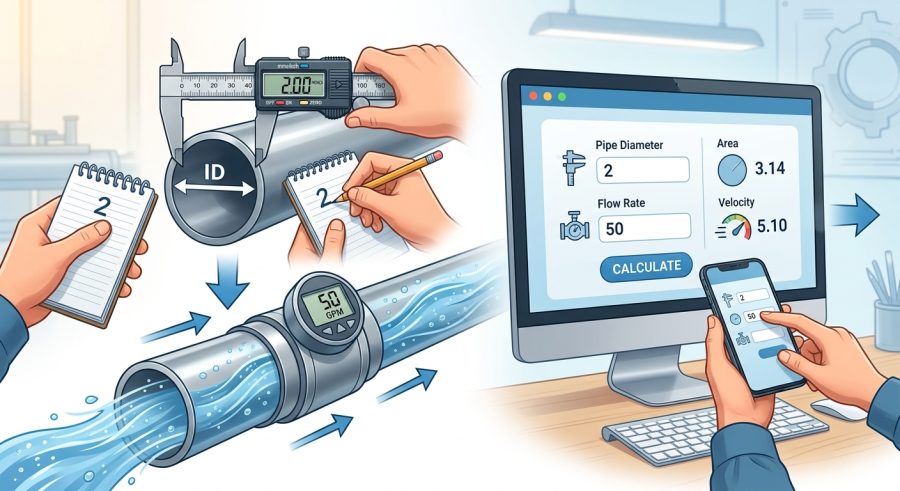
- Select the unit that matches your flow rate: liters per second, cubic meters per hour, US gallons per minute, or cubic feet per minute.
- Enter the numeric flow rate value in the Flow Rate field.
- Enter the pipe’s internal diameter, not the outer or nominal size.
- Select the diameter unit, either millimeters or inches.
- Review the four results: velocity in m/s and ft/s, cross-sectional area, and flow rate in m3/s.
- Adjust diameter or flow rate to see how velocity changes for different pipe sizing scenarios.
Understanding Flow Rate and Diameter Inputs
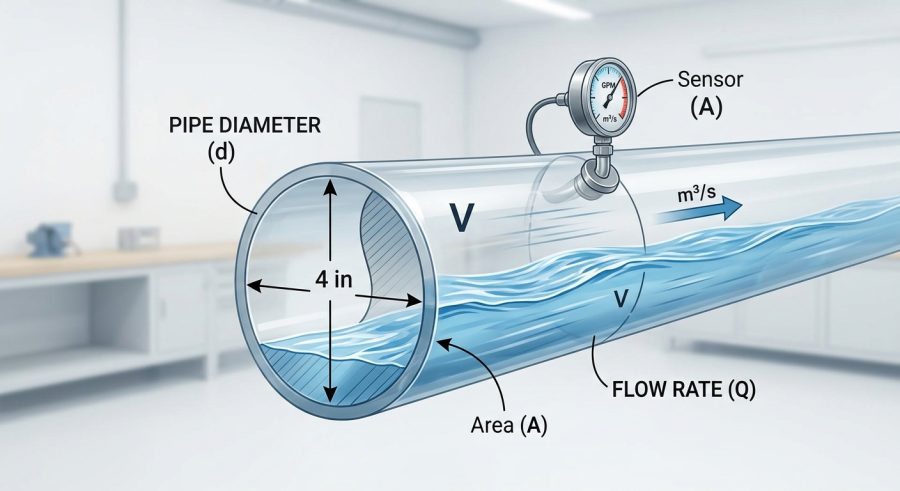
Flow Rate is the volume of fluid passing through the pipe per unit of time. Enter any positive number, then choose the matching unit from the dropdown: liters per second, cubic meters per hour, US gallons per minute, or cubic feet per minute. The calculator converts your entry into cubic meters per second internally so all math stays consistent.
Pipe Diameter must be the internal diameter of the pipe, since that is the space the fluid actually occupies. Nominal pipe sizes, such as a 4-inch schedule 40 pipe, often have a smaller actual internal diameter, so check a pipe specification sheet if precision matters. Choose millimeters or inches from the dropdown to match your measurement.
How Velocity, Area, and Flow Rate Relate
The core relationship is velocity equals flow rate divided by cross-sectional area, written as V = Q / A. Here, V is average velocity in meters per second, Q is volumetric flow rate in cubic meters per second, and A is the pipe’s internal cross-sectional area in square meters.
The area of a circular pipe is A = 3.14159265 x (D / 2)^2, where D is the internal diameter in meters and 3.14159265 approximates the constant pi. The diameter you enter in millimeters or inches is first converted to meters using the selected unit factor.
Flow rate unit factors convert your entry to cubic meters per second: 1 L/s equals 0.001 m3/s, 1 m3/h equals 0.000277778 m3/s, 1 GPM equals about 0.0000630902 m3/s, and 1 CFM equals about 0.000471947 m3/s. Velocity in feet per second is found by multiplying the meters-per-second result by 3.28084. These formulas assume steady, incompressible flow that is fully developed inside a straight circular pipe, with no allowance for fittings, elbows, or friction losses.
Five Sample Calculations Across Unit Systems
Example 1: Default metric values. Given: flow rate 10 L/s, diameter 100 mm. Formula: V = Q / A. Substitution: Q = 10 x 0.001 = 0.01 m3/s; radius = 0.05 m; A = 3.14159265 x 0.05^2 = 0.007854 m2. Calculation: V = 0.01 / 0.007854 = 1.27 m/s. Final result: 1.27 m/s (about 4.18 ft/s).
Example 2: US gallons per minute with inches. Given: flow rate 50 GPM, diameter 4 in. Substitution: Q = 50 x 0.0000630902 = 0.003155 m3/s; radius = 0.0508 m; A = 3.14159265 x 0.0508^2 = 0.008107 m2. Calculation: V = 0.003155 / 0.008107 = 0.389 m/s. Final result: 0.39 m/s (about 1.28 ft/s).
Example 3: Cubic feet per minute, larger pipe. Given: flow rate 200 CFM, diameter 6 in. Substitution: Q = 200 x 0.000471947 = 0.094389 m3/s; radius = 0.0762 m; A = 3.14159265 x 0.0762^2 = 0.018241 m2. Calculation: V = 0.094389 / 0.018241 = 5.17 m/s. Final result: 5.17 m/s (about 16.98 ft/s).
Example 4: Cubic meters per hour, metric diameter. Given: flow rate 36 m3/h, diameter 200 mm. Substitution: Q = 36 x 0.000277778 = 0.01 m3/s; radius = 0.1 m; A = 3.14159265 x 0.1^2 = 0.031416 m2. Calculation: V = 0.01 / 0.031416 = 0.318 m/s. Final result: 0.32 m/s (about 1.04 ft/s).
Example 5: Small drainage line. Given: flow rate 2 L/s, diameter 50 mm. Substitution: Q = 2 x 0.001 = 0.002 m3/s; radius = 0.025 m; A = 3.14159265 x 0.025^2 = 0.001963 m2. Calculation: V = 0.002 / 0.001963 = 1.02 m/s. Final result: 1.02 m/s (about 3.34 ft/s).
General Velocity Guidelines by Application
The table below lists general velocity ranges commonly discussed in plumbing and HVAC planning. These are general guidelines only, not a substitute for the specific plumbing, mechanical, or fire code that applies in your jurisdiction, and actual limits vary by system and material.
| Application | Commonly Cited Velocity Range | Notes |
|---|---|---|
| Cold water supply lines | 1 to 2.5 m/s (3 to 8 ft/s) | Higher speeds can raise noise and wear risk |
| Hot water supply lines | 1 to 1.5 m/s (3 to 5 ft/s) | Lower limit often used to reduce erosion |
| Gravity drainage pipes | 0.6 to 3 m/s (2 to 10 ft/s) | Enough speed helps prevent solids settling |
| HVAC chilled water | 1.2 to 2.4 m/s (4 to 8 ft/s) | Balances pump energy against pipe noise |
| Compressed air lines | 6 to 9 m/s (20 to 30 ft/s) | Gas systems tolerate higher speeds than liquids |
Reading Your Velocity and Area Results
The primary output is Flow Velocity in meters per second, shown alongside the same value converted to feet per second for US customary users. Both describe the same average speed, just in different units, so use whichever matches your project’s standard.
Pipe Cross-Sectional Area shows the internal area the fluid flows through, useful for checking pipe sizing calculations independently. Volumetric Flow Rate confirms your entered flow rate after conversion to cubic meters per second, which is helpful for verifying you selected the correct unit.
Results are estimates based on average velocity across the entire cross-section. Actual velocity varies slightly across the pipe, with faster flow near the center and slower flow near the pipe wall due to friction.
What Changes the Velocity Result
Flow rate: A higher flow rate increases velocity proportionally for a fixed diameter. This calculator accounts for it directly.
Pipe diameter: Velocity is inversely proportional to the square of the diameter, so small diameter changes cause large velocity changes. This calculator accounts for it directly.
Internal vs nominal diameter: Using a nominal pipe size instead of true internal diameter introduces error. This calculator only uses the number you enter, so accuracy depends on you supplying the correct internal diameter.
Fluid type and temperature: Water, air, and other fluids behave differently under pressure and temperature changes, but this calculator does not model fluid properties, only geometry and flow rate.
Pipe roughness and fittings: Friction losses from elbows, valves, and rough pipe walls are not included in this velocity-only calculation.
Errors That Skew Pipe Velocity Numbers
- Using outer diameter instead of internal diameter: Always measure or specify the internal diameter, since that is the actual flow path.
- Confusing nominal pipe size with actual size: A nominal 2-inch pipe rarely has a true 2-inch internal diameter; check a pipe schedule chart.
- Selecting the wrong flow unit: Mixing up GPM and CFM, or L/s and m3/h, produces a velocity that is off by a large factor.
- Forgetting unit consistency: Make sure the diameter unit dropdown matches the unit you actually measured in.
- Assuming uniform velocity everywhere: This result is an average; actual local velocity varies across the pipe cross-section.
- Ignoring friction losses: Velocity alone does not capture pressure drop from fittings, bends, or rough interior surfaces.
- Applying results to non-circular ducts: This formula only works for circular pipes, not rectangular or oval ducts.
What This Calculator Does Not Cover
This calculator computes average velocity for steady, incompressible flow in a straight circular pipe. It does not model compressible gas behavior, two-phase flow, pipe friction losses, elbow or valve effects, or changes in fluid density from temperature and pressure. It does not check compliance with any specific plumbing, mechanical, or fire code, since those requirements vary by location and application. Results depend entirely on the accuracy of the diameter and flow rate you enter. For pipe sizing decisions affecting safety, structural integrity, or code compliance, consult a licensed plumber, mechanical engineer, or other appropriately qualified professional.
Why Small Diameter Changes Shift Velocity So Much
Because pipe area depends on the square of the radius, doubling the diameter quadruples the area. For the same flow rate, that means velocity drops to roughly one-quarter of its original value. This is why upsizing a pipe by even one standard size can dramatically reduce velocity, noise, and erosion risk, while downsizing can sharply increase velocity and pressure drop.
Manual Shortcuts for Converting Flow Units
If you need to convert flow units by hand: multiply liters per second by 0.001 to get cubic meters per second, multiply cubic meters per hour by 0.000277778, multiply US gallons per minute by about 0.0000630902, and multiply cubic feet per minute by about 0.000471947. These are the same factors this calculator applies automatically when you choose a flow unit from the dropdown.
Working Backward From a Target Velocity
Sometimes you know the flow rate and want to find the diameter needed for a target velocity. Rearranging the formula gives diameter equal to two times the square root of flow rate divided by pi times velocity. While this calculator does not solve for diameter directly, you can try different diameter values and compare the resulting velocity until it matches your target, which is a practical way to explore pipe sizing options such as those discussed in a pipe fall calculator for drainage slope when gravity flow speed matters.
Pairing Velocity With Other Pipe Planning Tools
Velocity is only one part of pipe system planning. Once diameter and material are chosen, project weight and material cost also matter for structural supports and budgeting, which is where a pipe weight per foot calculator becomes useful for estimating total pipe load across a run.
Pipe Velocity Questions Answered
What is a safe or typical pipe velocity for water systems?
Many plumbing and HVAC references commonly cite roughly 1 to 2.5 meters per second (3 to 8 feet per second) for cold water supply lines, though exact limits depend on your local code, pipe material, and system type. Always confirm against the applicable code for your project.
How does pipe diameter affect velocity for a fixed flow rate?
Velocity is inversely proportional to the square of the diameter. Doubling the diameter roughly quarters the velocity for the same flow rate, while halving the diameter roughly quadruples it, since cross-sectional area changes with the square of the radius.
Why does velocity matter for pipe sizing and erosion prevention?
Excessive velocity can cause noise, vibration, erosion of pipe walls, and increased pressure loss, while velocity that is too low can allow sediment or solids to settle in drainage lines. Checking velocity helps balance these competing risks during pipe sizing.
How do I convert GPM or CFM into cubic meters per second manually?
Multiply US gallons per minute by about 0.0000630902 to get cubic meters per second, or multiply cubic feet per minute by about 0.000471947. This calculator applies these same conversion factors automatically once you select the matching unit.
What is the difference between average velocity and peak velocity in a pipe?
Average velocity, which this calculator reports, represents the overall flow speed across the entire pipe cross-section. Peak velocity, found near the center of the pipe, is typically higher than the average because friction slows fluid near the pipe walls.
Does this calculator account for pipe material or roughness?
No. This tool only uses geometry and flow rate to compute average velocity. It does not factor in pipe roughness, material friction coefficients, or fitting losses, all of which affect pressure drop but not the basic velocity calculation.
Can I use this calculator for air or gas flow in ducts?
The velocity formula works for any fluid moving through a circular cross-section, including air, as long as you use consistent flow rate and diameter units. However, it assumes incompressible flow and does not account for gas compressibility or density changes with pressure and temperature.
How accurate are the velocity and area results?
Results are mathematically accurate for the inputs you provide, but they represent an estimated average velocity based on ideal, steady flow. Real-world factors like turbulence, fittings, and pipe roughness are not included, so treat results as planning estimates rather than exact measurements.
Using Velocity Numbers in Real Pipe Design
Pipe velocity is a quick, useful check when sizing pipes, diagnosing noise or erosion complaints, or comparing design options. Use the calculator to test how changing flow rate or diameter shifts velocity, then compare results against general guidelines or applicable codes for your specific system and location before finalizing any design decision.
