
The weight of a pipe per foot depends on its outer diameter, wall thickness, and material density. Enter those three values along with your total pipe length, fluid type, and number of sections to instantly calculate weight per linear foot in both lb/ft and kg/m, total empty pipe weight, fluid weight per foot, and combined operating weight — everything needed for structural support, hanger design, shipping estimates, and procurement planning.
Pipe Weight per Foot Calculator – Steel, PVC & More
Calculate pipe weight per foot by material, outer diameter, and wall thickness. Get lb/ft, kg/m, and total run weights instantly.
What This Pipe Weight Calculator Computes
This calculator finds the weight of any hollow cylindrical pipe per linear foot and per meter, the total empty weight of a full pipe run, the weight of fluid inside the pipe per foot, and the combined operating weight of pipe plus fluid. It covers ten common materials — from carbon steel and stainless steel to PVC, copper, aluminum, and cast iron — and scales results across multiple pipe sections for procurement and logistics planning.
Engineers use it to size pipe hangers and supports, estimate shipping loads, check structural beam capacity, and compare material options by weight. Contractors use it to plan rigging and lifting equipment. Fabricators use it to quote material costs by weight. Results are planning estimates based on nominal density values and ideal cylinder geometry; always confirm against certified mill test reports for structural design work.
How to Enter Your Pipe Dimensions
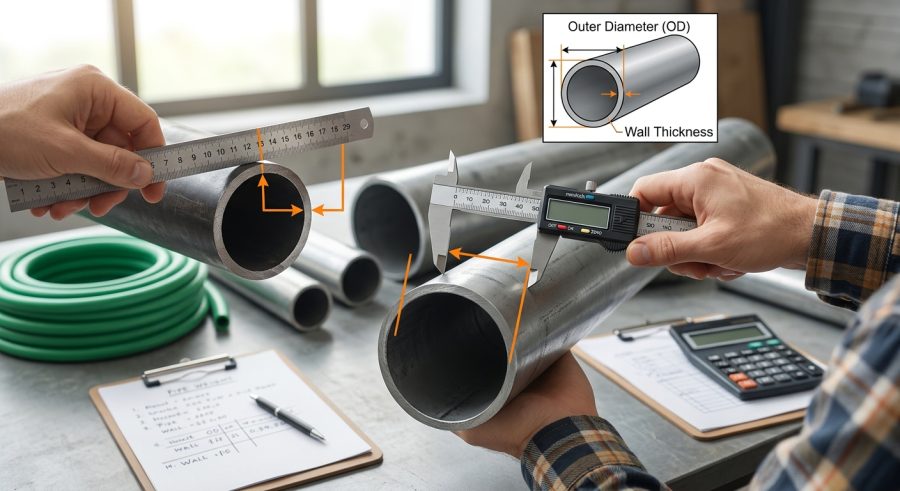
- Enter the Outer Diameter (OD) in inches. For standard pipe, use the actual OD from a pipe chart, not the nominal pipe size (NPS).
- Enter the Wall Thickness in inches. Look up the wall thickness for your pipe schedule (e.g., Sch 40, Sch 80) from ASME B36.10 or B36.19 tables, then type it in.
- Select the Material from the dropdown. Each option shows its density in lb/in³ so you know exactly which value is used.
- Enter the Total Pipe Length in feet for your run or project segment.
- Select the Fluid Inside Pipe if the pipe will carry liquid. Choose None / Empty for shipping or empty-pipe structural checks.
- Enter the Number of Pipe Sections to scale total weight across multiple identical pieces for procurement or logistics.
Understanding Each Input Field and Unit
Outer Diameter (OD), inches: The outside diameter of the pipe measured across the full circle. For standard pipe, this is a fixed dimension that does not equal the nominal pipe size (NPS) for sizes below 14 inches. Always use the actual OD from a pipe dimension table such as ASME B36.10M (carbon and alloy steel) or ASME B36.19M (stainless steel). The default is 4.000 in, which is the actual OD of 4-inch NPS pipe.
Wall Thickness, inches: The radial thickness of the pipe wall. This value changes with pipe schedule — a 4-inch Sch 40 pipe has a 0.237-inch wall, while a 4-inch Sch 80 pipe has a 0.337-inch wall. Look up the exact value for your schedule and NPS from a published pipe schedule table, then enter it here. The minimum allowed value is 0.010 in; the wall thickness must also be less than half the OD so that the inner diameter remains positive.
Material (density in lb/in³): Select the pipe material from the dropdown. Each option displays its nominal density. Density values are room-temperature averages; actual density can vary slightly by alloy grade, heat treatment, and temperature. Carbon steel (0.2833 lb/in³) is the default.
Total Pipe Length, feet: The total length of the pipe run or the combined length of all sections you want to weigh. Used to calculate total empty weight and total operating weight.
Fluid Inside Pipe: Select the fluid that will fill the pipe during operation. Choose None / Empty for shipping weight, hydrostatic test planning with air, or empty-pipe hanger checks. Water, seawater, diesel, crude oil, and natural gas options are provided. Fluid is assumed to completely fill the bore.
Number of Pipe Sections: Enter how many identical pipe pieces are in your order or project. This multiplies the total weight results, making it easy to estimate full-project or full-shipment weight without manual multiplication.
The Pipe Weight Formula: Variables and Derivation
Pipe weight per foot is calculated from the annular (ring-shaped) cross-sectional area of the pipe wall, multiplied by the material density and the number of inches in a foot.
Step 1 — Annular cross-sectional area (in²):
A = π × [ (OD/2)² − (ID/2)² ]
where OD is the outer diameter in inches, ID = OD − 2 × t, and t is the wall thickness in inches. π is approximated as 3.14159265.
Step 2 — Weight per foot (lb/ft):
W = A × ρ × 12
where ρ is the material density in lb/in³ and 12 converts inches to feet (there are 12 inches per foot, so 1 ft of pipe has a volume of A × 12 in³).
Step 3 — Weight per meter (kg/m):
W_m = W × 1.48816
The conversion factor 1.48816 comes from 1 lb/ft = 0.453592 kg ÷ 0.3048 m = 1.48816 kg/m.
Step 4 — Fluid weight per foot (lb/ft):
W_f = π × (ID/2)² × ρ_f × 12
where ρ_f is the fluid density in lb/in³ and ID/2 is the inner radius. This uses the full bore area, assuming the pipe is completely filled.
Step 5 — Total weights:
Total empty weight = W × L × Q, where L is total pipe length in feet and Q is the number of sections. Total operating weight = (W + W_f) × L × Q.
All formulas assume a perfect hollow cylinder with uniform wall thickness and no external coatings, linings, or corrosion allowances.
Five Worked Pipe Weight Examples
Example 1 — 4-inch Sch 40 Carbon Steel Pipe, 100 ft, Water-Filled
Given: OD = 4.000 in, t = 0.237 in, ρ = 0.2833 lb/in³, L = 100 ft, fluid = water (0.03612 lb/in³), Q = 1
ID = 4.000 − 2 × 0.237 = 3.526 in
A = 3.14159265 × [(2.000)² − (1.763)²] = 3.14159265 × [4.0000 − 3.1082] = 3.14159265 × 0.8918 = 2.8014 in²
W = 2.8014 × 0.2833 × 12 = 9.52 lb/ft (published Sch 40 value is 9.11 lb/ft; small difference reflects rounding in published tables vs. exact formula)
W_f = 3.14159265 × (1.763)² × 0.03612 × 12 = 3.14159265 × 3.1082 × 0.03612 × 12 = 4.22 lb/ft
Total operating weight = (9.52 + 4.22) × 100 = 1,374 lb
Note: The calculator uses exact formula geometry. Published pipe weight tables often use a slightly different density convention (0.2836 lb/in³) or rounding, which can produce differences of 1–3%.
Example 2 — 2-inch Sch 80 Carbon Steel Pipe, 50 ft, Empty
Given: OD = 2.375 in, t = 0.218 in, ρ = 0.2833 lb/in³, L = 50 ft, fluid = none, Q = 1
ID = 2.375 − 2 × 0.218 = 1.939 in
A = 3.14159265 × [(1.1875)² − (0.9695)²] = 3.14159265 × [1.4102 − 0.9399] = 3.14159265 × 0.4703 = 1.4771 in²
W = 1.4771 × 0.2833 × 12 = 5.02 lb/ft (published value: 5.02 lb/ft ✓)
Total empty weight = 5.02 × 50 = 251 lb
Example 3 — 6-inch Sch 40 PVC Pipe, 200 ft, Water-Filled, 3 Sections
Given: OD = 6.625 in, t = 0.280 in, ρ = 0.0520 lb/in³, L = 200 ft, fluid = water (0.03612 lb/in³), Q = 3
ID = 6.625 − 2 × 0.280 = 6.065 in
A = 3.14159265 × [(3.3125)² − (3.0325)²] = 3.14159265 × [10.9727 − 9.1961] = 3.14159265 × 1.7766 = 5.5793 in²
W_pipe = 5.5793 × 0.0520 × 12 = 3.48 lb/ft
W_fluid = 3.14159265 × (3.0325)² × 0.03612 × 12 = 3.14159265 × 9.1961 × 0.03612 × 12 = 12.51 lb/ft
Total operating weight = (3.48 + 12.51) × 200 × 3 = 15.99 × 600 = 9,594 lb
Example 4 — 1-inch Copper Tube (Type L), 25 ft, Empty
Given: OD = 1.125 in, t = 0.060 in, ρ = 0.3240 lb/in³, L = 25 ft, fluid = none, Q = 1
ID = 1.125 − 2 × 0.060 = 1.005 in
A = 3.14159265 × [(0.5625)² − (0.5025)²] = 3.14159265 × [0.31641 − 0.25251] = 3.14159265 × 0.06390 = 0.20077 in²
W = 0.20077 × 0.3240 × 12 = 0.78 lb/ft (published Type L copper 1-inch: ~0.78 lb/ft ✓)
Total empty weight = 0.78 × 25 = 19.5 lb
Example 5 — 12-inch Sch 20 Carbon Steel Pipe, 500 ft, Crude Oil, 2 Sections
Given: OD = 12.750 in, t = 0.250 in, ρ = 0.2833 lb/in³, L = 500 ft, fluid = crude oil (0.02888 lb/in³), Q = 2
ID = 12.750 − 2 × 0.250 = 12.250 in
A = 3.14159265 × [(6.375)² − (6.125)²] = 3.14159265 × [40.6406 − 37.5156] = 3.14159265 × 3.1250 = 9.8175 in²
W_pipe = 9.8175 × 0.2833 × 12 = 33.38 lb/ft
W_fluid = 3.14159265 × (6.125)² × 0.02888 × 12 = 3.14159265 × 37.5156 × 0.02888 × 12 = 40.84 lb/ft
Total operating weight = (33.38 + 40.84) × 500 × 2 = 74.22 × 1000 = 74,220 lb
Common Pipe Schedule Wall Thicknesses and Weights
| NPS (in) | Actual OD (in) | Schedule | Wall Thickness (in) | Carbon Steel (lb/ft) | Stainless 304 (lb/ft) | PVC (lb/ft) |
|---|---|---|---|---|---|---|
| ½ | 0.840 | Sch 40 | 0.109 | 0.85 | 0.87 | 0.15 |
| ½ | 0.840 | Sch 80 | 0.147 | 1.09 | 1.11 | 0.19 |
| 1 | 1.315 | Sch 40 | 0.133 | 1.68 | 1.71 | 0.31 |
| 1 | 1.315 | Sch 80 | 0.179 | 2.17 | 2.22 | 0.40 |
| 2 | 2.375 | Sch 40 | 0.154 | 3.65 | 3.73 | 0.67 |
| 2 | 2.375 | Sch 80 | 0.218 | 5.02 | 5.13 | 0.92 |
| 4 | 4.500 | Sch 40 | 0.237 | 9.52 | 9.73 | 1.75 |
| 4 | 4.500 | Sch 80 | 0.337 | 13.00 | 13.28 | 2.39 |
| 6 | 6.625 | Sch 40 | 0.280 | 18.97 | 19.38 | 3.48 |
| 6 | 6.625 | Sch 80 | 0.432 | 28.57 | 29.19 | 5.25 |
| 8 | 8.625 | Sch 40 | 0.322 | 28.55 | 29.17 | 5.25 |
| 12 | 12.750 | Sch 40 | 0.375 | 49.56 | 50.64 | 9.11 |
Values calculated using this calculator’s formula with nominal densities. Minor differences from published tables may occur due to rounding conventions. Always verify wall thickness from ASME B36.10 or B36.19 for your specific schedule and NPS.
Reading and Applying Your Calculated Results
Pipe Weight per Foot (lb/ft) is the primary output. Use it to compare material options, check hanger spacing limits, or verify against a manufacturer’s published weight. This value covers the pipe wall only — no fluid, coating, or insulation.
Pipe Weight per Meter (kg/m) is the same result converted for metric specifications, international shipping documents, or projects using SI units. The conversion factor is exactly 1.48816 kg/m per lb/ft.
Total Pipe Weight (Empty, lb) multiplies the per-foot weight by total length and number of sections. Use this for shipping manifests, crane lift plans, and empty-pipe structural checks. If your pipe run has multiple diameters or schedules, calculate each segment separately and add the results.
Fluid Weight per Foot (lb/ft) shows how much the contained fluid adds per linear foot. For large-bore water lines, fluid weight often exceeds pipe wall weight and dominates hanger load design. If you selected None / Empty, this result will be 0.00 lb/ft.
Total Operating Weight (Pipe + Fluid, lb) is the combined load used for pipe support and hanger design. Structural engineers and piping designers use this value — along with insulation weight, valve weights, and dynamic loads — to size supports and check beam capacity. This calculator provides the pipe-and-fluid portion only.
Inner Diameter (ID, in) is a derived output useful for flow calculations, fluid volume estimates, and confirming that your wall thickness entry is physically valid. If the ID appears unexpectedly small or negative, check that wall thickness is less than OD/2.
All results are rounded to the decimal places shown. For structural design, always apply appropriate safety factors and verify inputs against certified pipe data.
Factors That Materially Change Pipe Weight
Outer Diameter has the largest effect on pipe weight because it appears squared in the area formula. Doubling the OD roughly quadruples the wall area for the same wall thickness. The calculator uses your entered OD directly.
Wall Thickness directly controls the annular area. Heavier schedules (Sch 80, Sch 160, XXH) have thicker walls and significantly higher weight per foot than standard or Sch 40 pipe of the same OD. The calculator uses your entered wall thickness; it does not look up schedule values automatically.
Material Density scales the result linearly. Carbon steel (0.2833 lb/in³) is about 2.9 times denser than PVC (0.0520 lb/in³), so a steel pipe of the same geometry weighs nearly three times as much. The calculator applies the density you select from the dropdown.
Fluid Density affects operating weight but not empty pipe weight. Water at 0.03612 lb/in³ is about 12.8% the density of carbon steel, but because the fluid fills the entire bore while the pipe wall is only a thin annulus, fluid weight often exceeds pipe wall weight in larger-diameter pipes. The calculator accounts for this in the fluid weight and operating weight results.
Pipe Length and Quantity scale total weight linearly. They do not affect per-foot results.
Factors the calculator does not include: external coatings (paint, epoxy, FBE), internal linings, insulation, flanges, fittings, corrosion allowance, and temperature-dependent density changes. These must be added separately for a complete system weight estimate.
Common Errors When Calculating Pipe Weight
- Entering nominal pipe size instead of actual OD. For NPS below 14 inches, the nominal size does not equal the OD. A 4-inch NPS pipe has an actual OD of 4.500 in, not 4.000 in. Always use the actual OD from a pipe dimension table.
- Guessing wall thickness instead of looking it up. Wall thickness varies by schedule and NPS. A 6-inch Sch 40 pipe has a 0.280-inch wall; Sch 80 is 0.432 inches — a 54% difference that changes weight by the same proportion. Use ASME B36.10 or B36.19 tables.
- Forgetting to change the fluid selection. The default fluid is water. If your pipe carries gas or is empty during the load case you are checking, select None / Empty or the correct fluid to get an accurate operating weight.
- Using the per-foot result as total weight without entering length. The lb/ft result is per linear foot only. Enter your actual pipe length and quantity to get total weight for shipping or structural checks.
- Confusing lb/ft with kg/m. These are different units with a factor of 1.48816 between them. The calculator provides both; make sure you use the correct unit for your specification or shipping document.
- Applying the result directly to structural design without safety factors. Calculated weights are planning estimates. Structural hanger and support design requires safety factors, dynamic load allowances, and verification against certified pipe data — consult a qualified engineer.
- Not accounting for fittings, flanges, and valves. This calculator covers straight pipe only. Elbows, tees, flanges, and valves add significant weight that must be estimated separately.
- Entering wall thickness greater than OD/2. This produces a negative or zero inner diameter, which is physically impossible. The calculator will return a nonsensical result. Always confirm that wall thickness is less than half the outer diameter.
Calculator Scope, Assumptions, and Safety Notice
This calculator models pipe as a perfect hollow cylinder with uniform wall thickness and no external features. It does not account for:
- External coatings, paint, fusion-bonded epoxy (FBE), or concrete weight coating
- Internal linings or cladding
- Thermal insulation or jacketing
- Flanges, fittings, valves, or other inline components
- Corrosion allowance or mill tolerance on wall thickness (typically ±12.5% per ASTM standards)
- Temperature effects on material density
- Pipe ovality or out-of-roundness
Density values are nominal room-temperature averages (~70°F / 21°C). Actual density varies by specific alloy grade, heat treatment, and operating temperature. For high-temperature or cryogenic service, consult material-specific data.
Pipe schedule is not selected directly. Users must enter the actual wall thickness corresponding to their schedule from ASME B36.10M (carbon and alloy steel welded and seamless pipe) or ASME B36.19M (stainless steel pipe). The reference table in this article provides common values as a starting point.
Safety notice: Results are planning estimates only. Do not use calculator output as the sole basis for structural design, hanger engineering, pressure system design, or any safety-critical application. Always verify against certified mill test reports and engage a licensed professional engineer for structural and pressure system work.
Nominal Pipe Size vs. Actual Outer Diameter Explained
One of the most common sources of error in pipe weight calculations is confusing nominal pipe size (NPS) with actual outer diameter. NPS is a dimensionless designator — it does not directly represent any physical measurement for pipe sizes below 14 inches.
For example, 2-inch NPS pipe has an actual OD of 2.375 inches. 4-inch NPS pipe has an actual OD of 4.500 inches. Only at 14-inch NPS and above does the NPS equal the OD in inches. This convention exists so that pipes of the same NPS can share fittings and flanges regardless of schedule (wall thickness).
Always enter the actual OD — not the NPS — into this calculator. If you only know the NPS, look up the corresponding OD in ASME B36.10M or B36.19M, or use the reference table in this article as a quick guide for common sizes.
How Pipe Schedule Affects Weight per Foot
Pipe schedule is a standardized designation for wall thickness. Common schedules include Sch 5, Sch 10, Sch 20, Sch 40, Sch 80, Sch 120, Sch 160, and the double-extra-heavy (XXH) designation. For a given NPS, a higher schedule number means a thicker wall and a heavier pipe.
Because wall thickness appears in the annular area formula, the relationship between schedule and weight is not linear — it depends on both the OD and the specific wall thickness values. For a 4-inch NPS pipe, Sch 40 (t = 0.237 in) weighs about 9.52 lb/ft, while Sch 80 (t = 0.337 in) weighs about 13.00 lb/ft — a 37% increase for a 42% increase in wall thickness.
Stainless steel pipe uses a different schedule series (Sch 5S, 10S, 40S, 80S) defined in ASME B36.19M, with wall thicknesses that differ from the carbon steel schedules in B36.10M for the same NPS. Always confirm which standard applies to your pipe specification before entering wall thickness values.
Using Pipe Weight for Hanger and Support Design
Pipe support and hanger design requires knowing the total load that each support point must carry. That load includes the weight of the pipe itself, the weight of the fluid inside, insulation weight, and any concentrated loads from valves or flanges near the support.
This calculator provides the pipe wall weight per foot and the fluid weight per foot, which together give the distributed load along the pipe run. To find the load at a single hanger, multiply the operating weight per foot by the hanger spacing in feet. For example, if a 4-inch water-filled carbon steel pipe has an operating weight of 13.74 lb/ft and hangers are spaced 10 feet apart, each hanger carries approximately 137 lb from the pipe and fluid alone — before adding insulation or fitting weights.
Hanger spacing limits are also governed by pipe deflection and stress criteria, not just weight. Consult MSS SP-69 or your project’s piping specification for maximum recommended hanger spacing by pipe size and schedule. For a related structural calculation, the section modulus calculator can help evaluate beam capacity for pipe support structures.
Comparing Material Weights: Steel, Aluminum, PVC, and Copper
Material choice has a dramatic effect on pipe weight. For the same OD and wall thickness, the weight ratio between materials is directly proportional to their densities. Carbon steel at 0.2833 lb/in³ is about 2.9 times heavier than PVC at 0.0520 lb/in³, and about 2.9 times heavier than aluminum at 0.0975 lb/in³.
Copper at 0.3240 lb/in³ is actually heavier than carbon steel per unit volume, which is why copper plumbing systems — despite using thin-walled tubing — can add up to significant weight in large installations. Stainless steel 304 and 316 are slightly denser than carbon steel, adding a few percent to weight for the same geometry.
When weight is a constraint — such as in offshore platforms, aircraft ground support, or seismic zones — aluminum or PVC pipe may be preferred despite lower pressure ratings. Use the material dropdown to compare weights side by side for your specific pipe geometry before committing to a material specification.
Pipe Weight Calculation: Frequently Asked Questions
What is the formula for pipe weight per foot?
Pipe weight per foot (lb/ft) = π × [(OD/2)² − (ID/2)²] × ρ × 12, where OD is the outer diameter in inches, ID = OD − 2 × wall thickness in inches, ρ is the material density in lb/in³, and 12 converts the per-inch result to per-foot. The term in brackets is the annular cross-sectional area of the pipe wall in square inches.
How do I find the wall thickness for a given pipe schedule?
Wall thickness for each combination of nominal pipe size (NPS) and schedule is defined in ASME B36.10M for carbon and alloy steel pipe and ASME B36.19M for stainless steel pipe. These standards are published by ASME and are widely reproduced in engineering handbooks and pipe supplier catalogs. The reference table in this article lists wall thicknesses for common NPS and schedule combinations as a quick reference.
What is the difference between nominal pipe size and outer diameter?
Nominal pipe size (NPS) is a dimensionless label used to group pipes that share the same fittings and flanges. For NPS below 14 inches, the NPS does not equal the actual outer diameter. For example, 2-inch NPS pipe has an actual OD of 2.375 inches, and 4-inch NPS pipe has an actual OD of 4.500 inches. At NPS 14 and above, the NPS equals the OD in inches. Always enter the actual OD into this calculator.
How do I calculate the weight of a pipe filled with water?
First calculate the pipe wall weight per foot using the annular area formula. Then calculate the fluid weight per foot using the bore area: π × (ID/2)² × 0.03612 lb/in³ × 12. Add both values to get operating weight per foot. Multiply by total pipe length and number of sections for total operating weight. This calculator performs all these steps automatically when you select Water from the fluid dropdown.
How do I convert pipe weight from lb/ft to kg/m?
Multiply lb/ft by 1.48816 to get kg/m. This factor comes from dividing the pound-to-kilogram conversion (1 lb = 0.453592 kg) by the foot-to-meter conversion (1 ft = 0.3048 m): 0.453592 ÷ 0.3048 = 1.48816. The calculator displays both lb/ft and kg/m automatically so you do not need to convert manually.
Why does my calculated weight differ from the manufacturer's listed weight?
Small differences of 1–3% are normal. Published pipe weight tables often use a slightly different density convention (some sources use 0.2836 lb/in³ for carbon steel instead of 0.2833), apply a mill tolerance adjustment, or round intermediate values differently. Larger differences usually mean the OD or wall thickness entered does not match the actual pipe dimension. Verify your inputs against the pipe’s actual measured dimensions or certified mill test report.
What is the weight of standard Schedule 40 carbon steel pipe per foot for common sizes?
Using this calculator’s formula with carbon steel density (0.2833 lb/in³): ½-inch NPS Sch 40 ≈ 0.85 lb/ft; 1-inch ≈ 1.68 lb/ft; 2-inch ≈ 3.65 lb/ft; 4-inch ≈ 9.52 lb/ft; 6-inch ≈ 18.97 lb/ft; 8-inch ≈ 28.55 lb/ft; 12-inch ≈ 49.56 lb/ft. These values may differ slightly from published tables due to rounding conventions. The reference table in this article lists values for additional sizes and schedules.
How does insulation or coating add to pipe weight?
This calculator covers the pipe wall and contained fluid only. External insulation, jacketing, paint, fusion-bonded epoxy, and concrete weight coating all add to the total system weight and must be estimated separately. Insulation weight depends on insulation type, thickness, and density. For a complete pipe system weight, add insulation weight per foot (from the insulation manufacturer’s data) to the operating weight per foot from this calculator before sizing supports.
Plan Confidently with Accurate Pipe Weight Estimates
Accurate pipe weight estimates are essential for hanger design, structural checks, shipping logistics, and material procurement. Enter your pipe’s actual outer diameter, wall thickness, material, length, fluid, and quantity to get instant results in both imperial and metric units. Use the reference table and worked examples to verify your inputs, and always confirm critical values against certified pipe data and consult a licensed engineer for structural or pressure system design.

4 Responses