
This rebar weight calculator finds the unit weight and total weight of steel reinforcing bars from their nominal size, quantity, and length. Select a standard rebar size, enter the number of bars and length per bar, and choose your length unit. The tool applies the standard diameter-based steel weight formula to return unit weight in kilograms per meter and pounds per foot, plus total project weight in both kilograms and pounds for material takeoffs.
Rebar Weight Calculator: Total & Unit Weight Estimator
Calculate rebar unit weight and total weight by bar size, quantity, and length in both metric and US customary units.
What This Rebar Weight Tool Calculates
This calculator finds the weight of steel reinforcing bars used in concrete construction. It works for estimators building a material takeoff, contractors pricing a job, and DIY builders figuring out how much rebar to buy or haul.
The tool calculates unit weight per meter and per foot, plus total weight in kilograms and pounds, based on the bar’s nominal diameter and total length. Results are estimates based on standard steel density and nominal sizing, so they are close but not identical to a certified mill weight.
Steps to Find Your Rebar Weight
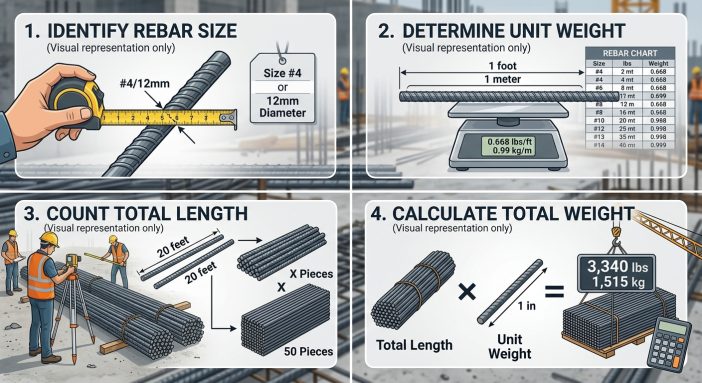
- Select your Rebar Size from the dropdown, choosing the US or metric designation that matches your project drawings.
- Enter the Number of Bars you need to weigh, based on your takeoff or cut list.
- Type the Length per Bar using the actual cut length for a single piece of rebar.
- Choose the matching Length Unit: meters, feet, inches, or millimeters.
- Review the unit weight, total length, and total weight results in both kilograms and pounds.
Understanding Bar Size, Quantity, and Length Fields
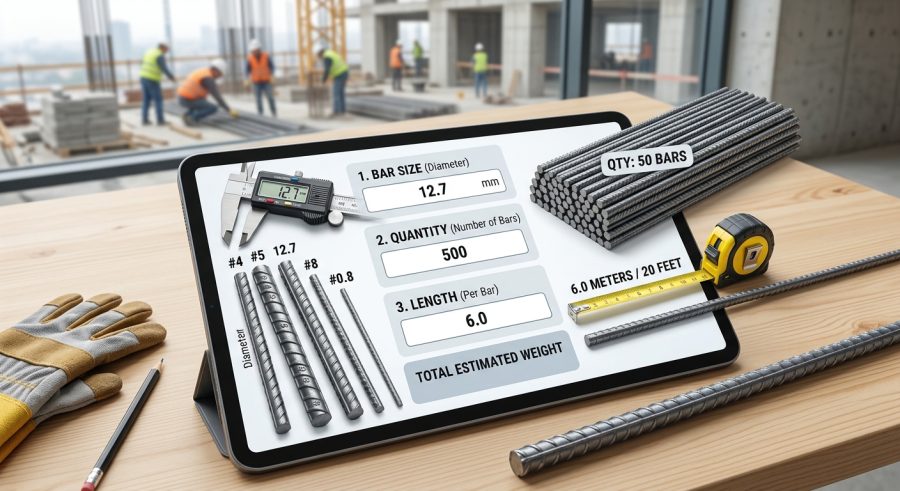
Rebar Size (Nominal Diameter): Choose the standard US or metric bar designation, from #3 (9.5 mm) up to #18 (57.3 mm). This sets the nominal diameter used in the weight formula.
Number of Bars: Enter the total count of individual rebar pieces at that size, taken from your cut list or drawing schedule.
Length per Bar: Enter the cut length of one bar. This should reflect the actual piece length, not a rounded stock length, for the most useful estimate.
Length Unit: Select meters, feet, inches, or millimeters. The calculator converts this value to meters internally so the weight formula stays consistent.
The Diameter-Based Rebar Weight Formula
Unit weight in kilograms per meter uses the standard construction industry approximation:
Unit Weight (kg/m) = bar_size^2 / 162
Here, bar_size is the nominal bar diameter in millimeters. This formula comes from the steel density of about 7850 kg per cubic meter combined with the circular cross-sectional area of the bar, simplified into a single divisor that engineers and suppliers commonly use.
Unit weight in pounds per foot converts the metric value:
Unit Weight (lb/ft) = Unit Weight (kg/m) x 0.671969
Total length in meters is found by:
Total Length = quantity x length_per_bar x length_unit
Where length_unit is the conversion factor to meters (1 for meters, 0.3048 for feet, 0.0254 for inches, 0.001 for millimeters).
Total weight in kilograms multiplies unit weight by total length:
Total Weight (kg) = Unit Weight (kg/m) x Total Length (m)
Total weight in pounds converts kilograms using the standard factor:
Total Weight (lb) = Total Weight (kg) x 2.20462206
This method assumes straight bars with no bends, hooks, or splices, and applies to standard carbon steel reinforcing bar only.
Five Sample Rebar Weight Calculations
Example 1: Small footing job
Given: US #4 bar (12.7 mm), 10 bars, 6 meters each.
Formula: Unit Weight = 12.7^2 / 162
Substitution: 161.29 / 162 = 0.996 kg/m
Calculation: Total Length = 10 x 6 x 1 = 60 m; Total Weight = 0.996 x 60 = 59.74 kg (131.68 lb)
Final result: about 59.74 kg of rebar.
Example 2: Slab reinforcement in feet
Given: US #8 bar (25.4 mm), 20 bars, 20 feet each.
Formula: Unit Weight = 25.4^2 / 162 = 3.982 kg/m
Substitution: Total Length = 20 x 20 x 0.3048 = 121.92 m
Calculation: Total Weight = 3.982 x 121.92 = 485.55 kg
Final result: about 485.55 kg (1,070.68 lb).
Example 3: Column ties in feet
Given: US #6 bar (19.1 mm), 50 bars, 12 feet each.
Formula: Unit Weight = 19.1^2 / 162 = 2.252 kg/m
Substitution: Total Length = 50 x 12 x 0.3048 = 182.88 m
Calculation: Total Weight = 2.252 x 182.88 = 411.83 kg
Final result: about 411.83 kg (908.15 lb).
Example 4: Heavy dowels in inches
Given: US #10 bar (32.3 mm), 5 bars, 40 inches each.
Formula: Unit Weight = 32.3^2 / 162 = 6.440 kg/m
Substitution: Total Length = 5 x 40 x 0.0254 = 5.08 m
Calculation: Total Weight = 6.440 x 5.08 = 32.72 kg
Final result: about 32.72 kg (72.15 lb).
Example 5: Light mesh support in millimeters
Given: US #3 bar (9.5 mm), 100 bars, 3000 mm each.
Formula: Unit Weight = 9.5^2 / 162 = 0.557 kg/m
Substitution: Total Length = 100 x 3000 x 0.001 = 300 m
Calculation: Total Weight = 0.557 x 300 = 167.13 kg
Final result: about 167.13 kg (368.44 lb).
Standard Rebar Sizes and Their Weights
| Bar Size | Nominal Diameter (mm) | Unit Weight (kg/m) | Unit Weight (lb/ft) |
|---|---|---|---|
| US #3 / 10M | 9.5 | 0.557 | 0.374 |
| US #4 / 13M | 12.7 | 0.996 | 0.669 |
| US #5 / 16M | 15.9 | 1.561 | 1.049 |
| US #6 / 19M | 19.1 | 2.252 | 1.513 |
| US #7 / 22M | 22.2 | 3.042 | 2.044 |
| US #8 / 25M | 25.4 | 3.982 | 2.676 |
| US #9 / 29M | 28.7 | 5.085 | 3.417 |
| US #10 / 32M | 32.3 | 6.440 | 4.328 |
| US #11 / 36M | 35.8 | 7.911 | 5.316 |
| US #14 / 43M | 43.0 | 11.414 | 7.670 |
| US #18 / 57M | 57.3 | 20.267 | 13.619 |
Values assume standard nominal diameters and 7850 kg per cubic meter steel density. Actual mill weights may vary slightly by manufacturer.
Reading Your Unit Weight and Total Weight Results
The Unit Weight results show how much one meter or one foot of the selected bar size weighs, useful for spot-checking prices per length. The Total Length result confirms the combined length of all bars converted into meters, which helps verify your quantity and length entries are correct.
The Total Weight results in kilograms and pounds represent the full estimated steel weight for your entered quantity, useful for ordering, freight calculations, and cost estimates. All weight results are rounded to two or three decimal places and represent estimates based on nominal sizing, not a certified scale weight.
What Changes a Rebar Weight Estimate
Bar diameter: The calculator accounts for this directly through the selected nominal size, since weight increases with the square of diameter.
Quantity and length: Both are accounted for directly, scaling total weight linearly with total bar length.
Steel grade and alloy: Not accounted for. Most construction rebar shares a similar density, but specialty alloys or coatings such as epoxy can shift actual weight slightly.
Manufacturing tolerance: Not accounted for. Actual bar diameter can vary within a small tolerance band by mill and standard, which the calculator does not adjust for.
Waste, laps, and bends: Not accounted for. The calculator assumes straight bar length only, so add extra length separately if your project needs splices or hooks.
If you also work with flat steel stock, a steel plate weight calculator uses the same density-based approach for plates instead of round bars.
Rebar Takeoff Errors Worth Avoiding
- Entering stock length instead of cut length: Use the actual length each bar will be cut to, not a standard 20 or 40 foot stock length, unless that matches your order.
- Mixing up length units: Always confirm the Length Unit dropdown matches the number entered, since feet and meters produce very different totals.
- Confusing bar number with diameter: A US #8 bar is 25.4 mm, not 8 mm, so always select from the dropdown rather than guessing.
- Forgetting lap length: This calculator only weighs the bars as entered, so add extra length manually for splices, hooks, or laps.
- Assuming all mills produce identical weights: Small tolerance differences between manufacturers mean actual delivered weight can differ slightly from this estimate.
- Rounding bar size manually: Selecting the closest metric equivalent instead of the exact standard size can introduce small but avoidable errors.
Where This Estimate Has Boundaries
This calculator estimates rebar weight using standard nominal diameters and an industry-accepted density formula. It does not account for manufacturing tolerances, epoxy coatings, galvanizing, alloy variations, or bar deformation patterns that can slightly change actual weight. It also does not include waste, lap splices, hooks, or bends in the length entered.
Regional standards for bar sizing can vary, and some countries use different metric bar series than the US customary sizes listed here. For structural design, procurement contracts, or projects requiring certified material weights, consult mill test certificates or a qualified structural engineer rather than relying solely on this estimate.
Matching US Bar Numbers to Metric Sizes
US rebar sizes are labeled by a number, such as #4 or #8, which roughly corresponds to the bar diameter in eighths of an inch. A #8 bar is about 8 eighths of an inch, or 1 inch, in diameter. Metric designations like 13M or 25M instead reference the nominal diameter in millimeters directly. Both systems appear in the size dropdown here so you can select whichever matches your project drawings.
Adding Waste and Lap Length to Your Order
This calculator weighs only the straight bar length you enter. Real projects often need extra length for lap splices where two bars overlap, plus a small waste allowance for cutting errors. A common approach is to add the required lap length, based on project specifications, to each bar’s cut length before entering it here, or to increase your final quantity by a percentage to cover offcuts.
Using Rebar Weight for Cost and Delivery Planning
Once you have a total weight in kilograms or pounds, you can multiply it by your supplier’s price per unit weight to estimate material cost. Total weight also helps plan delivery logistics, since trucking and crane capacity are often rated by load weight. If your project also uses round steel pipe for supports or casings, a pipe weight per foot calculator can estimate that material using a similar density-based method.
rebar weight calculator Questions and Answers
How is rebar weight calculated from diameter?
Rebar weight per meter is calculated by squaring the nominal diameter in millimeters and dividing by 162, an industry-standard approximation based on steel density. Total weight then multiplies this unit weight by the total length of all bars combined.
What is the standard formula for rebar unit weight in kilograms per meter?
The formula is unit weight equals bar diameter squared divided by 162, where diameter is in millimeters. This gives weight in kilograms per meter and is the same approximation used throughout the construction industry.
How do I convert rebar weight from metric to US customary units?
Multiply kilograms per meter by 0.671969 to get pounds per foot, or multiply total kilograms by 2.20462206 to get total pounds. This calculator performs both conversions automatically alongside the metric results.
Why do rebar weights vary slightly between manufacturers?
Manufacturing tolerances allow small variations in actual bar diameter and cross-section within accepted standards. This means the nominal weight calculated here can differ slightly from a certified mill weight, though usually by a very small margin.
How much does a standard 20-foot rebar bar weigh?
It depends on the bar size. For example, a US #8 bar (25.4 mm) at 20 feet weighs about 24.28 kilograms, or roughly 53.53 pounds, based on the standard unit weight formula used in this calculator.
Do I need to account for waste or lap length when ordering rebar?
Yes, this calculator only weighs the straight length you enter. For real orders, add extra length for lap splices, hooks, or cutting waste before entering your final length per bar, since these are not calculated automatically.
What is the difference between US rebar sizes and metric rebar sizes?
US sizes use a number roughly tied to diameter in eighths of an inch, while metric sizes like 13M or 25M state the nominal diameter in millimeters directly. Both systems are included in the size selection for convenience.
How accurate is this rebar weight calculator for construction estimating?
It provides a close estimate based on standard nominal diameters and typical steel density, suitable for planning and material takeoffs. For contracts or structural documentation requiring certified weights, rely on supplier mill certificates instead.
Putting Rebar Weight Numbers to Work
Calculating rebar weight accurately helps with ordering the right quantity, budgeting material costs, and planning transportation loads. This calculator gives a reliable estimate based on standard nominal bar sizes and steel density, but always confirm critical project weights with supplier documentation or an engineer before finalizing orders on larger jobs.
