
A steel plate’s weight equals its volume multiplied by the material’s density. For a standard A36 mild-steel plate measuring 1,000 mm × 500 mm × 10 mm, that works out to roughly 39.3 kg (86.6 lb). Enter your plate shape, dimensions, steel grade, and quantity below to get an instant weight estimate in both metric and imperial units — useful for procurement, structural planning, and freight quoting.
Steel Plate Weight Calculator – Instant kg & lb Results
Calculate the weight of rectangular or circular steel plates in kilograms and pounds using dimensions and steel grade density.
What This Steel Plate Weight Calculator Computes
This calculator finds the theoretical weight of a rectangular or circular steel plate from its physical dimensions and the nominal density of the chosen steel grade. It returns six results: volume per plate, weight per plate in kilograms and pounds, total order weight in both units, and a surface weight density in kg/mm². Those outputs cover the most common needs in structural engineering, metal fabrication, procurement, and freight planning.
The tool suits structural engineers sizing beams and connections, fabricators quoting jobs, metal suppliers generating packing lists, project managers estimating crane and forklift loads, and DIY builders checking whether a floor or trailer can carry a plate. Results are theoretical (calculated) weights based on nominal dimensions and standard density values — not certified mill weights. Expect agreement with actual weights to within roughly 1–3% for standard hot-rolled plate.
Step-by-Step Guide to Using the Calculator
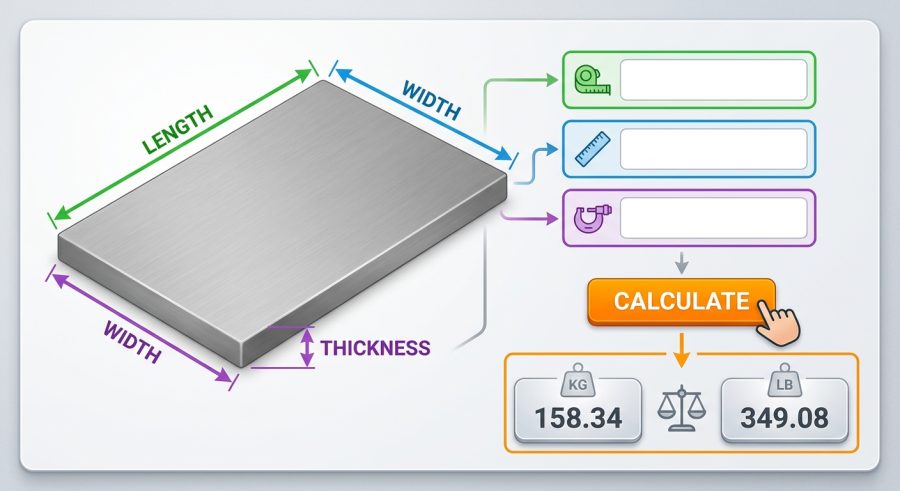
- Select the plate shape — choose Rectangular for flat sheet stock or Circular (disc) for round blanks and flanges.
- Enter the dimensions — for rectangular plates, type the length and width in millimetres; for circular plates, enter the outer diameter in the Length field (the Width field is not used).
- Enter the thickness in millimetres — this is the single biggest driver of plate weight, so measure or confirm it carefully.
- Choose the steel grade — select the alloy that matches your material; each grade carries a different nominal density.
- Set the quantity — enter the number of identical plates to get a total order weight alongside the per-plate result.
- Read the results — the calculator instantly shows volume per plate, weight per plate in kg and lb, and total order weight in both units.
Understanding Each Input Field and Its Units
Plate Shape — Select Rectangular for standard flat sheet or plate stock. Select Circular (disc) for round blanks, base plates, and flanges. The shape choice switches the area formula used internally.
Length / Diameter (mm) — For rectangular plates, this is the longer side in millimetres. For circular plates, enter the outer diameter in millimetres. The calculator uses half this value as the radius when computing circular area.
Width (mm) — The shorter side of a rectangular plate in millimetres. This field is not used when Circular is selected, so you can leave it at its default.
Thickness (mm) — The plate thickness in millimetres. This is the most weight-sensitive dimension; a 1 mm error on a thick plate can shift the result by several kilograms. Minimum accepted value is 0.5 mm.
Steel Grade / Density — Choose the alloy that matches your material. Each option carries a nominal density in kg/m³ drawn from widely published industry references. If your exact grade is not listed, pick the closest match or note that results will be approximate.
Number of Plates — Enter the total count of identical plates in your order or batch. The calculator multiplies the single-plate weight by this number to give total order weight, saving manual multiplication for large orders.
The Weight Formulas Behind the Results
All weight calculations follow the same two-step approach: compute the plate volume, then multiply by density.
Rectangular plate volume (m³):
V = L × W × T ÷ 1,000,000,000
where L = length (mm), W = width (mm), T = thickness (mm), and dividing by 10⁹ converts mm³ to m³.
Circular plate volume (m³):
V = π × (D ÷ 2)² × T ÷ 1,000,000,000
where D = diameter (mm) entered in the Length field, and π ≈ 3.14159265.
Weight per plate (kg):
Wkg = V × ρ
where ρ = density in kg/m³ from the selected steel grade.
Weight per plate (lb):
Wlb = Wkg × 2.20462262
The conversion factor 1 kg = 2.20462262 lb is exact by international definition.
Total order weight:
Wtotal = Wkg × Q, where Q = number of plates.
Surface weight density (kg/mm²):
σ = Wkg ÷ Aplan
where Aplan is the plan-view area (L × W for rectangular, π × (D/2)² for circular). This simplifies to ρ × T ÷ 10⁹ and is useful for checking rack or floor load ratings expressed per unit area.
All density values are nominal industry figures. Actual mill material may vary by ±1–2% depending on heat, rolling practice, and specification tolerance.
Five Realistic Steel Plate Weight Examples
Example 1 — Standard mild-steel sheet (rectangular)
Given: L = 2,400 mm, W = 1,200 mm, T = 10 mm, Grade = Mild Steel / A36 (7,850 kg/m³), Qty = 1
V = 2,400 × 1,200 × 10 ÷ 1,000,000,000 = 28,800,000 ÷ 1,000,000,000 = 0.0288 m³
Weight = 0.0288 × 7,850 = 226.08 kg (498.5 lb)
Example 2 — Thick structural plate (rectangular)
Given: L = 1,500 mm, W = 800 mm, T = 50 mm, Grade = Mild Steel / A36 (7,850 kg/m³), Qty = 4
V = 1,500 × 800 × 50 ÷ 1,000,000,000 = 60,000,000 ÷ 1,000,000,000 = 0.06 m³
Weight per plate = 0.06 × 7,850 = 471 kg (1,038.2 lb)
Total order weight = 471 × 4 = 1,884 kg (4,152.9 lb)
Example 3 — Circular stainless steel disc (304)
Given: Diameter = 600 mm, T = 12 mm, Grade = Stainless 304 (8,000 kg/m³), Qty = 1
V = 3.14159265 × (300)² × 12 ÷ 1,000,000,000 = 3.14159265 × 90,000 × 12 ÷ 1,000,000,000 = 3,392,920.7 ÷ 1,000,000,000 ≈ 0.003393 m³
Weight = 0.003393 × 8,000 = 27.14 kg (59.8 lb)
Example 4 — HSLA plate for structural use (rectangular)
Given: L = 3,000 mm, W = 1,500 mm, T = 20 mm, Grade = HSLA / A572 (7,870 kg/m³), Qty = 10
V = 3,000 × 1,500 × 20 ÷ 1,000,000,000 = 90,000,000 ÷ 1,000,000,000 = 0.09 m³
Weight per plate = 0.09 × 7,870 = 708.3 kg (1,561.5 lb)
Total order weight = 708.3 × 10 = 7,083 kg (15,615 lb)
Example 5 — Small tool-steel blank (circular)
Given: Diameter = 200 mm, T = 25 mm, Grade = Tool Steel / H13 (7,750 kg/m³), Qty = 6
V = 3.14159265 × (100)² × 25 ÷ 1,000,000,000 = 3.14159265 × 10,000 × 25 ÷ 1,000,000,000 = 785,398.2 ÷ 1,000,000,000 ≈ 0.0007854 m³
Weight per plate = 0.0007854 × 7,750 ≈ 6.087 kg (13.42 lb)
Total order weight = 6.087 × 6 = 36.52 kg (80.5 lb)
Nominal Density and Typical Uses by Steel Grade
| Steel Grade / Alloy | Nominal Density (kg/m³) | Typical Applications | Weight vs. Mild Steel |
|---|---|---|---|
| Mild Steel / A36 / S275 | 7,850 | General structural, fabrication, base plates | Baseline |
| HSLA / A572 Gr50 | 7,870 | Bridges, heavy equipment, structural frames | +0.3% |
| Stainless Steel 304 | 8,000 | Food processing, architectural, chemical plant | +1.9% |
| Stainless Steel 316 | 8,030 | Marine, pharmaceutical, high-corrosion environments | +2.3% |
| Duplex Stainless 2205 | 7,805 | Offshore, pressure vessels, desalination | −0.6% |
| Tool Steel / H13 | 7,750 | Dies, moulds, hot-work tooling | −1.3% |
Reading and Applying Your Weight Results
Volume per Plate (m³) — The geometric volume of one plate in cubic metres, shown to six decimal places. Use this to cross-check your inputs or to calculate material cost when your supplier quotes by volume.
Weight per Plate (kg) and (lb) — The theoretical weight of a single plate. These are the values most useful for crane and forklift load planning, handling risk assessments, and per-piece pricing. Results are rounded to two decimal places.
Total Order Weight (kg) and (lb) — The combined weight of all plates at the entered quantity. Use these figures for freight quoting, truck payload checks, and purchase order documentation. For large orders, add a small buffer (typically 1–3%) to account for mill tolerance and handling losses.
Weight per mm² of Surface (kg/mm²) — This surface weight density equals density × thickness ÷ 10⁹. It is independent of plate plan dimensions and is handy for checking whether a storage rack, floor slab, or pallet rated in kg/m² or kg/mm² can safely carry the plate. Convert to kg/m² by multiplying by 1,000,000.
If your calculated weight differs noticeably from a mill certificate or weigh-bridge reading, the most likely causes are thickness tolerance, surface coating weight, or a density difference between the nominal grade and the actual heat composition.
What Drives Steel Plate Weight the Most
Thickness — Because thickness appears as a direct multiplier of area, it has the greatest proportional effect on weight. Doubling the thickness doubles the weight. Even a 0.5 mm under-tolerance on a 10 mm plate reduces weight by 5%. The calculator uses the value you enter exactly; it does not apply mill tolerance automatically.
Plan-view area — For rectangular plates, length × width determines area. For circular plates, area scales with the square of the radius, so a 10% increase in diameter raises area (and weight) by about 21%.
Steel grade density — The density difference between the lightest grade in the list (Tool Steel H13 at 7,750 kg/m³) and the heaviest (Stainless 316 at 8,030 kg/m³) is about 3.6%. For most structural mild-steel work the difference between grades is under 0.5%, but for stainless steel it is meaningful enough to select the correct grade.
Quantity — Total order weight scales linearly with quantity. The calculator accounts for this directly.
Holes, cutouts, and tapers — The calculator assumes a solid, uniform plate. Any material removed by cutting, drilling, or profiling will reduce actual weight below the calculated value. Deduct the weight of cutouts manually if precision is needed.
Surface coatings — Paint, galvanising, and other coatings add a small but sometimes measurable weight. Hot-dip galvanising typically adds 0.5–1.5 kg/m² depending on coating thickness. The calculator does not include coating weight.
Common Errors That Skew Your Weight Estimate
- Entering dimensions in the wrong unit — All dimension fields expect millimetres. Entering centimetres or metres will produce results that are off by factors of 10 or 1,000. Convert to mm before entering values.
- Using diameter instead of radius for circular plates — The calculator interprets the Length field as the full outer diameter and halves it internally. Do not enter the radius; enter the full diameter.
- Leaving Width populated for circular plates — The Width field is ignored for circular plates, but entering an incorrect value there will not affect the result. It can cause confusion when reviewing inputs, so set it to a neutral value if desired.
- Selecting the wrong steel grade — Choosing Mild Steel when the actual material is Stainless 316 understates weight by about 2.3%. Always confirm the alloy designation on the mill certificate or purchase order.
- Ignoring thickness tolerance — Hot-rolled plate is often supplied at nominal thickness or slightly under. EN 10029 allows a negative tolerance of up to 0.3 mm on 10 mm plate. For tight weight budgets, use the minimum supplied thickness rather than the nominal.
- Treating calculated weight as a certified shipping weight — Theoretical weight is a planning estimate. Freight invoices, customs declarations, and structural certifications require actual weighed values.
- Forgetting to set quantity — The default quantity is 1. If you are ordering multiple plates and only read the per-plate result, you will underestimate total freight and handling loads.
- Applying the result to non-uniform plates — Plates with tapers, steps, or large cutouts are not uniform solids. The formula overstates weight for such shapes; subtract the volume of removed material separately.
What the Calculator Does and Does Not Cover
This calculator computes theoretical weight for solid, uniform rectangular or circular steel plates only. It does not handle I-beams, channels, tubes, angles, or any other structural section profile.
Density values are nominal industry-standard figures. Actual material density varies with heat composition, rolling practice, and the specific standard revision in use. Differences of ±1–2% from nominal are normal and are not errors in the calculator.
No mill thickness tolerance is applied. Hot-rolled plate is commonly supplied at or slightly below nominal thickness per standards such as EN 10029 or ASTM A6. For weight-critical applications, use the actual measured thickness.
The calculator does not account for surface coatings (paint, galvanising, epoxy), weld deposits, or fastener weight. It also assumes whole, identical plates — partial plates or mixed sizes require separate calculations.
Results are suitable for procurement planning, freight estimation, and preliminary structural load assessment. They are not certified weights and must not be used as the sole basis for structural design, crane lift plans, or legal shipping documentation without verification by a qualified engineer or an actual weigh-bridge measurement.
This tool is designed for steel. Using it for aluminium, copper, titanium, or other metals by selecting a mismatched density will produce inaccurate results. A dedicated material-specific calculator or manual density entry would be needed for non-steel metals.
Converting Between mm, cm, and Inches Before You Calculate
All dimension fields in this calculator use millimetres. If your drawings or supplier quotes use other units, convert before entering values:
- Centimetres to mm: multiply by 10 (e.g., 120 cm = 1,200 mm)
- Metres to mm: multiply by 1,000 (e.g., 2.4 m = 2,400 mm)
- Inches to mm: multiply by 25.4 (e.g., 48 in = 1,219.2 mm)
- Feet to mm: multiply by 304.8 (e.g., 4 ft = 1,219.2 mm)
A common source of large errors is entering a dimension in centimetres without converting — a 120 cm plate entered as 120 mm produces a weight 100 times too low. Double-check your unit before reading the result.
Using Surface Weight Density to Check Floor and Rack Loads
The Weight per mm² of Surface result is a compact way to check storage and handling capacity. Most rack and floor load ratings are expressed in kg/m², so multiply the kg/mm² result by 1,000,000 to convert.
For example, a 20 mm mild-steel plate has a surface weight density of 7,850 × 20 ÷ 1,000,000,000 ≈ 0.000157 kg/mm², which equals 157 kg/m². If your storage rack is rated at 500 kg/m², a single layer of 20 mm plate fits comfortably. Stacking two layers doubles the load to 314 kg/m², still within the rating. This quick check can prevent overloading without requiring a full structural analysis for routine storage decisions.
Always confirm rack and floor ratings with the equipment manufacturer or a structural engineer before storing very heavy plate.
Estimating Freight Cost from Total Plate Weight
Freight carriers typically quote steel shipments by gross weight (plates plus packaging) or by a combination of weight and volume (dimensional weight). The Total Order Weight results give you the net steel weight as a starting point.
Add roughly 2–5% for pallet, dunnage, and strapping weight on standard orders. For flatbed or container shipments, also check whether the total weight exceeds the vehicle’s legal payload — a standard 20-foot shipping container has a typical payload limit of around 28,000 kg, and a standard flatbed truck in the US is limited to about 20,000 kg net cargo depending on axle configuration and state regulations.
Freight rates for steel plate are usually quoted per tonne (1,000 kg). Divide your Total Order Weight in kg by 1,000 to get tonnes, then multiply by the carrier’s rate per tonne. Always confirm actual rates and payload limits with your freight provider, as these vary by route, carrier, and regulation.
Rectangular vs. Circular Plates: When Shape Matters Most
For the same bounding dimensions, a circular disc always weighs less than a rectangular plate because the circle’s area (π/4 × D²) is about 78.5% of the square with the same side length as the diameter. If you are cutting circular blanks from rectangular sheet, the offcut (skeleton) accounts for roughly 21.5% of the original plate weight — useful for scrap estimation and material yield calculations.
When ordering circular plates, suppliers may quote by the enclosing rectangle (the bounding box) and charge for the full rectangular blank, or they may quote by the disc weight only. Clarify with your supplier which basis applies before using the calculator result for cost comparison.
Steel Plate Weight: Frequently Asked Questions
How is steel plate weight calculated?
Steel plate weight equals the plate’s volume multiplied by the material’s density. Volume is length × width × thickness for rectangular plates, or π × (diameter ÷ 2)² × thickness for circular plates, converted from mm³ to m³ by dividing by 1,000,000,000. Multiplying that volume in m³ by the density in kg/m³ gives weight in kilograms.
What is the density of mild steel compared to stainless steel?
Mild steel (A36, S275) has a nominal density of 7,850 kg/m³. Stainless Steel 304 is denser at 8,000 kg/m³, and Stainless 316 is slightly higher at 8,030 kg/m³. That means a stainless plate of the same dimensions weighs roughly 2–2.3% more than an equivalent mild-steel plate — a meaningful difference for large orders or precise load calculations.
How do I calculate the weight of a circular steel plate?
Enter the outer diameter in the Length field, select Circular (disc) as the shape, enter the thickness, and choose your steel grade. The calculator applies the formula π × (D/2)² × T ÷ 1,000,000,000 × density. For example, a 500 mm diameter, 15 mm thick mild-steel disc has a volume of about 0.002945 m³ and weighs approximately 23.1 kg (50.9 lb).
Why does my calculated weight differ from the mill certificate weight?
Mill certificates report actual measured weight, which can differ from theoretical weight for several reasons: thickness tolerance (plates are often at or slightly below nominal), density variation between heats, surface scale or coating, and measurement rounding. A difference of 1–3% is normal. If the gap is larger, check that you entered the correct dimensions and selected the right steel grade.
How much does a standard 2,400 × 1,200 × 10 mm mild-steel plate weigh?
Using the formula: V = 2,400 × 1,200 × 10 ÷ 1,000,000,000 = 0.0288 m³. Weight = 0.0288 × 7,850 = 226.08 kg (498.5 lb). This is a common sheet size in many markets and is a useful benchmark — roughly 226 kg per sheet at 10 mm thickness.
What is the weight of 1 mm thick mild-steel plate per square metre?
A 1 mm thick mild-steel plate (density 7,850 kg/m³) weighs 7,850 × 0.001 = 7.85 kg per square metre. This is a widely used rule of thumb: multiply the thickness in mm by 7.85 to get kg/m² for mild steel. For stainless 304, use 8.0 kg per mm of thickness per square metre instead.
How do I convert a steel plate weight from kg to lb?
Multiply kilograms by 2.20462262 to get pounds. For example, 226.08 kg × 2.20462262 = 498.5 lb. The calculator performs this conversion automatically for both per-plate and total order weights, so you do not need to convert manually when using the tool.
Does plate thickness tolerance significantly affect the calculated weight?
Yes, especially for thinner plates. EN 10029 allows a negative thickness tolerance of up to 0.3 mm on 10 mm hot-rolled plate, which is a 3% reduction in thickness and therefore a 3% reduction in weight. On a 226 kg sheet that is about 6.8 kg per plate. For weight-critical applications, use the minimum guaranteed thickness rather than the nominal value when calculating.
Quick Summary for Confident Steel Plate Estimates
Steel plate weight is straightforward to calculate once you have accurate dimensions and the correct density for your grade. Use the per-plate results for handling and crane planning, the total order weight for freight and procurement, and the surface weight density to verify storage rack capacity. Always treat results as theoretical estimates and confirm with actual weigh-bridge data for structural certifications or legal shipping documents. When in doubt, consult a qualified structural engineer.

6 Responses