
Enter your wire diameter, mesh opening size in both directions, panel length and width, material type, and number of panels to calculate wire mesh weight in kilograms or pounds. The calculator applies a standard wire mesh density formula based on wire cross-section, pitch spacing, and material density. Results show weight per panel, total order weight, total mesh area, and total wire length needed for planning.
Wire Mesh Weight Calculator: Panel & Total Weight in kg/lb
Calculate wire mesh weight per panel and total order weight from wire diameter, mesh opening size, panel dimensions, and material density.
What This Wire Mesh Weight Tool Calculates
This tool estimates the weight of woven or welded wire mesh panels using wire diameter, mesh opening size, panel dimensions, and material density. It helps fabricators, estimators, and buyers plan material orders, calculate freight weight, and check cost before purchasing. The result is an engineering estimate based on a standard wire mesh density formula, not a manufacturer’s certified weight, so treat it as a close planning figure rather than an exact production value.
Steps to Estimate Your Mesh Weight
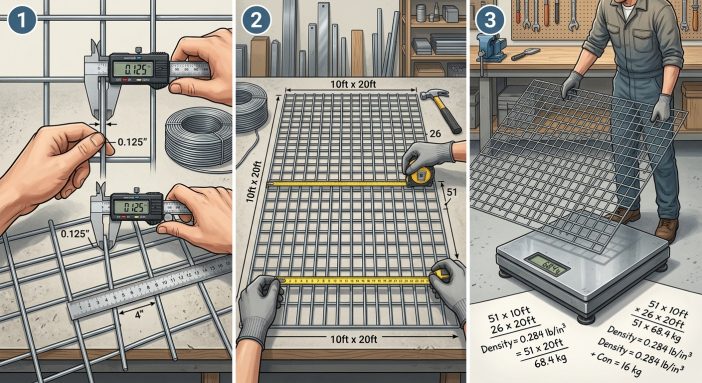
- Measure or look up the wire diameter of your mesh in millimeters.
- Enter the horizontal and vertical mesh opening sizes, measured as the clear gap between adjacent wires.
- Enter the panel length and width in meters.
- Select the mesh material to load the correct density.
- Enter the number of identical panels you need, then choose kilograms or pounds for the output unit.
- Review the weight per panel, total weight, total area, and total wire length results.
Understanding Each Input Field
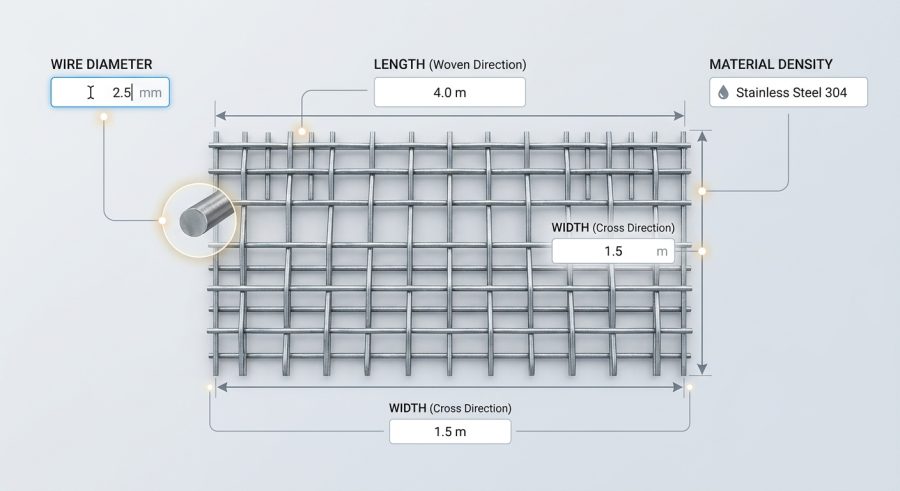
Wire Diameter (mm) is the thickness of a single wire strand, measured with calipers or taken from a mesh specification sheet.
Mesh Opening (Horizontal and Vertical, mm) is the clear gap between two adjacent parallel wires, not the distance between wire centers. Square mesh uses the same value for both; rectangular mesh uses different horizontal and vertical values.
Panel Length and Width (m) describe the overall size of one finished mesh panel.
Material selects a typical density in kilograms per cubic meter for common metals used in mesh manufacturing.
Number of Panels is the total panel count for the order, used to scale up total weight and total wire length.
Output Unit switches the weight results between kilograms and pounds without changing any other input.
The Math Behind Wire Mesh Weight
The calculator first finds the wire cross-sectional area using the circle area formula: area = (pi/4) times wire diameter squared, with diameter converted from millimeters to meters.
Next it finds the wire pitch in each direction by adding the wire diameter to the mesh opening, then converting to meters: pitch = (opening + wire diameter) / 1000. The number of wires per meter of width in each direction equals 1 divided by that pitch.
Weight per Square Meter = area times material density times the sum of (1 / horizontal pitch) and (1 / vertical pitch). This represents the combined mass contributed by wires running in both directions across one square meter of mesh.
Weight per Panel multiplies weight per square meter by panel length, panel width, and the output unit conversion factor (1 for kilograms, 2.20462 for pounds).
Total Weight (All Panels) adds the quantity of panels into that same formula.
Total Wire Length Used multiplies the wires-per-meter sum by panel length, width, and quantity, giving the combined linear meters of wire needed to produce the order.
All formulas assume a uniform grid of straight wires with no allowance for weld nodes, crimping waviness, or edge selvage.
Sample Calculations for Common Mesh Types
Example 1: Standard square mesh panel. Given: wire diameter 2 mm, opening 25 mm by 25 mm, panel 2 m by 1 m, mild steel (7850 kg/m3), 1 panel, output in kg. Formula: weight/m2 = (pi/4) x (0.002)^2 x 7850 x (1/0.027 + 1/0.027). Substitution: 0.0000031416 x 7850 x 74.074 = 1.827 kg/m2. Calculation: weight per panel = 1.827 x 2 x 1 = 3.65 kg. Final result: about 3.65 kg per panel, 148.1 m of wire used.
Example 2: Stainless steel mesh order. Given: wire diameter 3 mm, opening 50 mm by 50 mm, panel 3 m by 2 m, stainless steel 304 (8000 kg/m3), 5 panels, output in lb. Formula: weight/m2 = (pi/4) x (0.003)^2 x 8000 x (1/0.053 + 1/0.053). Substitution: 0.0000070686 x 8000 x 37.736 = 2.134 kg/m2. Calculation: total weight = 2.134 x 6 m2 x 5 panels x 2.20462 = 141.13 lb. Final result: about 141.1 lb total, 28.23 lb per panel.
Example 3: Fine aluminum mesh. Given: wire diameter 1 mm, opening 10 mm by 10 mm, panel 1 m by 1 m, aluminum (2700 kg/m3), 10 panels, output in kg. Formula: weight/m2 = (pi/4) x (0.001)^2 x 2700 x (1/0.011 + 1/0.011). Substitution: 0.00000078540 x 2700 x 181.818 = 0.386 kg/m2. Calculation: total weight = 0.386 x 1 m2 x 10 panels = 3.86 kg. Final result: about 0.39 kg per panel, 3.86 kg total, 1818.2 m of wire used.
Example 4: Rectangular galvanized mesh. Given: wire diameter 4 mm, opening 100 mm by 50 mm, panel 5 m by 1.2 m, galvanized steel (7850 kg/m3), 2 panels, output in lb. Formula: weight/m2 = (pi/4) x (0.004)^2 x 7850 x (1/0.104 + 1/0.054). Substitution: 0.00001257 x 7850 x 28.134 = 2.775 kg/m2. Calculation: weight per panel = 2.775 x 6 m2 x 2.20462 = 36.72 lb. Final result: about 36.72 lb per panel, 73.44 lb total.
Typical Density Values by Metal
| Material | Density (kg/m3) | Approx. Density (lb/ft3) | Common Use |
|---|---|---|---|
| Mild Steel | 7850 | 490 | General fencing and construction mesh |
| Stainless Steel 304 | 8000 | 499 | Food-grade and corrosion-resistant mesh |
| Galvanized Steel | 7850 | 490 | Outdoor fencing and enclosures |
| Aluminum | 2700 | 169 | Lightweight screens and insect mesh |
| Copper | 8960 | 559 | Electrical shielding and decorative mesh |
| Brass | 8500 | 531 | Decorative and filtration mesh |
Densities are typical published averages; actual alloy composition can shift these values slightly.
Reading Your Weight and Wire Length Results
Weight per Square Meter is the base density figure used in every other calculation and is useful for comparing mesh types independent of panel size.
Total Mesh Area shows the combined surface area of all panels, helpful for coating, painting, or shipping crate estimates.
Weight per Panel and Total Weight (All Panels) are the main outputs for ordering and freight planning, shown in whichever unit you selected.
Total Wire Length Used estimates raw wire needed for fabrication, which is useful for spool planning or in-house production. All results are rounded to the decimal places shown and represent estimates based on the assumptions described in this article, not certified production figures.
What Changes Mesh Weight the Most
Wire diameter has the largest effect on weight because it is squared in the area formula; doubling diameter roughly quadruples weight per unit area. The calculator accounts for this directly.
Mesh opening size changes how many wires fit per meter. Smaller openings mean more wires and more weight; this is fully accounted for through the pitch calculation.
Material density scales weight linearly and is accounted for through the material selection.
Panel dimensions and quantity scale total weight and area proportionally and are included in every total result.
Factors not accounted for include weld node buildup, crimping waviness in woven mesh, coating thickness, and selvage or border wires, which can add a few percent to actual manufactured weight.
Common Errors When Estimating Mesh Weight
- Confusing opening size with pitch: enter the clear gap between wires, not the center-to-center spacing; the calculator adds the wire diameter automatically to find pitch.
- Mixing units: keep wire diameter and opening size in millimeters and panel dimensions in meters as labeled.
- Forgetting to update quantity: the per-panel result will look correct but total weight will be wrong if quantity is left at 1.
- Choosing the wrong material: stainless, aluminum, and galvanized steel have different densities, and using the wrong one skews weight noticeably.
- Ignoring coatings: galvanizing or paint adds a small amount of weight not captured in a bare wire calculation.
- Assuming crimped weave weighs the same as straight wire: crimped mesh uses slightly more wire length than a flat grid due to waviness.
- Reading the wrong output unit: double-check whether kilograms or pounds is selected before using the number for shipping quotes.
Assumptions and Accuracy Limits
This calculator models mesh as an idealized grid of straight wires and does not include weld node material buildup, crimp waviness, selvage edges, overlaps, or coating thickness, all of which can add a small percentage to real manufactured weight. Material density values are typical averages and can vary by alloy grade, supplier, or manufacturing process. It is intended for planning, quoting, and shipping estimates rather than certified structural or engineering specifications. For load-bearing, structural, or safety-critical mesh applications, confirm final weight and specifications with the mesh manufacturer or a qualified structural engineer before ordering or installation.
Woven, Welded, or Crimped: Does Mesh Type Matter?
This calculator treats mesh as a flat grid of straight wires crossing in two directions, which fits welded wire mesh and plain woven mesh reasonably well. Crimped woven mesh, where wires bend slightly at each crossing, uses a bit more wire per square meter than a perfectly straight grid, so actual weight may run a few percent higher than the estimate for heavily crimped patterns.
Mesh Opening vs Wire Pitch: Why the Distinction Matters
Mesh opening is the clear space you can see between two wires, while pitch is the distance between the centers of adjacent wires. Pitch always equals opening plus wire diameter. The calculator adds wire diameter to your entered opening automatically, so you should always enter the clear opening size rather than a pre-calculated pitch value to avoid double-counting wire thickness.
Using Total Weight for Shipping and Cost Estimates
Once you have total order weight, you can compare it against freight carrier limits or estimate material cost if you know a per-kilogram or per-pound price. If your project also involves flat metal stock, tools like a steel plate weight calculator or a pipe weight per foot calculator can help you total the weight of an entire metal order that mixes mesh with plate or pipe components.
Wire Mesh Weight Questions Answered
How is wire mesh weight calculated from wire diameter and opening size?
Weight is calculated by finding the wire's cross-sectional area from its diameter, multiplying by material density, then multiplying by the number of wires per meter in both directions, which depends on mesh opening plus wire diameter (pitch). This gives weight per square meter, which is then scaled by panel area and quantity.
What is the difference between mesh opening and wire pitch?
Mesh opening is the clear gap between two adjacent wires, while pitch is the center-to-center distance, equal to opening plus wire diameter. Always enter the clear opening in this calculator; it automatically adds wire diameter to find pitch for the weight calculation.
How does material choice affect wire mesh weight?
Weight scales directly with material density. Stainless steel and copper are denser and heavier than the same size mesh made from aluminum, so switching materials at the same wire diameter and opening size can change total weight significantly.
Can this calculator be used for both woven and welded wire mesh?
Yes, it works well for both since each is modeled as a straight two-directional wire grid. Crimped woven mesh may weigh slightly more than the estimate because crimping adds extra wire length at each crossing point that a flat grid model does not capture.
How accurate is the estimated weight compared to actual manufactured mesh?
The estimate is typically close for planning purposes but actual mesh may weigh two to five percent more due to weld nodes, crimping, coatings, or selvage edges that are not included in this straight-wire model. For critical or large orders, confirm the certified weight with your mesh manufacturer.
Why does the calculator ask for separate horizontal and vertical opening values?
Many mesh products are rectangular rather than square, with a different opening size along each direction. Entering both values lets the formula calculate the correct number of wires per meter in each direction, which is essential for accurate weight on non-square mesh.
Does switching between kilograms and pounds change the underlying weight calculation?
No, only the final display changes. The calculator computes weight in kilograms first, then multiplies by a conversion factor of 2.20462 when pounds is selected, so the underlying wire and material math stays identical.
Does galvanizing or coating add noticeable weight to the mesh?
Galvanizing and similar coatings typically add only a small percentage to bare wire weight and are not included in this calculation. For most planning purposes this difference is minor, but for precise coated-weight totals check the coating thickness with your supplier.
Planning Your Next Wire Mesh Order
Estimating wire mesh weight accurately helps with ordering the right amount of material, budgeting freight costs, and planning fabrication time. By entering wire diameter, opening size, panel dimensions, material, and quantity, you get a reliable planning estimate in kilograms or pounds. Always confirm final weights with your supplier for large or structural orders.
